




For an investor of Rekha Jhunjhunwala’s stature, buy and hold is not just a strategy but a legacy. With the multi-billion-dollar mantle of her late husband, India’s Warren Buffett Rakesh Jhunjhunwala, her portfolio remains the envy of most investors. Her portfolio is currently valued at over Rs 48,000 cr with 27 stocks.
However, what has caught the attention of many investors is the fact that the current market cycle has been less kind to the portfolio’s older constituents. Two of her oldest holdings which she has held at least since the filing for the quarter ending December 2015, have corrected by over 50% in the last year. For the average retail investor, such a vertical drop is a signal to flee.
Rekha Jhunjhunwala however refuses to budge and continues holding these two stocks. What is fuelling her conviction since at least the last 10 years. Let us look deep into the stocks to try and find out.
Valor Estate- Battling the Ghosts of DB Realty
Incorporated in 2007, Valor Estate Ltd (Earlier DB Realty Limited) is primarily in the business of real estate construction, development and other related activities. Most of the projects are based in and around Mumbai and are under various stages of planning and construction.
With a market cap of Rs 6,172 cr currently, the company has over 500 acres of land and focuses on residential and commercial developments.
Jhunjhunwala bought a stake in the company as per the exchange filings for the quarter ending December 2015. She may have bought it even earlier, but that is the oldest data on trendlyne.com.
Currently she holds a 4.6% stake worth Rs 285 cr. Apart from her, another super investor of India, Mukul Agarwal, also holds a 1.2% stake in the company since the quarter ending June 2025.
It is this conviction shown by Jhunjhunwala that has given rise to a lot of questions, because the share price of Valor has corrected considerably in the last few months. Let us take a look.
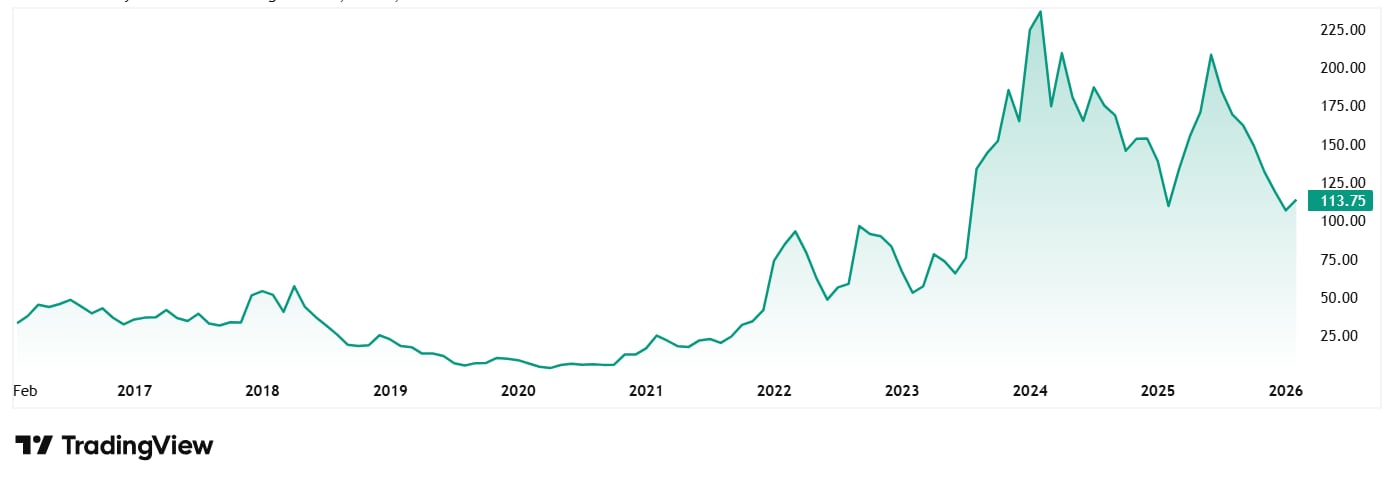
The stock was trading at a price of around Rs 23 in February 2021 and as of closing on 27th February 2026, it was Rs 114, which is almost a 400% jump in 5 years. However, in the last 6 months, the price has corrected from its 52-week high of Rs 219 to the current price, which is over a 48% correction.
The Demerger Reset- Why the Market is Repricing Valor
This correction is a case of a structural valuation reset. The primary catalyst was the demerger of its hospitality arm into Advent Hotels International. The pivot made Valor into a pure-play real estate entity and stripped Valor of the steady, annuity-like cash flows that previously balanced its volatile development business.
With the record date in July 2025 and the subsequent listing of the new entity, the market has aggressively repriced the remaining core, moving away from previous speculative highs to reflect a leaner, yet more concentrated, risk profile.
However, both Rekha Jhunjhunwala and Mukul Agarwal do not seem to be worried by this pivot. Let us look at the financials to see if we can find a reason for it.
The sales have seen a compounded growth of 46% from Rs 169 cr in FY20 to Rs 1,133 cr in FY25. For the 3 quarters of FY26 ending in December 2025, sales of Rs 1,506 cr were recorded already.
The EBITDA (earnings before interest, taxes, depreciation, and amortization) logged what can be called a roller coaster ride.
| FY | FY20 | FY21 | FY22 | FY23 | FY24 | FY25 |
| EBITDA/Rs Cr | -235 | -109 | -98 | -715 | 28 | -119 |
For the 3 quarters of FY26 ending in December 2025, EBITDA logged by the company was Rs 102 cr, showing signs of a turnaround.
The Turnaround Math: From Losses to Rs 86 Crore Profit
The net profits also saw a similar pattern.
| FY | FY20 | FY21 | FY22 | FY23 | FY24 | FY25 |
| Profits/Rs Cr | 440 | -167 | 22 | -90 | 1,317 | -118 |
And between April and December 2025, the company has recorded profits of Rs 86 cr and has finally started seeing profitable quarters.
In fact, in the last 12 months (TTM – Trailing Twelve Months), the sales grew at a compound rate of 322% while the profits at 148%.
As for valuations, the company’s share is trading at a current PE of a big 113x, while the current industry median is a modest 29x.
Ultimately, Valor Estate is a high-stakes turnaround play. While the 48% correction and hospitality demerger have cooled off the initial euphoria, the recent swing toward profitability explains why super-investors like Rekha Jhunjhunwala and Mukul Agarwal are staying the course.
However, with a PE of 113x dwarfing the industry average, the market is already pricing in a flawless execution of its 500-acre land bank. For investors, the multibagger easy money has probably already been made. The next leg depends entirely on whether these quarterly profits are a fluke or the new normal for this leaner, pure-play developer.
Aptech- Holding Fort in Generative AI Storm
Established in 1986, Aptech Ltd. is a pioneer in the non-formal education and training business in the country with a significant global presence.
With a market cap of Rs 507 cr the company has a presence in diverse sectors ranging from IT training, media & entertainment, retail & aviation, beauty & wellness, banking & finance, and pre-school segment amongst others. It has successfully trained students, professionals, universities & corporates through its two main streams of business – Individual Training and Enterprise Business Group.
Jhunjhunwala might have bought the stock earlier, but as per the oldest data on trendlyne.com, she is holding a stake in the company at least since December 2015. And as per the filings for the quarter ending December 2025, she holds a 21% stake in the company worth Rs 107 cr (per trendlyne).
But this holding is under the scanner of many investors as the company’s share prices took plunge in the last few months.
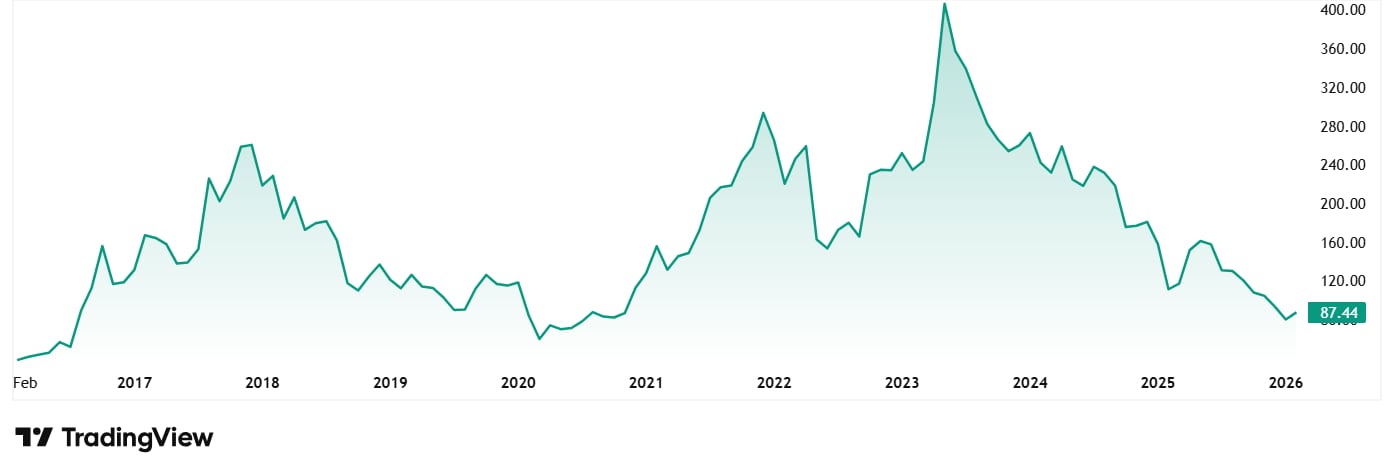
The share price of Aptech was around Rs 160 in February 2021 and as of closing on 27th February 2026 I was Rs 88, which is a considerable drop. In just the last 1 year, the price fell from its 52-week high of Rs 182, which is a 52% correction.
Let us look at the financials to see what is it that is making Jhunjhunwala worry free when it comes to Aptech.
The sales of the company jumped from Rs 158 cr in FY20 to Rs 460 cr in FY25, recording a compound growth of 24%. For the 3 quarters of FY26 ending in December 2025, the sales recorded by the company were Rs 394 cr.
The EBITDA saw an upward trend until FY23 post which it saw a sharp decline.
| Year | FY20 | FY21 | FY22 | FY23 | FY24 | FY25 |
| EBITDA/Rs Cr | 37 | 16 | 41 | 76 | 42 | 29 |
And for the 3 quarters of FY26 ending in December 2025, the EBITDA logged by the company was almost Rs 29 cr, hinting at a stronger FY26.
Coming to the net profits, the figures followed a similar part like the EBITDA.
| Year | FY20 | FY21 | FY22 | FY23 | FY24 | FY25 |
| Profits/Rs Cr | 14 | 12 | 49 | 68 | 29 | 19 |
For the 3 quarters of FY26 ending in December 2025, the Net Profits logged by the company was almost Rs 22 cr, already surpassing the previous year’s figure.
Education Play That Refuses to Budge
Aptech’s decline from its peak highlights a painful reality check for shareholders. The rise of generative AI has cast a long shadow over its core VFX and animation training business, sparking fears that its student base may shrink as technology automates creative roles.
With profit margins thinning and revenue growth hitting a wall, the stock has lost its lustre for many investors. Once a favourite of marquee investors, the company is now struggling to prove its relevance in a tech-disrupted world, leading the market to slash its valuation to reflect these new risks.
However, what makes it interesting is the fact that despite all this, Rekha Jhunjhunwala still holds a seat at the table, which could mean she is betting on something that the average investors cannot even see right now.
Beyond the 50% Crash: The High-Stakes Math of Staying Invested
The trust of Rekha Jhunjhunwala in Valor Estate and Aptech serves as a lesson in high-conviction investing, or perhaps a cautionary tale about the endowment effect. While the 50% decline in both stocks suggest a structural breakdown to the average observer, the underlying data hints at a calculated gamble on long-term turnarounds rather than blind loyalty.
In both cases, we see a striking disconnect between the stock price and recent operational performance. Valor is emerging as a leaner, profitable land-bank giant, and Aptech is already beating its previous year’s profits despite the looming threat of AI. For the retail investor, the dilemma remains: do you follow the super investors that have the stomach to watch half its value vanish, or do you respect the market’s aggressive repricing?
Whether this is a rare opportunity to buy at a discount or a stubborn attachment to a fading era is a question only the next few quarters will answer. For now, you might want to add these stocks to a watchlist and keep an eye on them.
Disclaimer:
Note: We have relied on data from www.Screener.in and www.trendlyne.com throughout this article. Only in cases where the data was not available, have we used an alternate, but widely used and accepted source of information.
The purpose of this article is only to share interesting charts, data points and thought-provoking opinions. It is NOT a recommendation. If you wish to consider an investment, you are strongly advised to consult your advisor. This article is strictly for educative purposes only.
Suhel Khan has been a passionate follower of the markets for over a decade. During this period, He was an integral part of a leading Equity Research organisation based in Mumbai as the Head of Sales & Marketing. Presently, he is spending most of his time dissecting the investments and strategies of the Super Investors of India.
Disclosure: The writer and his dependents do not hold the stocks discussed in this article.
The website managers, its employee(s), and contributors/writers/authors of articles have or may have an outstanding buy or sell position or holding in the securities, options on securities or other related investments of issuers and/or companies discussed therein. The content of the articles and the interpretation of data are solely the personal views of the contributors/ writers/authors. Investors must make their own investment decisions based on their specific objectives, resources and only after consulting such independent advisors as may be necessary.