



Water crises rarely begin with headlines.
They begin silently, when reservoirs drop faster than projected, when industries begin limiting supply, when cities stretch systems that were never devised for current demand.
In a coastal city in the Middle East, a distillation plant runs through the night, changing seawater into drinking water for millions. There are no hoists, no evident construction surge.
But without it, the city will slow down.
This is the nature of water infrastructure. And, it becomes noticeable only when it stops.
And that is exactly what is changing.
Across regions, from the Middle East to Southeast Asia, water is no longer regarded as a background utility.
It is being built, financed, and managed as critical infrastructure, on par with power and transport.
At the centre of this shift are specialised engineering companies.
VA Tech Wabag (Wabag) is one of them, working not at the point of supply, but where water is cured, salvaged, and sustained.
It’s a story worth knowing.
Before water became a tactical priority
For years, water sat outside the central infrastructure story. Governments focused on the most visible: highways, railways, and power plants.
Water systems stayed municipal duties, underfunded, and uneven.
For companies like Wabag, that meant a business formed on smaller projects, irregular implementation cycles, and limited prospects beyond each order.
Though water was essential, it had not become a restraint on growth, yet.
When water became a constraint
The shift did not come from an individual incident. It built slowly, and then all at once.
Cities began using water faster than nature could refill it. Industries used not just abundant water, but good quality water constantly.
Besides, a growing share of available freshwater must be treated before it can be utilised. This shift altered the nature of the problem.
It wasn’t about sourcing more water. It was about handling what already existed.
Water was no longer a resource, but it had become a limitation.
The need for water solutions
Water infrastructure is not static. Unlike highways or power plants, a water project does not finish once the structure is built.
It must run constantly. As water stress intensifies, failure becomes expensive.
An underachieving plant is not just wasteful, but it also means disruption in how the cities and industries run. That’s why priorities changed.
And then it’s more about dependability than execution. More about continuous performance than delivery.
That’s why the businesses in this sector were forced to think beyond one-time projects to systems that not only must be built, but also function consistently.
And sitting right at this juncture was Wabag.
From executing contracts to building water solutions
For years, the company worked as an EPC contractor, executing projects for clients or governments. These contracts were transactional.
A plant would be erected, delivered, and then the arrangement would end.
But water systems aren’t static infrastructure. They need continuous improvement, adapting to varying input quality, unpredictable demand, stricter standards, and operational efficiency.
Over time, the performance isn’t decided when contracting, but it is assessed over years of steady output.
This made Wabag change its business model.
One where it not only built plants, but designed, operated, and managed systems over time.
From building solutions to owning expertise
The major shift in Wabag’s business wasn’t geographic. It was fundamental.
From executing projects to delivering end-to-end solutions, and progressively, to taking on after-execution processes and system optimisation.
And this transition mattered.
Because EPC businesses are usually commoditised, led by price, subject to execution risks, and constrained to one-off revenues.
Solution providers, on the other hand, run closer to the central problem: water accessibility, treatment, and reuse.
That allows for greater margins, deeper client relations, and longer-term agreements.
In other words, Wabag moved from building infrastructure to holding expertise within it.
And the numbers can vouch for It
The transition did not show up as rapid growth. It showed up as solidity.
Over time, the margins improved, and revenue went up further.
Its 9M FY26 revenue rose to ₹2,530 crore from ₹2,138 crore in FY25, up 18.3% YoY. Its profit after tax was ₹242 crore, marking a growth of 23.7% YoY.
The return on capital employed at 18.9% and return on equity at 15.3% show increasing capital efficiency in 9M FY26.
Wabag’s order book today stands at roughly ₹16,300 crore, growing 15% YoY offering a multi-year horizon.
More importantly, close to 48% of this came from international markets, particularly the Middle East and North Africa, where water scarcity is structural rather than cyclical.
Operating margins have stabilised, hovering between 11-13%, supported by stricter project selection and improved working capital discipline.
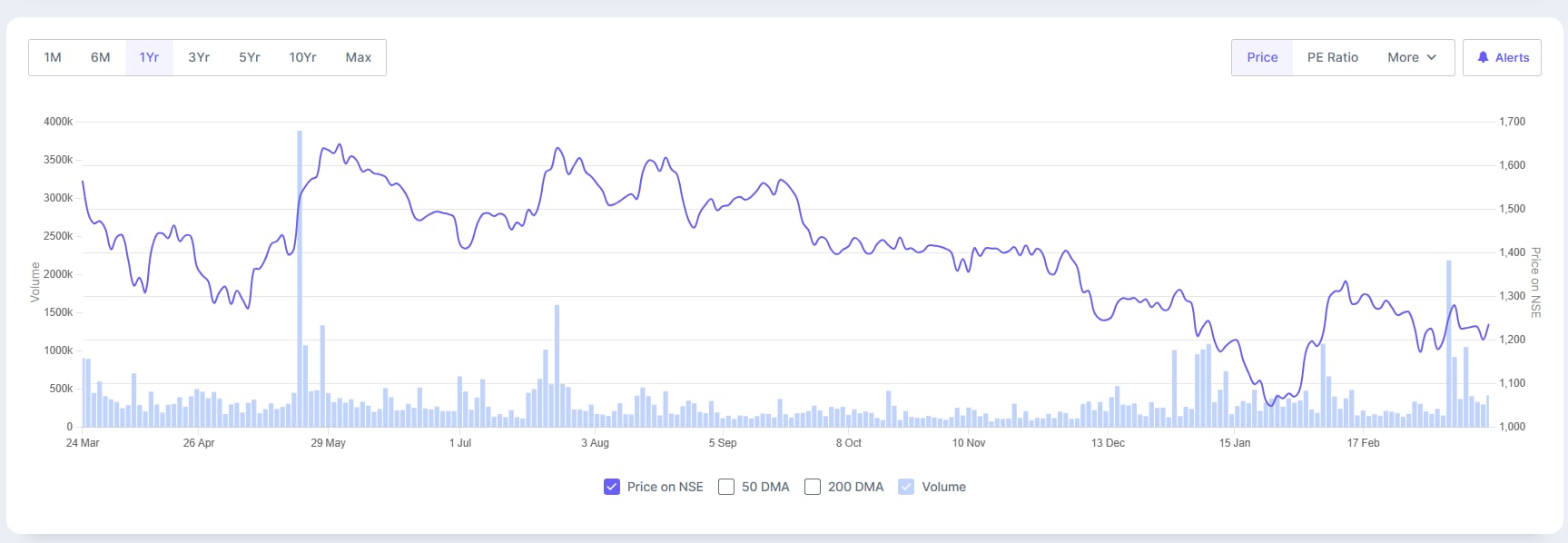
The company has stayed net cash positive for the 12th quarter in a row at ₹1006.5 crore because of order book quality and cash management. The share price, however, fell 18% in a year due to a recent ratings downgrade and sectoral weakness.
Va Tech Wabag 1-Year Share Price Trend
Valuations display partial recognition.
At roughly 22.3x earnings, it is trading at a higher P/E compared to the sectoral median at ~16x. And the Enterprise Value/Earnings before interest, taxes, depreciation and amortisation (EBITDA) multiples of 13x is at a premium compared to the sector median of 10x.
The market looks to be acknowledging increased stability, but perhaps not fully pricing in the change toward a more system-led, repeat-driven business model.
This is typical of such transitions.
They are recognised gradually, and often late.
Why water will be the next infrastructure frontier
Infrastructure cycles have generally been about growth.
Roads increase movement.
Power improves supply.
Digital infrastructure increases connectivity.
But water acts differently.
In many parts of the world, supply can’t be significantly extended. Freshwater availability is physically limited, and in several regions is already used over the limit.
According to UNICEF, over 40% of the global population, nearly 4 billion people, face serious water scarcity at least one month each year. 25 countries today are facing water scarcity after using over 80% of their renewable water.
This crisis did not appear overnight, but was driven by excessive demand, climate change, and pollution. And this number could still rise further.
It’s not water scarcity, It’s what we do with It
But the real shift is not just about scarcity. It is about wastefulness.
A sizable share of water, especially in urban and industrial processes, is still used once and thrown away. In India, only 28% of wastewater is treated, with the rest either released untreated or under-processed.
Even where treatment exists, recycling is still constrained. Not between demand and supply, but between use and reuse. And that difference is what is restructuring capital allocation.
Instead of financing only new sources, governments and industries are increasingly directing funds toward wastewater recycling, industrial reuse systems, zero liquid discharge infrastructure, and distillation.
In many cases, water treatment and reuse are no longer voluntary. They are driven by regulation, mounting input costs, and the increasing risk of supply disruption.
These circumstances have changed the nature of the sector.
From expansion-led utilities to efficacy-led systems.
From a one-time project series to recurrent, performance-linked demand.
Global scale vs India’s catch-up opportunity
This is where the prospect starts splitting across topographies. In areas like the Middle East and North Africa, water shortage is complete.
Distillation is not an additional process; it is the need of the hour. These markets are investing at scale, establishing large, long-cycle opportunities with high-execution prospects.
This trend also explains why exports now dominate Wabag’s order mix.
India, in contrast, is earlier in this shift.
Urban demand is still rising, industrial use is becoming more intensive, and government policy is slowly moving to recycling and sustainability.
While programmes like Jal Jeevan Mission have expanded access, the next phase of financing is likely to move toward treatment, recycling, and organisational efficiency.
The AMRUT (Atal Mission for Rejuvenation and Urban Transformation) 2.0 aims for 100% sewage management in 500 cities by 2026, while the National Mission for Clean Ganga initiative targets an increase in capacity.
The Indian Water and Wastewater Treatment Technology (WWT) [AC4] report suggests the market is likely to expand to $2.99 billion in 2026 from $2.73 billion in 2025. It also forecasts that the market will reach $4.73 billion by 2031 at 9.59% CAGR over 2026-2031.
This could become a dual growth opportunity for Wabag. Exports will offer magnitude and short-term prominence, while India supports long-term structural demand.
The risks beneath the opportunity
Water infrastructure may be a fundamental opportunity, but the business of developing it remains a challenge.
Nearly all water projects are capital-intensive and execution-heavy, often bound to government agencies or large industrial clients. This trend generates a layered risk.
Authorizations can take time. Project timelines can extend. And even after implementation, payments are often milestone-based, not direct. That is where the real stress lies.
Working capital is another crucial factor. Companies must invest in building, handle procurement, and continue operations even when there is a receivables backlog.
A slowdown in one huge project can impact cash flows through the business, not just that contract. This is why revenue alone does not tell the complete story.
In water EPC, managing cash flow is as important as expanding the order book. Project quality is also a key factor.
Winning deals is not tough in a demand-heavy sector. Implementing them profitably is. Cost overruns, design alterations, or delays can squeeze margins rapidly, especially in fixed-price contracts.
Competition is never far behind. Global engineering firms bring magnitude and technology. Local players contest on pricing and relationships.
In many markets, particularly global, the difference between winning and losing a project can come down to both price and trustworthiness.
For Wabag, the limitation is not opportunity. It is dependability.
Delivering complicated, multi-year projects in different topographies, while preserving margins, controlling working capital, and avoiding execution slippage, is what eventually will define the business.
Because in this business, growth is visible.
But discipline is what maintains it.
The Infrastructure We’ve Noticed at Last
Every infrastructure cycle has a moment when it becomes impossible to overlook.
Roads had it.
Power had it.
Digital had it.
Water has not had that moment yet.
But the signals are building. Growing urban stress, industrial demand, regulatory push to recycle, and an increasing capital share globally.
The difference is that by the time water infrastructure becomes evident, the problem is already urgent. Which raises a different kind of question for investors.
Are we early in identifying this shift or already late?
Want to keep an eye on this business? Add it to your watchlist.
Disclaimer
Note: We have relied on data from www.Screener.in throughout this article. Only in cases where the data was not available have we used an alternate, but widely used and accepted source of information.
The purpose of this article is only to share interesting charts, data points, and thought-provoking opinions. It is NOT a recommendation. If you wish to consider an investment, you are strongly advised to consult your advisor. This article is strictly for educative purposes only.
Archana Chettiar is a writer with over a decade of experience in storytelling and, in particular, investor education. In a previous assignment, at Equentis Wealth Advisory, she led innovation and communication initiatives. Here, she focused her writing on stocks and other investment avenues that could empower her readers to make potentially better investment decisions.
Disclosure: The writer and her dependents do not hold the stocks discussed in this article. The website managers, their employees (s), and contributors/writers/authors of articles have or may have an outstanding buy or sell position or holding in the securities, options on securities, or other related investments of issuers and/or companies discussed therein. The content of the articles and the interpretation of data are solely the personal views of the contributors/writers/authors. Investors must make their own investment decisions based on their specific objectives, resources, and only after consulting such independent advisors as may be necessary.