



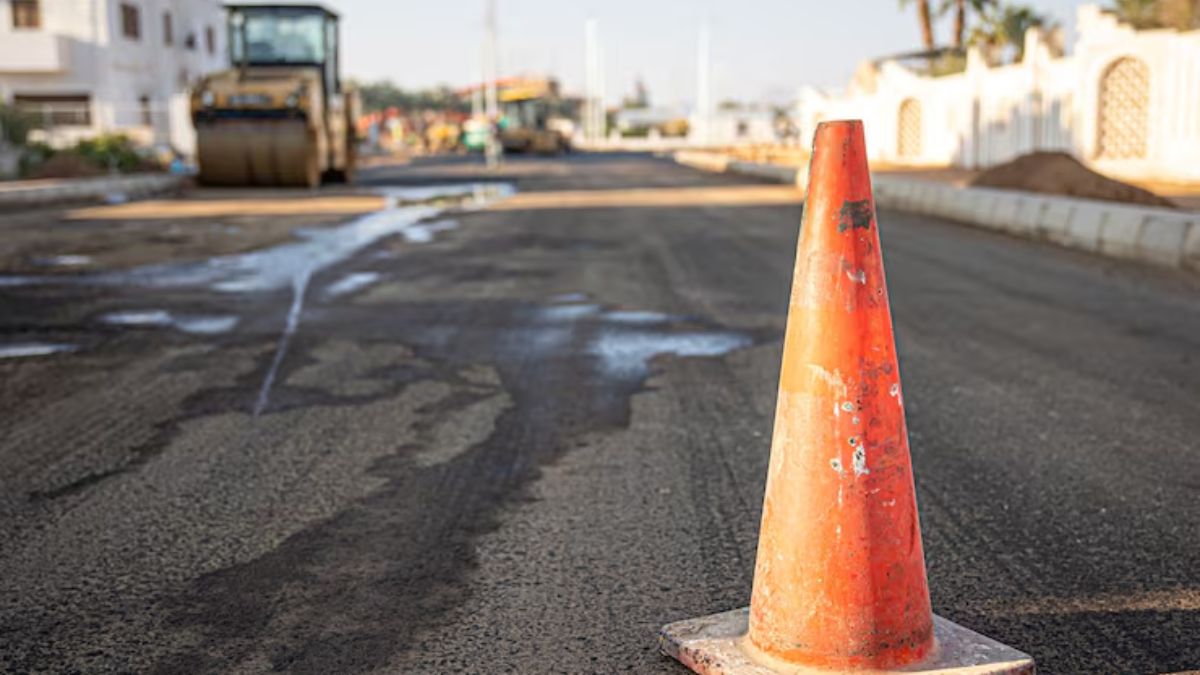
Nearly half of India’s under-construction National Highway projects have exceeded their original completion timelines, highlighting the growing challenge of delivering large-scale road infrastructure on schedule despite record investments in the sector.
The government informed Parliament on Wednesday that 629 of the 1,191 National Highway (NH) projects currently under construction have crossed their original completion schedule. While the Ministry of Road Transport and Highways did not specify project-wise reasons for the delays, the figures point to the execution hurdles that continue to affect highway development across the country.
Almost one in two highway projects running behind schedule
In a written reply in the Rajya Sabha, Union Road Transport and Highways Minister Nitin Gadkari said 1,191 National Highway projects are presently under construction and are yet to reach various stages of completion.
“Of these, 629 projects have spilled beyond their original completion schedule,” the minister stated, according to PTI.
The reply comes at a time when the government continues to expand the National Highway network through projects under Bharatmala Pariyojana, economic corridors, expressways and logistics-focused connectivity initiatives. Delays in execution can increase project costs, postpone economic benefits and affect connectivity timelines for industries and commuters alike.
The government, however, did not disclose the reasons behind the delayed completion or provide a state-wise or project-wise break-up of the affected projects.
Government tightens oversight of construction quality
Apart from project delays, the government also highlighted steps being taken to improve quality and accountability in highway construction.
Responding to another question, Gadkari informed the House that between 2023-24 and 2025-26, 103 contractors and concessionaires were blacklisted or penalised for poor quality work during National Highway construction.
The ministry is also expanding the deployment of Advanced Traffic Management Systems (ATMS) across the National Highway network to improve traffic monitoring, incident management and operational efficiency.
According to Gadkari, the rollout will cover all four-lane and above National Highways and Expressways, spanning around 52,647 km. The plan includes setting up local, regional and national command-and-control centres for centralised monitoring and coordinated response.
To support this, the government is implementing a Unified ATMS Software Platform with standardised protocols for monitoring, enforcement, data integration and performance management across the highway network.
AI identifies black corridors; FASTag annual pass gains traction
The government also shared updates on road safety initiatives.
Based on accident data available through the Electronic Detailed Accident Report (e-DAR) system for 2023-2025, 6,358 black corridors have been identified across the country. These are continuous stretches on National Highways that meet the criteria for accident-prone locations involving repeated fatal and grievous injury crashes.
According to the minister, these corridors have been identified using AI-based tools, enabling authorities to prioritise safety interventions and engineering improvements.
On electronic toll collection, Gadkari said the FASTag-based Annual Pass introduced for non-commercial cars, jeeps and vans has witnessed significant adoption since coming into force on August 15, 2025.
The annual pass, available for Rs 3,075 for 2026-27, allows travel through National Highway and Expressway toll plazas for one year or up to 200 crossings, whichever comes first.
“As of June, 2026, more than 77 lakh Annual Passes have been issued registering 63 crore transactions on National Highway Fee Plazas,” Gadkari said, adding that around 33 per cent of all electronic toll collection transactions by cars, jeeps and vans are now made using Annual Passes.