



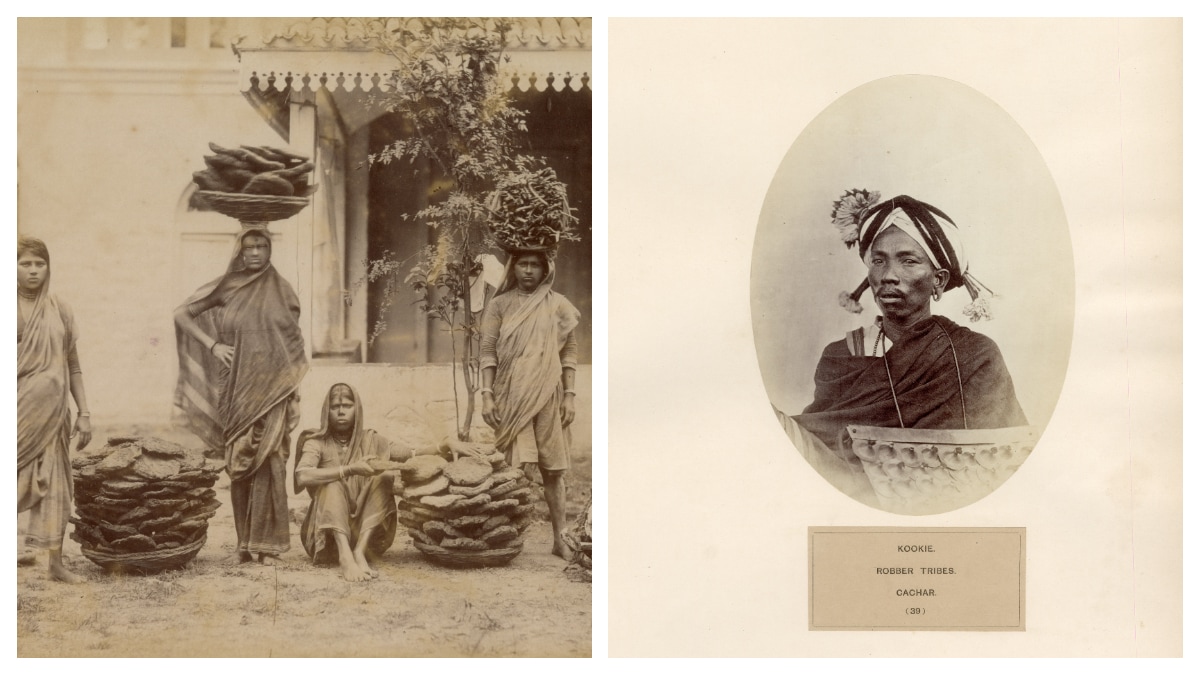
Walking through Typecasting: Photographing the Peoples of India, 1855–1920 at Bikaner House, New Delhi, the instinct is to read the photographs as evidence, of caste, tribe, occupation, difference. That instinct, the exhibition suggests, is precisely the problem.
Presented by DAG and curated by historian Sudeshna Guha, the exhibition, on till February 15, brings together nearly 200 photographs and photographic objects produced between 1855 and 1920. It is one of the most extensive presentations of early Indian photography, but its ambition is not encyclopaedic. Instead, Typecasting asks viewers to sit with discomfort, with the ways photography fixed people into types, and with our continued willingness to believe those types.
Guha is careful to resist a single explanatory frame. “The archive has not been created as a tool of colonial anything,” she says. What DAG has assembled over decades is a collection of 19th-century photographs, some made under ethnographic surveys, others by commercial studios, and still others by Indian photographers such as Daroga Abbas Ali. To flatten these varied histories into a monolithic “colonial gaze,” Guha argues, would be to miss the complexity of photographic encounters. “What has been important to me is to show the power of photographs,” Guha says, “and the fact that photographs tell many stories.”
Finding Agency in the Archive
At the heart of the exhibition are folios from The People of India, the eight-volume project compiled by John Forbes Watson and John William Kaye between 1868 and 1875. Produced in the aftermath of the 1857 uprising, the series emerged from a moment when the British rulers felt an urgent need to “know” India. Photography, newly endowed with the authority of mechanical objectivity, promised that knowledge.
That claim of objectivity is one the exhibition repeatedly unsettles. As Giles Tillotson, senior curator and senior vice president at DAG, puts it: “Photography carried a claim of scientific objectivity, it could show exactly what was there. The exhibition asks: do we believe these photographs, or was this an unreal way of looking?”
Guha insists that even within explicitly ethnographic images, meaning remains unstable. “How do we make the distinction between ethnography and portraiture?” she asks. Notes left by amateur photographers reveal negotiations that complicate any straightforward reading of control. “There was a huge amount of native agency in the ways the sitters posed, what they showed.”
This insistence on agency shapes how the exhibition is experienced. Many images are staged, yet subjects often meet the camera’s gaze. In photographs of the Toda community, women stand with palms pressed to their chests, eyes sharp, while captions reduce their lives to a single practice: polyandry. The label fixes the type while the gaze resists it. “These are photographs of types,” Guha says, “but when you look closely, you realise that type is a construct. Type does not exist in nature.”
From Scientific Evidence to Global Commodity
The exhibition’s four sections—The People of India, Tribe, Beauties and Dancing Girls, and Trade—trace how such constructs were formed and circulated. In the section on Beauties and Dancing Girls, photography slides into spectacle. Women appear repeatedly as postcards, posed, sometimes hand-painted, circulated far beyond India. One postcard shows a man and woman seated together, titled Love’s New Victim. Another frames a woman leaning back, arms behind her head, captioned simply ‘Tamil Woman’. These images were not merely photographs, but commodities.
Language in the exhibition remains deliberately unresolved. Archival terms like ‘coolies’ are reproduced as they appear in the original captions. “We don’t decide to retain or challenge this language,” Guha says. “The challenging has to be done by the viewers.” The exhibition, she insists, is not a corrective but an invitation, to think about how description becomes belief.
The most difficult aspect of the project, Guha admits, lies in its afterlife. “What if someone comes and says, ‘You put my grandmother up on the wall?’” These images are not abstractions, they are genealogies. They reopen questions of identity, inheritance, and historical violence. “These are explosive things,” she says.
By refusing easy conclusions, Typecasting positions itself as an argument rather than a display. The photographs are not showing India to the world. They are revealing how ways of seeing were constructed, normalised, and inherited. As Tillotson’s question lingers, “do we believe what the camera shows?”, the exhibition leaves viewers with a more necessary task, to recognise how readily we still do.