




Close your eyes and imagine a valley so still you can hear the wind move through bamboo. Paddy fields roll out in every direction, bright green and geometric, framed by pine-covered hills that disappear into low cloud. Smoke drifts from wooden houses. Somewhere nearby, a rooster and that’s all the alarm clock you need. You have arrived at Ziro.
While the rest of India packs into Manali or queues for a Shimla cable car every summer, a completely different kind of experience is waiting in the far northeast — quiet and almost entirely undiscovered.

Ziro Valley in Arunachal Pradesh is that rarest of things in 2026: a place that hasn’t been Instagrammed into a theme park yet. But that window is closing. The roads are getting better, the word is slowly spreading, and the kind of travellers who found Kasol “before it changed” are already circling it on maps.
Here’s why you should go as soon as possible — and how.
Why Ziro is different from every hill station you’ve been to
Most Indian hill stations follow a formula: a mall road, a viewpoint with a queue, overpriced Maggi and your run-of-the-mill cafes. Ziro doesn’t have any of that. Sitting at roughly 1,500 metres above sea level, it’s both the headquarters of the Lower Subansiri district and the valley itself — a point worth clarifying early.
“Ziro Valley and the main town are the same place — that is the township is within Ziro itself,” says Pradip Borah, who has been running Driyang Tours and Travels out of Naharlagun for fifteen years. There’s no separate area to base yourself in, no transit hub to pass through. You arrive in the valley and that’s all you need.

The area is home to the Apatani tribe, one of the most fascinating indigenous communities in all of India. The Apatanis are known for their colourful festivals, intricate handloom designs, skills in cane and bamboo crafts, and a land use tradition so advanced that their cultural landscape has been placed on UNESCO’s Tentative World Heritage List.
You’ll see elder Apatani women with traditional facial tattoos — a practice that has all but faded with younger generations, making the elders living archives of a world that’s quietly passing.
Spend an afternoon in Hong Village, the largest Apatani settlement, and you’ll understand what it means to be a guest in someone’s culture and not just a spectator of it. Hija Village is worth the detour too — it’s known for its well-preserved traditional houses and the intricate irrigation systems the Apatani have maintained for centuries.
At the centre of each village, look for the lapang — an open wooden platform where elders deliberate, and settle disputes. It’s where, if you’re on a heritage walk, you’re most likely to be introduced to Apatani law and origin lore. The architecture tells you something the guidebooks don’t: in this culture, governance is communal and hospitality is intimate, and the two have always been kept carefully apart.
What makes Ziro particularly special is that each village within the valley has its own distinct identity. “Ziro is a cluster of different small villages where the tribe differs as you travel from one to the other,” says Rahul Das of MyNortheast Tours and Travels, who has been guiding travellers through the Northeast for eleven years. “You get to experience different cultures, different tribes — it changes village to village.”
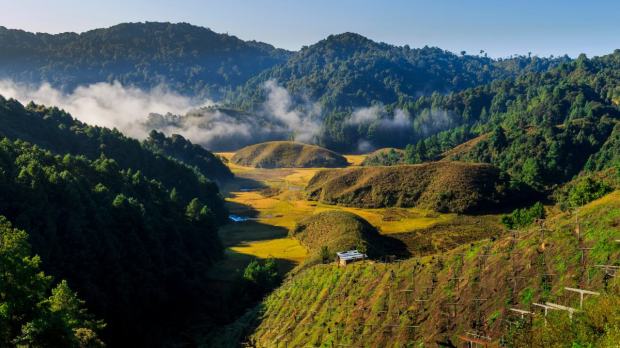
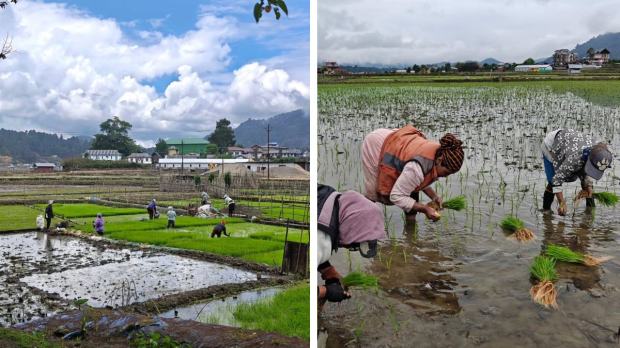
The landscape earns its UNESCO nomination in practical, visible ways. Fish are raised directly alongside paddy crops in a system of integrated farming that has sustained the Apatani for centuries — you can see it working in the fields as you walk through the valley.
The Tarin Fish Farm makes this tangible in a way that’s worth an hour of anyone’s time, not as a tourist attraction but as a reminder that some communities figured out sustainability long before it became a hashtag.
Nearby, the Talley Valley Wildlife Sanctuary — about 30 kilometres out — offers dense bamboo forest and opportunities to sight rare bird species such as the Beautiful Nuthatch, the endangered Black-necked Crane, the Rusty-bellied Shortwing and many more.
Ziro gives you something more than your average adventure tourism experience, something something harder to sell and more valuable: the feeling that the world still has corners in it, yet to be uncovered.
When to go
Ask two operators the same question and you get two useful answers. Rahul points to September and October as the overall sweet spot. Pradip goes further: “The flower season is the absolute best time — August to September.” That window, when the valley is in full bloom and the paddy is being harvested, is when Ziro is most completely itself.
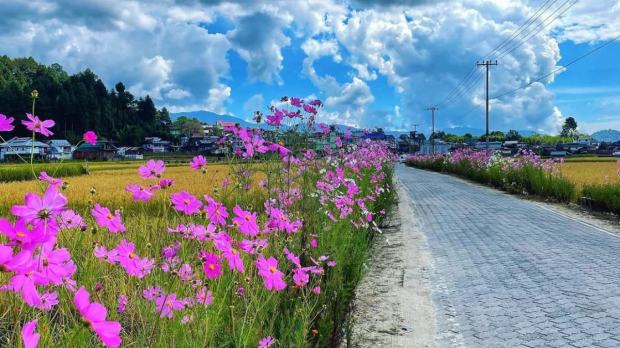
It’s also when the Ziro Music Festival happens — this year from 25 to 28 September. It’s not a typical music event. During festival time the Apatani and other local tribes come together to celebrate the harvest. “Folk artists from across the world come and perform, and tourists also come from worldwide,” says Rahul. “You get to experience local cuisine, local activities — like how to catch fish in the paddy fields — and local drinks.”
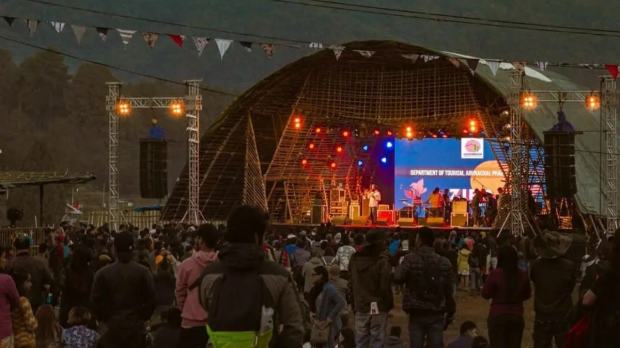
The festival enforces a zero-plastic policy, promotes bamboo architecture, and involves the community in a way that feels nothing like the corporate festivals that have swallowed everything else. Passes sell out quickly. If September is your window, plan for a full week — four days for the festival, the rest to let the valley settle into you.
But the Ziro Music Festival is only one entry point. The Apatani have their own calendar of celebrations that predate it by centuries, and any of them make for a compelling reason to visit.
Myoko, in March, is the biggest festival in the Apatani year — a month-long celebration of friendship, social renewal, and community prosperity. It rotates across different villages, so the festivities move through the valley rather than concentrating in one place.
At its heart are shamans leading purification rituals, families gathering for elaborate feasts, and the raising of the babo — a tall wooden pole, sometimes a hundred feet high, made from evergreen trees, its erection a collective act that involves the whole clan pulling together. If you want to understand what the Apatani value, watch them put up the babo.
Dree, in July, is an agricultural festival — prayers for a good harvest spilling over into laughter, apong, and song. Murung, in winter, honours ancestors through feasts and storytelling under open skies. None of these are ticketed events or organised for tourists. They’re just life here, and visitors who arrive at the right time are welcomed into them.

For those who can’t make any of the festivals work, April to June is a strong alternative. The rice fields are at their most vivid green, temperatures are cool and comfortable, and there are no crowds whatsoever. “June gives you pleasant weather,” notes Rahul — ideal if you’re escaping the heat that makes the rest of India difficult between April and June.
The first-timer’s practical guide
Is it safe?
This is the first question most people ask, and Rahul’s answer is unequivocal. “Arunachal Pradesh is one of the safest places in India — especially for women. Very few incidents have been registered.” For anyone nervous about travelling to the far Northeast for the first time, that’s worth sitting with.
The permit (don’t skip this)
Every Indian visitor to Arunachal Pradesh needs an Inner Line Permit — and almost every first-timer is intimidated by it but they shouldn’t be. “Three days in advance is enough,” says Pradip flatly. “You can do it yourself on the website, or we can do it for you.” Rahul agrees: “It’s just a matter of minutes. You go to arunachalilp.com, follow the instructions, and you can get it instantly.”
Foreign nationals require a Protected Area Permit (PAP) instead, which is a separate and more involved process — sort this well in advance through the Ministry of Home Affairs or a registered tour operator.
One important note both operators flag — the ILP is required from the moment you land, even at the airport. Sort it before you fly and definitely carry a printout. After that, you won’t think about it again.
Getting there
There are now direct flights to Itanagar from Delhi and Mumbai, making the Northeast more accessible than it has ever been. According to Skyscanner, fares start at around Rs 8,500 from Delhi and Rs 12,000–14,500 from Mumbai, while the shortest and cheapest route is from Kolkata, with fares from as low as Rs 3,800 for the 90-minute hop. Flights from Kolkata typically land around 2pm and from Delhi, around 3pm.
“After arriving, you can go directly to Ziro that same day,” says Pradip. The drive is about 100 kilometres — roughly three hours on roads that are considerably better than their reputation suggests. “The road up to Itanagar is four-lane, and from Itanagar it’s double-lane all the way to Ziro,” Pradip confirms. “No road problems.”
Rahul adds context for anyone who’s heard the old horror stories: “Previously it was quite adventurous, especially during monsoon — but that’s not the case anymore. The roads are newly constructed and very good.”
One practical caveat from Rahul: if you’re arriving late in the evening, don’t push on to Ziro the same night. Stay in Itanagar and drive up fresh in the morning. The journey is straightforward and there’s no need to make it stressful.
How many days do you need?
The bare minimum itinerary, per Pradip, is clean and simple: arrive in Itanagar, drive to Ziro the same evening. Full day of sightseeing the next day. Return to the airport the day after. That’s a two-night trip that gives you a genuine taste.

Rahul recommends pushing it to three or four nights at minimum for a proper experience. “That gets you a village tour, a wildlife sanctuary, and enough time to stop rushing,” he says. If trekking interests you, Talley Valley alone adds two days. Come during the festival and you’ll want a full week.
Getting around
Hiring a private vehicle is the standard and sensible approach. Pradip’s rates are straightforward: an Innova runs around Rs 6,000 per day and fits up to six people. An Ertiga is Rs 5,000 per day for four or five. A Swift Dzire, suitable for three, comes in at Rs 4,500 per day.
For a family splitting costs, this makes getting around genuinely affordable. For the more adventurous, cycling is a surprisingly good way to move through the valley — the flat rice-field paths are made for it, and you’ll stop more often, which is the whole point.
Budget
Ziro is accessible across a real range. For a family of four travelling four days — private vehicle and two rooms — Rahul estimates Rs 75,000 to Rs 80,000 all in. Solo travellers on a budget can manage comfortably between Rs 15,000 and Rs 20,000. The premium options exist, but they’re not necessary to have a remarkable trip.
A note on cash and connectivity
ATMs are scarce in Ziro. Carry enough cash for your entire stay before you leave Itanagar — don’t assume you’ll find a machine in the valley. Mobile network coverage is patchy in more remote parts, particularly on the trails. For the right kind of traveller, that’s a feature. For anyone who needs to stay reachable, it’s worth planning around.
Language barriers — and the lack thereof
Hindi speakers will have no trouble at all. “Arunachal is one of two tribal regions in the Northeast — along with Sikkim — where people speak good Hindi,” says Rahul. English works fine too. The communication barrier that puts some people off Northeast travel simply doesn’t apply here.
Where to stay
Both operators, without hesitation, say the same thing: homestay. “Compared to a hotel, a homestay is much better,” says Pradip. “The cost is lower, and you’ll get traditional food, organic vegetables, and local wine.”
Rahul puts it in terms of what you’d be missing otherwise: rooms that smell of pine and woodsmoke, meals cooked by the family, a valley view at sunrise that no resort can manufacture. For those who want something slightly more structured, resorts and eco-camps do exist — the options now span budget to comfortable.
What to see and do
A full day in Ziro covers more than most people expect. Pradip’s list for a single day of sightseeing: Siikhe Lake, a valley viewpoint overlooking the integrated fish and paddy farms, a kiwi garden, a kiwi wine factory, and Kasa Resort — where you can try on traditional Apatani dress and, yes, do a photo shoot if that’s your thing.
The 5,000 year old Meghna Cave Temple is worth adding to the list — a quieter, less-visited spot that most day-trippers skip entirely. For sunrise, head out early — the first light over the valley is one of those views that makes the early alarm entirely worth it.
On the way out of Ziro, Kile Pakho — on the Yazali road — is a viewpoint Pradip specifically flags. “Great viewpoint, natural beauty,” he says. “Don’t miss it.” And for those with an extra day, the Talley Valley trek remains the most immersive experience in the area — two full days in dense forest with almost no other visitors.
If you’d rather cover ground at your own pace, rent a bicycle. The valley paths between villages are flat and almost entirely free of traffic. It’s the best way to stumble into a hamlet that isn’t on any list.
What to eat
The food alone is reason enough to visit. Look for pika pila — fermented bamboo shoot cooked with pork — and apong, the local rice beer that arrives in a bamboo cup. Homestays are where you’ll eat best: organic vegetables from the family plot and decadent smoked meats. “Eat what the family eats,” as Pradip puts it.
One note on pacing
Rahul offered a perspective that’s worth holding onto, especially for first-time Northeast travellers. He gently suggested that visitors who have never been to Arunachal consider Tawang first — the state’s most visited and best-connected destination — before venturing somewhere as quietly remote as Ziro.
“Development should grow at its own pace, and the number of visitors should grow along with it,” he says. It’s a rare thing for someone in the tourism industry to say: come, but thoughtfully. Don’t rush and overwhelm a place before it’s ready. It’s also, perhaps, the most honest possible endorsement of Ziro — that the people who know it best want it protected more than they want it crowded.
From Ziro, for those who want to keep going, Pradip maps out a natural onward route: back through Bhalukpong, then up to Dirang and Tawang. A proper Arunachal circuit for anyone with the time.
Go before it changes
Every traveller who has watched a place they loved get “discovered” carries a particular kind of grief. The café that became a chain. The quiet village that got a highway. The homestay that turned into a resort. Ziro is at that precise moment before any of that happens — still raw and real; run by the people whose home it actually is.
Visit with that in mind. Tread carefully, spend locally, ask before photographing, and leave nothing behind but a good impression. The Apatani have kept this valley extraordinary for centuries. The least a visitor can do is help keep it that way for the next person.
Ziro isn’t waiting for you with fireworks. It’s waiting with something quieter, and considerably more rare — the feeling that you’ve arrived somewhere that still means something.