



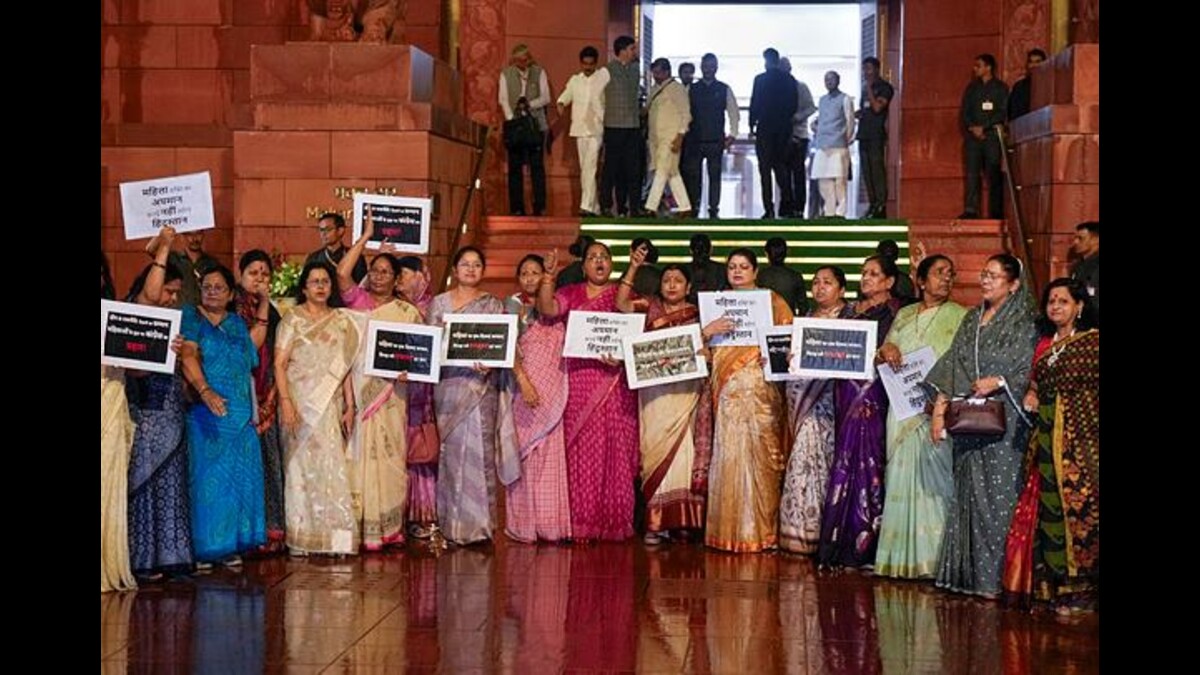
The Women’s Reservation Bill failed to pass the Lok Sabha test on Friday, with the ruling NDA government failing to secure the required two-thirds majority in the Lok Sabha, with 298 members voting in favour and 230 opposing it. This setback has made it one of the most stalled constitutional reforms in India’s history.
Though the political push for reserving 33 per cent of seats in the Lok Sabha and state assemblies for women dates back several decades, the women’s quota bill has repeatedly faced hurdles, often due to opposition from different political parties and internal disagreements.
Early origins and some initial attempts of Women’s Reservation Bill
The formal legislative journey of the modern Women’s Reservation Bill began in 1996, when the HD Deve Gowda‑led United Front government introduced the 81st Constitutional Amendment Bill in Parliament. This bill proposed reserving one‑third of seats for women, but the government lacked a stable majority. The House was soon dissolved, causing the bill to lapse without a final vote.
A similar fate followed in subsequent Lok Sabhas. The same concept was reintroduced as the 84th Constitutional Amendment Bill during the Bharatiya Janata Party (BJP)‑led National Democratic Alliance (NDA)‑I government of Atal Bihari Vajpayee in 1998. However, chaotic scenes and resistance from several parties meant the bill again failed to secure passage and eventually lapsed with the dissolution of the 12th Lok Sabha.
Over the next 27 years, almost every major government: United Front, BJP‑led NDA, Congress‑led UPA and later the NDA‑III- brought different variants of the women’s reservation bill, but each attempt met one of three outcomes- either it was shelved, defeated or simply lapsed due to the end of a Lok Sabha term.
Analysts and chronicles of the bill’s history note that there have been around six unsuccessful attempts to pass the Women’s Reservation Bill since 1996, corresponding roughly to the years 1996, 1998, 1999, 2002, 2003 and 2008–2010–2014 period, depending on how one counts reintroductions and lapses.
In each case, the failure was not due to a single political party alone but to a mix of competitive politics, concerns about caste and reservation and fears over the re-delimitation of constituencies.
Why political parties opposed or blocked the ‘Women’s Reservation Bill’?
- Anti‑quota camp and caste politics: Some parties, especially among Other Backward Classes (OBCs)‑centric outfits, opposed the bill unless there was a separate layer of reservation for OBC women within the 33 per cent, fearing that upper‑caste women would corner most seats.
- North–south and regional balance concerns: Several southern and eastern parties worried that adjusting seats based on updated population (through delimitation) would dilute their representation and power, so they often linked their opposition to delimitation with their stance on women’s reservation.
- Intra‑party gender politics: Within some parties, male leaders were reluctant to step aside from safe seats and some openly questioned the bill’s impact on existing power structures.
Because of these cross‑cutting objections, the bill was always kept watered down, delayed or allowed to lapse rather than being cleanly voted down on the floor in most of its earlier reincarnations.
High‑stakes defeat in Lok Sabha and Amit Shah’s big claims
The bill’s most recent major setback came on April 17, 2026 (Friday), when the ‘Nari Shakti Vandan Adhiniyam’ (Women’s Reservation Bill) was defeated in the Lok Sabha, despite 298 MPs voting in favour and 230 opposing it.
Since constitutional amendments require a two‑thirds majority of the total House strength, the bill fell short of the required threshold, effectively being rejected by the opposition bloc (INDI alliance), even though a majority of individual MPs supported it.
In the aftermath, Union Home Minister Amit Shah launched a sharp attack in the Lok Sabha, accusing the Congress‑led opposition of obstructing the bill and using ‘ifs and buts’ to block its passage.
He also linked the opposition to an older pattern of resistance to delimitation and women’s reservation, arguing that the same party that once stalled delimitation during the Emergency (via the 42nd Amendment in 1976) was now blocking reforms that would increase women’s representation and SC/ST‑reserved seats after delimitation.
How many times has it actually been rejected?
If one uses a strict definition of rejected as a bill being formally voted against or falling short of required majority in the Lok Sabha, then the record is limited to clearly documented instances such as the 1998 attempt (blocked by opposition and never passed) and the 2026 ‘Nari Shakti Vandan Adhiniyam’ (which lost on account of failing to secure a two‑thirds majority test).
However, in the broader political context- accounting for repeated lapsing, shelving and deliberate blocking- commentators often say the Women’s Reservation Bill has effectively been defeated or allowed to fail six times across different Parliaments since 1996, each time due to a mix of party politics, caste equations and regional fears.
None of these earlier versions became law. While the 2023–24 version was the first to cross both Houses before hitting implementation hurdles, the 2026 version holds the distinction of being the first to be formally voted down despite having majority support.