



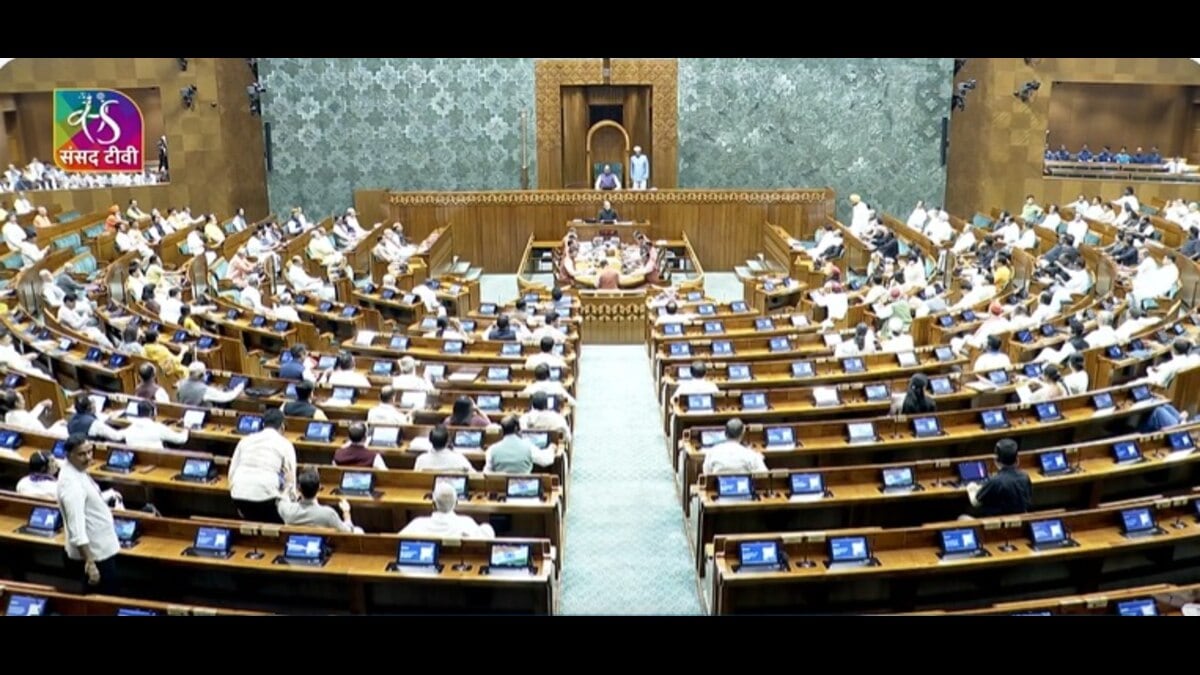
With the National Democratic Alliance (NDA) short of the required strength in the Lok Sabha to pass Constitution amendment Bills linked to women’s reservation in the Lok Sabha and state assemblies, the Centre has issued a notification making the 2023 Women’s Reservation Act, 2023 come into force on April 16 (Thursday).
The Gazette notification, issued by the Ministry of Law and Justice, invoked subsection (2) of Section 1 of the Constitution (One Hundred and Sixth Amendment) Act, 2023, designating April 16 as the date when the Act’s provisions will formally take effect.
The 2023 law had already been notified in September 2023 after presidential assent and contained a clause allowing the Central government to fix the enforcement date by notification.
Opposition leaders have called the timing of the re‑notification a desperate attempt to insulate the 2023 Act from possible failure of the new 2026 Constitution amendment package.
Congress MP Manish Tewari pointed out that the 2023 Act was effectively re‑gazetted after Rule 66 of the Lok Sabha’s Rules of Procedure- covering contingent Bills- was suspended, suggesting the government is trying to shield the 106th Amendment if the 131st Amendment (which seeks to bundle delimitation with women’s reservation) fails to pass.
The move underlines the government’s apprehension that the current arithmetic in the Lower House may not allow the core constitutional changes to clear a two‑thirds majority.
No numbers to pass Constitution amendment Bills
The Constitution amendment Bills connected to women’s reservation can only become effective after they are approved by both Houses of Parliament with a special majority- two‑thirds of those present and voting and at least half of the total strength of each House.
With 543 members in the Lok Sabha (three seats currently vacant), two‑thirds of the total strength is 362; if all MPs are present, the government must secure 362 votes. The NDA’s own tally is 293, leaving it 67–69 MPs short. Abstentions can reduce the effective threshold, but only if the number of absentees is very high.
On the day of introduction, voting on the motion to take the three Bills- the Constitution (131st Amendment) Bill, the Delimitation Bill and the Union Territories (Amendment) Bill—into consideration revealed that the NDA does not have the numbers: 251 votes in favour and 185 against out of 436 MPs present.
All four major opposition parties- Congress, Samajwadi Party, Trinamool Congress and DMK- voted against the introduction, and insiders suggest it will be difficult for them to switch positions the next day without political cost. BJP leaders privately acknowledge that losing the vote would create “bad optics,” giving the Opposition room to accuse the government of seeking excuses to dilute or delay women’s reservation or to manipulate state‑wise seat allocation through delimitation.
What are the options before the government?
Faced with this arithmetic, several options are available to the government. The first is to go ahead with the vote, risking rejection and using the defeat as a political weapon in future elections; BJP leaders from the south warn that failure would play into the hands of the Opposition, which is already using delimitation as a poll issue in Tamil Nadu.
Another option is to introduce targeted amendments to address the concerns of southern states- especially Tamil Nadu and Kerala- that fear losing weight in the new seat distribution, though crafting such changes without upsetting the BJP’s base elsewhere is politically sensitive.
A third route is to seek a cross‑party consensus and either send the Bills to a parliamentary committee for a time‑bound report or withdraw them temporarily to avoid a direct loss on the floor. Former Lok Sabha secretary general PDT Achary has noted that the government can move or accept a motion to refer the Constitution amendment to a Select Committee at any stage before voting, which would buy time and allow more discussion with the Opposition, without immediately risking defeat.
The Centre could also choose to fall back on implementing the 33% women’s quota in easier arenas- such as Union Territories via ordinary legislation or through local‑body laws- while postponing the full delimitation‑linked overhaul of Lok Sabha and state‑assembly seats.
Why the Opposition is holding back?
The principal reason the opposition bloc is wary of giving the NDA carte blanche on the 131st Amendment is that the government has tied the 2023 women’s quota to a controversial delimitation exercise based on the 2011 census and a proposed expansion of the Lok Sabha.
Many non‑BJP parties fear that delimitation, especially if it rewards states with higher population growth, could dilute the political weight of southern and some northeastern states that have controlled population growth more effectively than the Hindi‑belt states.
INDIA bloc parties like Congress, SP, TMC and DMK leaders have repeatedly argued that the 33 per cent women’s reservation should be implemented independently of delimitation, warning that linking the two issues is a way to stall or distort women’s quota rather than give it a clean, timely pathway.
In substance, the 2023 Women’s Reservation Act already stands on the statute book and has now been formally notified to “come into force” on April 16. Symbolically, this allows the government to claim that it has fulfilled its promise of enacting the 33 per cent quota.
However, the practical implementation of reservation in the Lok Sabha and state assemblies still depends on the underlying constitutional amendment and delimitation framework, which remains stuck in political limbo. Without passage of the 131st Amendment and the related delimitation law, the 2023 law will remain a dormant legal framework rather than a functioning electoral reality.