



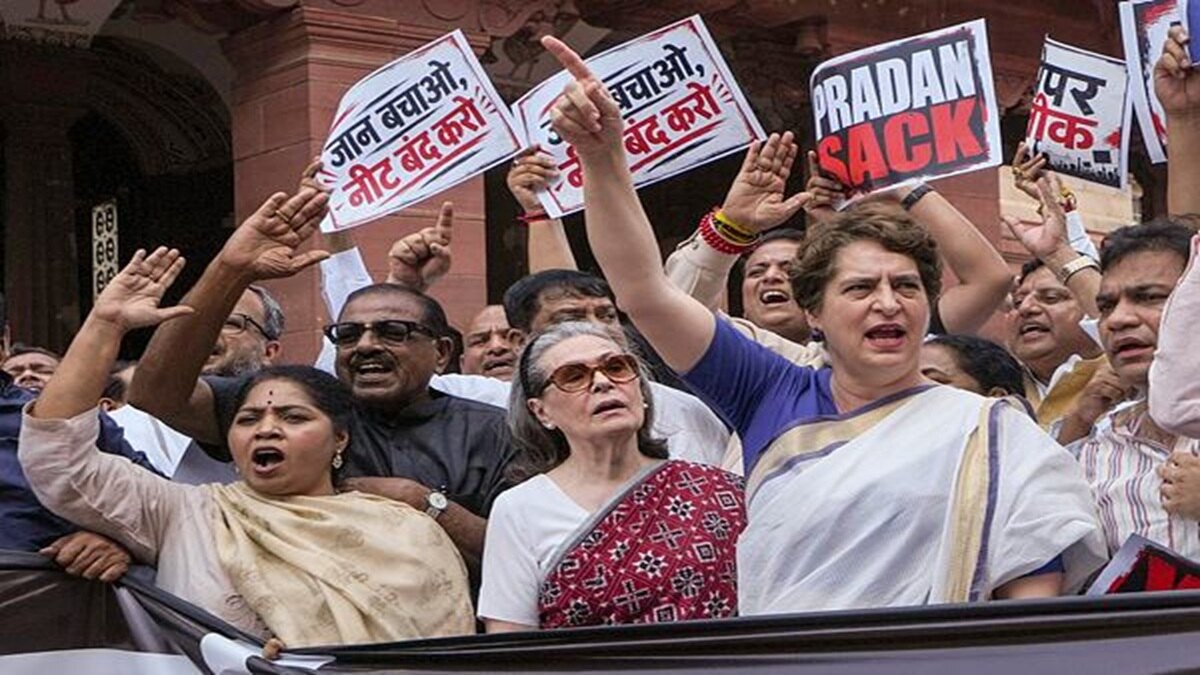
Amid ongoing student protests in Delhi, Congress Parliamentary Party chairperson Sonia Gandhi launched a scathing verbal attack on the Modi government for its education policies and its alleged refusal to take accountability.
“The Modi government has not just degraded India’s education landscape but has also made a habit of acting with utter impunity, supreme self-delusion, and abject insensitivity. India’s students have called the Modi regime’s bluff. It is our moral, political, and constitutional duty to stand with them and safeguard their future,” Gandhi wrote in a sharply worded opinion piece in The Hindu.
She framed the protests as a clash between a collapsing education system and a generation demanding fairness and reform. She places responsibility squarely on the Centre’s policies and governance style, arguing that the government’s response has exposed a deeper culture of impunity in the exercise of power.
Wave of peaceful student protests
For several weeks, young students across India have been staging peaceful demonstrations against repeated examination paper leaks and what they describe as the broader decay in the education system. According to Sonia Gandhi, their demands have been straightforward and to the point as accountability from the Government of India and meaningful education reform, particularly in the conduct of high-stakes competitive exams.
“These are our sons and daughters, our young men and women,” she writes for The Hindu, insisting that the protests are neither orchestrated nor anti-national, but a spontaneous tide of anger and anxiety among future doctors, engineers, teachers, civil servants and entrepreneurs.
Gandhi stresses that the demonstrators are seeking transparency, fairness and reliability in examinations, rather than any partisan objective.
July 20 ‘Day of Infamy’: Allegations of brutal police crackdown
Sonia Gandhi describes July 20, 2026 as a ‘day of infamy’, alleging that the Delhi Police and Central Armed Police Forces (CAPFs) unleashed “uncalled-for violence” on peaceful student protesters. She writes that the authorities used brutal lathi charges and tear gas, leaving scores injured, and even targeted students heading back home as ‘lathis rained down on their backs and heads’.
“The nation has seen some of the most depressing visuals of youth whose bodies have been scarred by pellets, the use of which would undoubtedly have been approved by the Union Home Minister himself,” Gandhi alleges, saying those videos are “seared into our memories” and have stirred the country’s conscience. She accuses the government and what she calls its “captive media” of spinning narratives to delegitimise the protests instead of confronting the underlying grievances.
Govt treats students as enemies, not inheritors of the future: Gandhi
In the op-ed, Gandhi asserts that the Modi government has responded to the “courage” of protesting students “with cowardice and wanton cruelty”, treating them “not as inheritors of the future but as enemies of the nation”. She argues that the regime routinely chooses state violence over dialogue, extending a pattern seen earlier in the crackdown on farmers’ protests and action against activists.
“But this week, even a government as insensitive as the one that has set new standards of authoritarian governance, sank to a new low,” she writes. “Instead of reaching out with understanding to our future doctors and engineers, teachers and civil servants, entrepreneurs and nation builders, it unleashed the repressive power of the state on them. This can neither be forgiven or forgotten.” Gandhi’s language positions the confrontation as a test of India’s democratic values and of how the state views its youth.
Linking protests to policy failures and education collapse
Sonia Gandhi situates the current protests within a larger critique of the Modi government’s education policy and approach to public education. She has previously accused the Centre of pursuing the “three Cs” that “haunt Indian education today” — centralisation, commercialisation and communalisation — and argues in her latest piece that the “collapse” of the education system and “young India’s trauma” are rooted in these trends.
She reiterates concerns that the government has undermined public education, reduced budgetary support and pushed privatisation, while using policy instruments like the National Education Policy (NEP) 2020 to consolidate control and reshape curricula along ideological lines. According to Gandhi, the student protests over exam leaks and administrative failures are “a natural consequence of today’s bleak education landscape in India and the government of the day’s unwillingness to be accountable or constructive”.
Call to ‘stand with students’ and safeguard their future
Central to Gandhi’s article is a moral appeal: that society and political leadership must “stand with” students rather than allow them to be criminalised or crushed. “It is our moral, political, and constitutional duty to stand with them and safeguard their future,” she writes, framing support for the protests as a constitutional responsibility rather than partisan choice.
She urges the government to stop using force, introspect on the policies and attitudes that have produced this crisis, and engage constructively with young people’s demands for transparent examinations, institutional accountability and fair access to quality education. In her telling, defending students is tantamount to defending the Republic’s democratic and social contract.
Kharge’s social media attack: ‘Not Mann Ki Baat, come to Parliament’
Congress president Mallikarjun Kharge has amplified the party’s criticism in a strongly worded post on X, targeting Prime Minister Narendra Modi’s late-night video statement on the crisis. “When Parliament is in session, the Prime Minister has to give a Statement on the floor of Parliament, not make a one-sided ‘Mann Ki Baat’ outside Parliament by recording a video late at night!!” Kharge wrote, insisting that accountability must be expressed in the House, not via social media or broadcast messages.
“Before coming to Parliament today, come after dismissing Dharmendra Pradhan,” Kharge demanded, referring to the Union Education Minister. “First, apologize to the students and take strict action against those who ordered the use of lathis, batons, and Pellet Guns to suppress the students’ voices. Then we are ready for a detailed Discussion on the education system.” His post ties three demands together: the sacking of Pradhan, an apology to students, and punitive action against officials responsible for the alleged excesses.
"The Modi government has not just degraded India’s education landscape but has also made a habit of acting with utter impunity, supreme self-delusion, and abject insensitivity. India’s students have called the Modi regime’s bluff. It is our moral, political, and constitutional… pic.twitter.com/h03A71ov6u
— Mallikarjun Kharge (@kharge) July 24, 2026
Accountability, resignations and education reform
Together, Sonia Gandhi’s op-ed and Kharge’s social media intervention sharpen the Opposition’s narrative that the student protests are not isolated incidents but symptomatic of deeper policy failures and an authoritarian mindset in the handling of dissent. Both leaders frame the unrest as a referendum on the Modi government’s stewardship of education.
By demanding Dharmendra Pradhan’s removal and a formal statement in Parliament, the Congress is attempting to convert street anger into parliamentary pressure, while also projecting itself as the political force “standing with students” against what it calls state repression.