



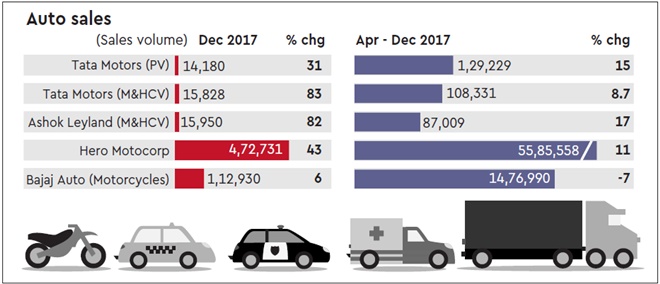
Sales of commercial vehicles and two-wheelers witnessed a sharp rise in December, growing over 80% and over 30%, respectively, for major players, owing to a low base effect of demonetisation. Both these segments were the most affected in December last year following the note ban, as much of the purchases in the two segments are done in cash. Two-wheeler volumes dipped by 22% in December 2016 (against December 2015), while medium and heavy truck (M&HCV) sales declined 12%, with the sharpest dip seen in sales of long-haul trucks. Sales of M&HCVs by Tata Motors grew a staggering 83% in December 2017 to 15,828 units, while Ashok Leyland reported growth of 82% to 15,950 units. Sales volumes of Ashok Leyland inched closer to those of Tata Motors, the market leader, in December. Analysts say that Ashok Leyland commands a larger share in the above 25-tonne segment, and is a great beneficiary of the over-loading restrictions that have been imposed in various north Indian states. M&HCV sales rose as buyers took advantage of steep discounts of 12-15% being offered by OEMs in December to clear inventory, and ahead of the rollout of costlier trucks with AC or ventilation systems in cabins, which has been mandated from January 1. Jinesh Gandhi, research analyst at Motilal Oswal, indicated in his report: “On the CV front, players are offering steep discounts (5% higher) and other incentives to clear the current stock ahead of the upcoming regulatory change that makes it mandatory for all new CVs to have air blowers (for better ventilation in the cabin) as a standard fitment from 1st January 2018”.
Analysts also point to increased government spend on road construction, along with a pick-up in infrastructure activity and mining. In light of this, they expect the positive trend on M&HCV sales to continue in the last quarter of the fiscal. Analysts at Nomura have noted a close correlation of railway freight traffic growth with M&HCV demand, and cite the pick-up in rail freight as a lead indicator for CV sales. Nomura said, “In the past few months, we have seen sustained improvement in freight traffic, driven initially by a pick-up in coal and supported by other segments like cement and food grains.” This, they feel, is a strong indication of positive growth in truck sales going ahead.
Two-wheeler sales also rose significantly in December. Hero Motocorp, the numero uno two-wheeler maker in the country, saw sales climb 43% in December 2017, compared with a decline of 34% in December 2016. TVS Motor saw volumes grew 35% in the month, compared with a 9% dip in December 2016. Bajaj Auto saw a more muted growth of 6% in December this year, against a decline of 11% in the corresponding month of the previous year.
Niche motorcycle brand Royal Enfield too posted a robust growth of 16% in the mid-weight segment (bikes in the range of 250-750cc), which is seeing several new launches by competitors, against a decline of % in December 2016. Tata Motors, which also reported its passenger vehicle sales on Tuesday (a day after most others in the segment), surprised with a strong 31% growth, driven to a large extent by its new compact-SUV Nexon. This is in line with sales trends of Honda Cars (26%) and Maruti Suzuki (12% on a large base). Toyota Kirloskar Motor joined Mahindra & Mahindra in reporting a decline in sales volumes in December. Sales for Toyota declined 15%, while Mahindra & Mahindra had reported a dip of 7%.