



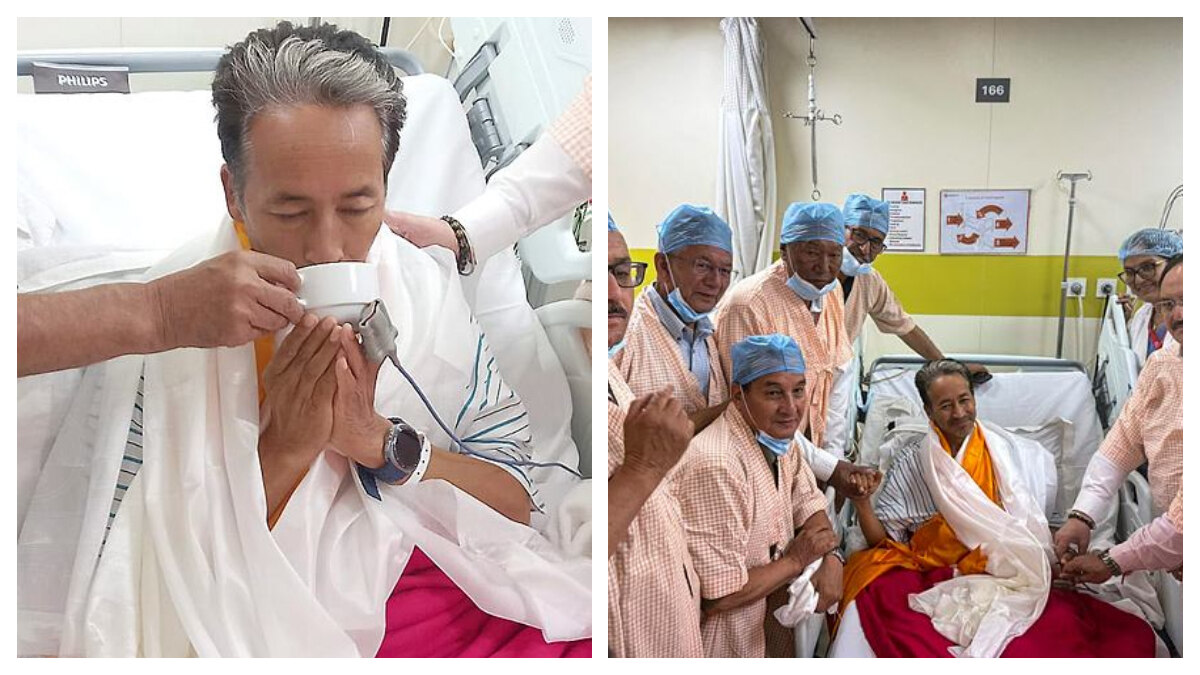
Climate activist Sonam Wangchuk ended his 26-day indefinite hunger strike after the Centre gave written assurances late at night that student protesters would not face FIRs or legal action and that existing cases would be withdrawn. His wife, Dr Gitanjali Angmo, told reporters that the written note clearly promised “no FIRs, no undue force against protesters, compensation for families of students who died by suicide over the NEET issue, and a discussion in Parliament on educational reforms and examination-related concerns”.
She said BJP leaders JP Nadda and Jitendra Singh met Wangchuk on behalf of the government to convey these assurances, following sustained pressure from nearly 65 MPs who had signed letters urging him to end the fast and committing to raise education accountability in Parliament during the Monsoon Session. After receiving these written guarantees, Wangchuk moved to a liquid diet and, as Angmo explained, will gradually progress to semi-solid and solid food over the coming days.
Opposition leaders question Wangchuk’s exit
Even as many Opposition MPs backed Wangchuk during his fast, some senior leaders have begun openly questioning the way it ended, sharpening a Congress vs Wangchuk sub-text in the unfolding politics. Shiv Sena (UBT) MP Sanjay Raut welcomed the activist’s decision to call off the fast but cast doubt on the optics and terms of the exit, arguing that “the same government against which the protest was held had its two ministers present when the hunger strike was ended. This raises several questions.”
Raut asked what exact assurances had been given and demanded that they be made public, pointing out that the resignation of Dharmendra Pradhan was “one of the main demands of the protest”.
“If this demand has not been fulfilled, then what was the reason for ending the hunger strike?” he said, alleging that the government was trying to protect Pradhan and take credit for ending a movement that belonged to the people. He accused the authorities of attempting to suppress and discredit the Jantar Mantar protests, and of treating Wangchuk in an “inhumane” manner.
‘Wake-up call’ and systemic rot, says Gitanjali Angmo
Angmo described the agitation as a “successful movement” that had forced a political and institutional response to what she called deep-rooted flaws in India’s examination and education system. “The NEET paper leak was the symptom, but the causes are present in the system… This has awakened the whole nation. We hope that this will be a wake-up call for the government,” she said, stressing that the protests had exposed systemic rot beyond a single exam.
Gurugram, Haryana: Activist Sonam Wangchuk’s wife, Dr Gitanjali Angmo, says, "Sonam Wangchuk has ensured the security of the students with the written confirmation that no legal action will be taken against them. The student leaders will decide on the course of the protest after… pic.twitter.com/FzGwh8UpNu
— IANS (@ians_india) July 24, 2026
She underlined that almost 65 MPs from the Opposition had given written assurances that the issue would be taken up in Parliament, and that both the government and Opposition had “decided that discussion on education reforms will take place in this Monsoon session”. At the same time, her repeated emphasis on accountability — and her earlier remarks that Dharmendra Pradhan “should resign” over the crisis — showed she was willing to criticise political forces across the aisle, including those now rallying behind Wangchuk.
Symbolism and ‘spirit of the movement’
Raut also attacked the manner and location of the fast’s conclusion, arguing it should have happened in the open, alongside the injured and protesting students rather than in a controlled setting with Union ministers. “If Wangchuk had to end his hunger strike, it would have been more appropriate if he had done so by drinking juice at the hands of injured students or fellow protesters. That would have respected the spirit of the movement,” he said, suggesting that the final tableau undercut the protest’s original moral and symbolic power.
He highlighted planned protests in Mumbai — including a “national anthem movement” led by Aaditya Thackeray and marches under Uddhav and Raj Thackeray — to signal that regional Opposition forces intend to carry the agitation forward even after Wangchuk’s fast has ended. In parallel, he accused the BJP government of abusing the anti-defection law and “buying” legislators, linking the handling of the student agitation and Wangchuk’s case to a broader pattern of systemic erosion and “political shopping”.
Angmo’s critique: Trust deficit with governments, all parties under lens
Interestingly, Gitanjali Angmo’s public interventions have cut both ways as she has been sharply critical of the government’s handling of her husband — describing his forced hospital transfer as akin to “detention” and expressing a deep “trust deficit” — but has also taken a firm line on opposition accountability and the broader political class. She repeatedly noted that MPs from multiple parties were initially blocked from meeting Wangchuk at Safdarjung and Medanta, calling it “shameful” that an Indian citizen fasting for 25 days was being kept under such stress despite stable vitals.
At the same time, she made it clear that Wangchuk would break his fast only after receiving written guarantees from both MPs and the government, including protection for protesters and parliamentary debate on reforms — a formulation that implicitly holds Opposition leaders responsible for following through on their own promises, not just attacking the BJP. Earlier, she had publicly said that Pradhan “should resign” and called the movement “apolitical”, welcoming support “across parties” but warning that any force, including Congress, would be judged by whether it delivered substantive education reforms rather than just statements.
CJP: Fast ends, agitation continues till Pradhan quits
While Wangchuk has stepped back from fasting, the Cockroach Janta Party (CJP) has made it clear that its protest campaign will not end until Union Education Minister Dharmendra Pradhan resigns. CJP founder Abhijeet Dipke said, “Our protest will continue until Dharmendra Pradhan resigns… His life is extremely precious to this country,” welcoming the end of the strike but insisting that the core demand of ministerial accountability stands.
Dipke also reiterated that any future negotiations with the Centre must be held on “neutral ground” and that “nothing less than the resignation of Dharmendra Pradhan will be accepted”. Another CJP leader, Ashutosh Ranka, echoed this line at Jantar Mantar, outlining plans for meetings with JP Nadda and Jitendra Singh and a press conference, but stressing that government assurances and the Prime Minister’s midnight video would count for little without Pradhan’s removal.
Movement beyond one man
Both Angmo and Raut have emphasised, in different ways, that the protests are not just about one individual but about the larger education and political system. Raut said “the movement was not about an individual but against the country’s political system. The government wanted to take credit for ending the movement, whereas the movement belonged to the people,” invoking Anna Hazare’s agitation to argue that democracy is strengthened when governments accept demands through dialogue rather than coercion.
Angmo similarly framed Wangchuk’s fast as a catalyst in a wider “wake-up call” for the nation, saying the recent demonstrations had “awakened the whole nation” and exposed deeper structural causes behind exam leaks and student distress. As Wangchuk shifts from salt water and liquids back to regular food, the political battlelines are hardening: the Congress and other Opposition leaders are attacking both the government and, at times, the terms of his compromise, while Wangchuk’s family and CJP insist that the real test now is whether Parliament, ministers and parties deliver on the written commitments made in the name of India’s youth.