



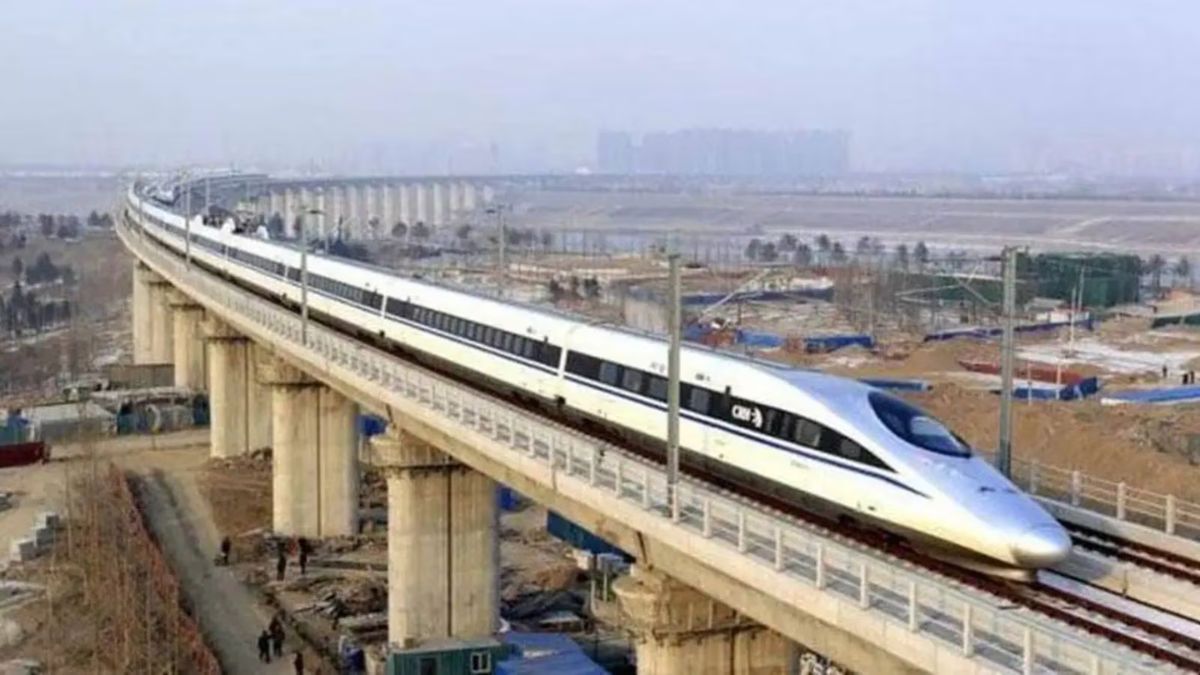
When it opens, the Mumbai-Ahmedabad corridor will cut a six-hour train journey to just over two hours. India’s first high-speed rail project has been in planning for years, but the construction activity is now visible across Gujarat, and Maharashtra makes it clear that it’s well beyond the planning stage. Recently, a 45-metre viaduct span has been successfully launched over Ahmedabad’s Kalupur Flyover.
Viaducts are rising over city flyovers, an undersea tunnel is being carved below Thane Creek, and station facades inspired by local architecture are beginning to take form. For the millions who travel between Mumbai and Ahmedabad each year, here is what the project means and where it stands.
Mumbai-Ahmedabad Bullet Train: The route and the promise
The Mumbai-Ahmedabad High Speed Rail corridor will stretch 508 kilometres, beginning at Bandra Kurla Complex in Mumbai and terminating at Sabarmati in Ahmedabad. Twelve stations are planned along the way, with stops at Thane, Virar, Boisar, Vapi, Bilimora, Surat, Bharuch, Vadodara and Anand, among others.
Trains will run at a top speed of 320 km/h. With limited stops at Surat, Vadodara and Ahmedabad, the full journey will take approximately two hours and seven minutes. The same trip today, by the fastest conventional train, takes over six hours.
Beyond the two anchor cities, the corridor is designed to serve industrial towns that currently have no airport connectivity, Boisar, Vapi, Bharuch and Anand among them. Boisar will also serve as a gateway to the upcoming Vadhvan Port, adding a logistics dimension to what is primarily seen as a passenger project.
Mumbai-Ahmedabad Bullet Train: Who is building it and what it costs
The project is being executed by the National High Speed Rail Corporation Limited, a special purpose vehicle incorporated in 2016 with equity held equally by the central government and the two state governments, 50% with the Ministry of Railways and 25% each with Gujarat and Maharashtra.
The estimated cost is Rs 1,08,000 crore, approximately $17 billion excluding taxes. Around 81% of that is being funded through a soft loan from the Japan International Cooperation Agency, with a repayment tenure of 50 years and a moratorium of 15 years. The financing arrangement has made the project viable at a scale that would otherwise be difficult to sustain.
All 1,390 hectares of land required for the corridor have been acquired.
Mumbai-Ahmedabad Bullet Train: How the track is being laid
About 90% of the alignment runs elevated, which reduces land conflict in urban and peri-urban stretches while keeping the corridor clear of road and rail crossings. The primary construction method is the Full Span Launching Method, a technique being used in India for the first time. NHSRCL says it is roughly ten times faster than conventional segmental viaduct construction. India is now among a small group of countries that have deployed and operationalised the technique.
The most recent illustration of progress came late last month, when a 45-metre, 1,200-tonne span was launched over the busy Kalupur flyover in Ahmedabad, one of 31 crossings the corridor navigates within that district alone. Work on 23 of those 31 crossings is already complete.
The corridor also involves 25 river bridges and 28 steel bridges spanning highways, irrigation canals and existing railway lines. The track itself uses the J-Slab ballastless system based on Japanese Shinkansen technology, another first for India, with fully mechanised installation using machines built to Japanese specifications.
Mumbai-Ahmedabad Bullet Train: The tunnel under the sea
The most technically ambitious element of the project is a 21-kilometre tunnel that begins near BKC and runs northward. Seven kilometres of it will pass beneath Thane Creek, making it India’s first undersea rail tunnel.
The tunnel will be bored using Tunnel Boring Machines with a cutter head diameter of 13.6 metres. The remaining stretch will use the New Austrian Tunnelling Method. A single tube, 13.1 metres in diameter, will carry both tracks.
Eight mountain tunnels are also being constructed, seven in Palghar district in Maharashtra and one in Gujarat’s Valsad district, using the same tunnelling method.
Mumbai-Ahmedabad Bullet Train: Stations built around the cities they serve
Rather than adopt a uniform architectural template, the project’s designers have attempted to root each station in the identity of its city. Surat, known as a diamond trading hub, has a station facade that incorporates diamond geometries in its elevation and ceiling.
Sabarmati’s design takes its reference from the river; wave forms run across the structure, alongside motifs drawn from the Ashoka Chakra.
Ahmedabad’s station draws on the jaali pattern of the Sidi Saiyyed mosque, one of the city’s most recognised architectural landmarks.
Inside, the passenger experience has been thought through with some care. Ticketing, security and other functions are arranged so that travellers complete them in motion, as they walk toward the platform. Waiting areas, business lounges, baggage lockers for day-trippers, nurseries, and facilities designed for differently-abled passengers are all part of the brief.
All 12 stations are being built to green building standards, incorporating rainwater harvesting, solar panels where feasible, and natural ventilation to reduce energy loads.
Four stations, Virar and Thane in Maharashtra, and Surat and Sabarmati in Gujarat, are being developed as model stations with direct input from Japanese urban planning experts. Transit Oriented Development schemes around these stations are being prepared by the respective state governments to encourage commercial and residential activity in the corridors that open up.
At Sabarmati, a multi-modal terminal is already functional, connecting the bullet train station to the city’s metro, BRTS and conventional rail network.
Mumbai-Ahmedabad Bullet Train: The safety architecture
The project is adopting three automated safety systems, each drawn from Japan’s Shinkansen network and adapted for the seismic and climatic conditions of western India.
Twenty-eight seismometers will be installed across the corridor, 22 along the alignment and six in inland areas identified as historically earthquake-prone, including Old Bhuj, Latur, Ratnagiri and Kheda. The system is designed to detect primary seismic waves before surface shaking begins, automatically cut traction power, and trigger emergency braking on any train within the affected zone.
Six rain gauge stations will be positioned near mountain tunnel portals, cuttings and slopes with landslide risk, particularly in the Thane and Palghar districts. They will feed hourly and 24-hour rainfall totals to the Operation Control Centre, which will use the data to adjust or suspend services based on pre-defined thresholds.
Fourteen anemometers will be placed at river crossings and coastal sections where wind concentrations are higher. Wind speeds between 72 and 130 km/h will require mandatory speed reductions. Above that, services can be halted. All three systems feed into a central Operation Control Centre that monitors the corridor in real time.
Mumbai-Ahmedabad Bullet Train: Where construction stands
Electrification work between Surat and Bilimora is underway, with steel masts for the overhead traction system going up along completed viaduct sections. Over 20,000 masts, between 9.5 and 14.5 metres in height, will be installed across the full corridor to support the 2×25 kV overhead system based on Shinkansen specifications. The masts are manufactured in India.
Rolling stock depots are under construction at three locations: Sabarmati, Surat and Thane. Twelve traction substations, two depot substations and 16 distribution substations are being built along the alignment to meet the corridor’s power requirements.