



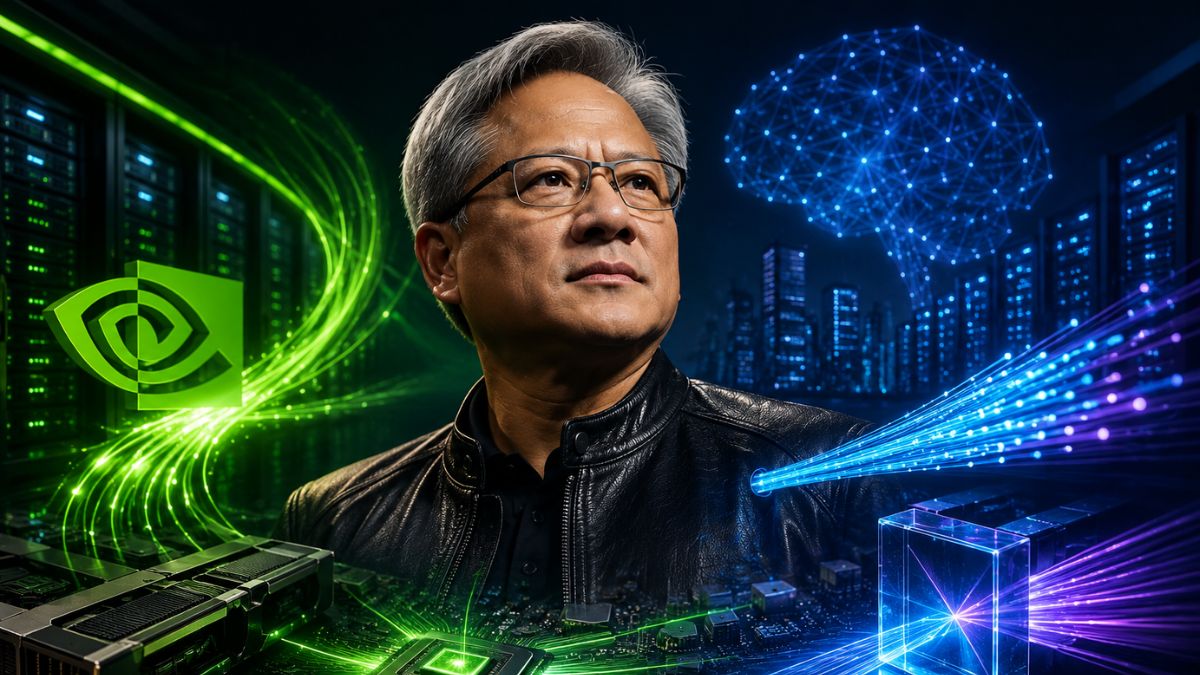
As artificial intelligence grows bigger and more powerful, one problem is becoming impossible to ignore that is energy. Training and running advanced AI models requires massive amounts of data to move constantly between chips, servers and data centres.
Today, most of that data travels through electrical signals and copper connections. But as AI systems scale up, experts say this approach could soon become a major bottleneck. That is why chip giant Nvidia is pouring billions of dollars into a technology many believe could redefine the future of AI infrastructure: photonics.
Nvidia’s $6.5 billion push
In just the past three months, Nvidia has committed at least $6.5 billion to companies developing photonics technology. The company announced investments worth $2 billion in optical technology firms including Lumentum, Coherent, Marvell to develop advanced optical connectivity solutions and participated in optics startup Ayar Labs $500 million Series E funding round. The investments show Nvidia’s belief that photonics could become a critical piece of the AI ecosystem in the coming years.
What is photonics?
Simply put, photonics uses light instead of electricity to transmit and process information. The technology involves generating, controlling and detecting photons that is particles of light to move data. Since light travels significantly faster than electrical signals and produces less heat, it offers a way to transfer huge amounts of information more efficiently. Photonics already powers many everyday technologies, from fiber-optic internet and smartphone cameras to medical imaging systems, laser surgery, solar panels and LIDAR sensors used in autonomous vehicles.
Why AI needs it
The AI boom has created an unprecedented demand for computing power. Modern AI systems rely on thousands and increasingly millions of GPUs working together. Moving data between these processors quickly and efficiently is becoming just as important as making the processors themselves more powerful. Photonics gives a potential solution by using light to move data between GPUs, memory systems, networking chips, servers and entire data centres. This could reduce energy consumption while dramatically increasing data transfer speeds.
“Photonics represents a way for Nvidia to scale their AI infrastructure without the energy costs that staying with electrical and copper will incur,” Alvin Nguyen, senior analyst at Forrester, told CNBC. “By investing in photonics companies, Nvidia is making sure that advancements in photonics continue and it will prevent them from hitting a scalability and performance wall that will occur if they remain on electrical and copper.”
Preparing for the next wave of AI
Industry experts believe optical connectivity will become increasingly important as AI models become larger and more widely used. “Nvidia’s roadmap of next generation AI rack-scale solutions will require an increasing amount of optical connectivity to process the exponentially rising bandwidth with new models and higher usage,” Brian Colello, senior equity analyst at Morningstar, told CNBC.
Nvidia has already begun integrating photonics into its networking products. At the company’s GTC conference in March, CEO Jensen Huang spoke about the growing role of silicon photonics in Nvidia’s future plans. “When you look upstream, you come to the conclusion that we’re starting to scale our silicon photonics technology,” Huang said. He added that Nvidia was also bringing photonics into its GPU-to-GPU interconnect technologies. “Which means the amount of silicon photonics technology capacity that we need is substantially higher than the world has today.”
Not just Nvidia
Nvidia is not the only company betting on light-powered computing. Chipmaker AMD participated in the Ayar Labs funding round and has previously acquired photonics startup Enosemi while investing in companies such as Teramount and Celestial AI. Venture arms of Alphabet and Microsoft have also backed photonics startup nEye. The growing list of investors suggests that the technology is increasingly being viewed as a key enabler for the next phase of AI development.
The challenge ahead
Despite the excitement, experts caution that photonics is still in its early stages. The biggest hurdle is not whether the technology works, but whether it can be manufactured at scale. “The technology is sound, production scale is the harder problem,” Nick Patience, AI lead at the Futurum Group, told CNBC.
“Manufacturing yield on complex co-packaged optical assemblies remains a challenge because precise alignment of optical and silicon components is unforgiving, and when something goes wrong in the packaging process, the assembly typically can’t be reworked.” Because of these manufacturing challenges, large-scale adoption may still be a few years away. “So the transition is underway, but it’s still early,” Patience told CNBC. “I would expect us to see large-scale adoption from 2028 onwards.” For Nvidia, the photonics push is about more than just faster data transfer. It is about ensuring that AI can continue to grow without being constrained by rising energy consumption and infrastructure limitations.