



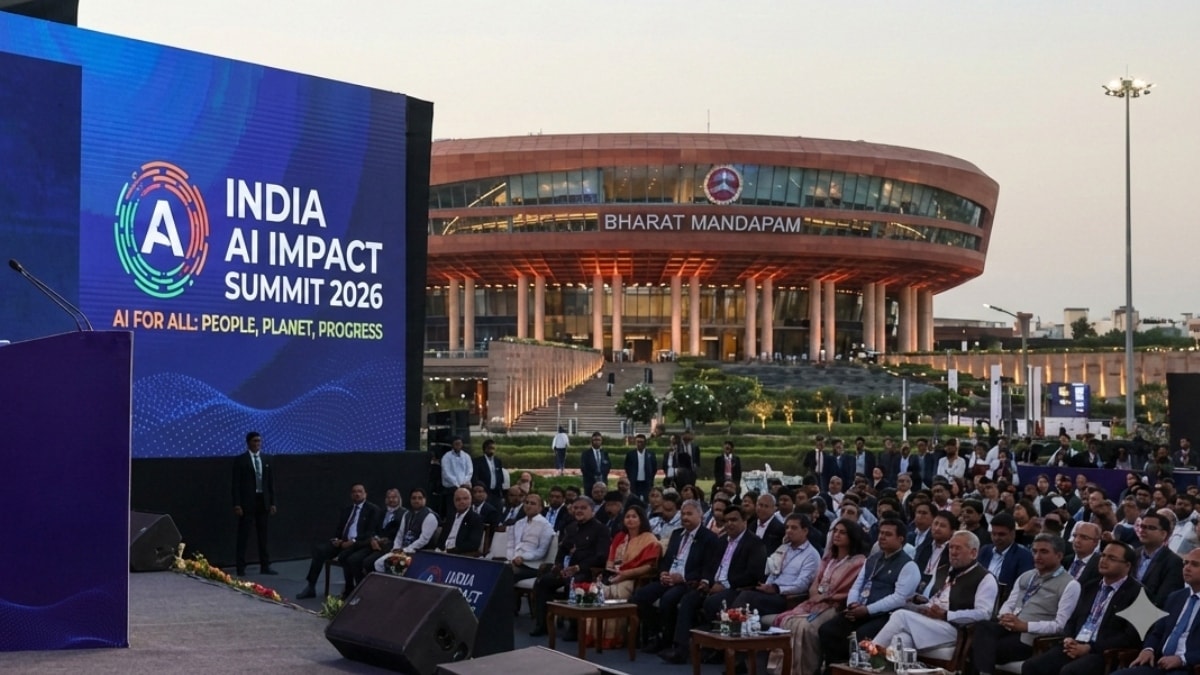
New Delhi woke up to billboards, barricades and buzz on Monday as the India AI Impact Summit 2026 opened at Bharat Mandapam — billed as the world’s largest artificial intelligence gathering — drawing packed halls, long queues and an unmistakable signal: India wants to sit at the head table of the global AI order.
By 9.30 am, lines had already begun snaking outside session halls. Delegates — policymakers, founders, engineers, investors and students — jostled to enter auditoriums that filled up quickly, forcing organisers to shut doors once capacity was reached. “You have to be there well in advance,” one participant said. “This isn’t a summit where you can float from session to session.”
Inside, the scale was hard to miss. Over five days, the summit is slated to host more than 3,000 speakers across 500-plus sessions, alongside a sprawling expo featuring over 300 exhibitions and 13 country pavilions. Tech majors including Google, Microsoft, Amazon, Meta, OpenAI and Nvidia showcased their latest AI deployments — from enterprise copilots to sovereign compute stacks.
Alongside serious policy discussions, the event features cutting-edge, dancing humanoid robots, highlighting advancements in robotics, AI-driven entertainment, and “Make in India” innovations.
Yet, as Delhi attempts to script its AI moment, a parallel conversation has unfolded online. Attendees took to X to flag overcrowding, patchy connectivity and restricted movement inside the venue. Some questioned whether a summit celebrating cutting-edge artificial intelligence should struggle with basic digital logistics. Others remarked — half in jest — that beyond branding and LED walls, visible AI integration in the public-facing experience was limited.
Organisers, for their part, said registrations exceeded expectations, reflecting surging interest in AI skilling, governance, infrastructure and generative deployment. On the ground, despite logistical hiccups, sessions ran largely on schedule and halls remained full — often to standing-room-only capacity.
If anything, the crush of people underlined the urgency of the subject. Panels on employability in the age of automation, safe AI at scale, public-sector deployment and sovereign compute drew intense engagement. In corridors between sessions, founders debated regulation, bureaucrats discussed procurement frameworks, and venture capitalists hunted for the next breakout model-layer start-up.
The heavyweights, however, are yet to take the stage. Sundar Pichai, Sam Altman, Dario Amodei and Demis Hassabis are scheduled to speak later in the week, alongside world leaders. Their presence underscores the summit’s ambition: to frame AI not merely as a technology race, but as a geopolitical and developmental inflection point.
Prime Minister Narendra Modi, in the run-up to the summit, pitched India as ready to host the world’s data and lead the next wave of digital transformation. The government’s own Economic Survey has argued for “application-led innovation” rather than chasing frontier-scale mega-models — a tacit acknowledgement that while India has yet to produce a globally dominant foundational AI model, it may well dominate in deployment.
The numbers offer some backing. India has emerged as one of the largest user markets for generative AI tools, and global tech firms have pledged tens of billions of dollars in AI and cloud infrastructure investments in the country through 2030. Data centres are rising, semiconductor ambitions are sharpening, and enterprise adoption is accelerating across banking, retail, governance and healthcare.
The summit also unfolds against a more complicated backdrop. India’s $283-billion IT services industry faces mounting disruption from AI-led automation, with some analysts warning of revenue pressures in traditional outsourcing segments over the coming decade. The same technology that promises productivity gains and global leadership could unsettle millions of white-collar jobs.
That tension — between opportunity and displacement — hovers over the conference halls. India’s strategy appears clear: lean into scale, talent and digital public infrastructure; democratise access rather than monopolise models; and shape global norms before they are shaped without it.
For five days, Delhi will be the epicentre of that conversation. The optics are grand, the attendance formidable, the ambition unmistakable. Whether the summit ultimately marks India’s decisive leap into AI leadership — or merely a high-decibel declaration of intent — will depend not on packed halls, but on what follows after the banners come down.