



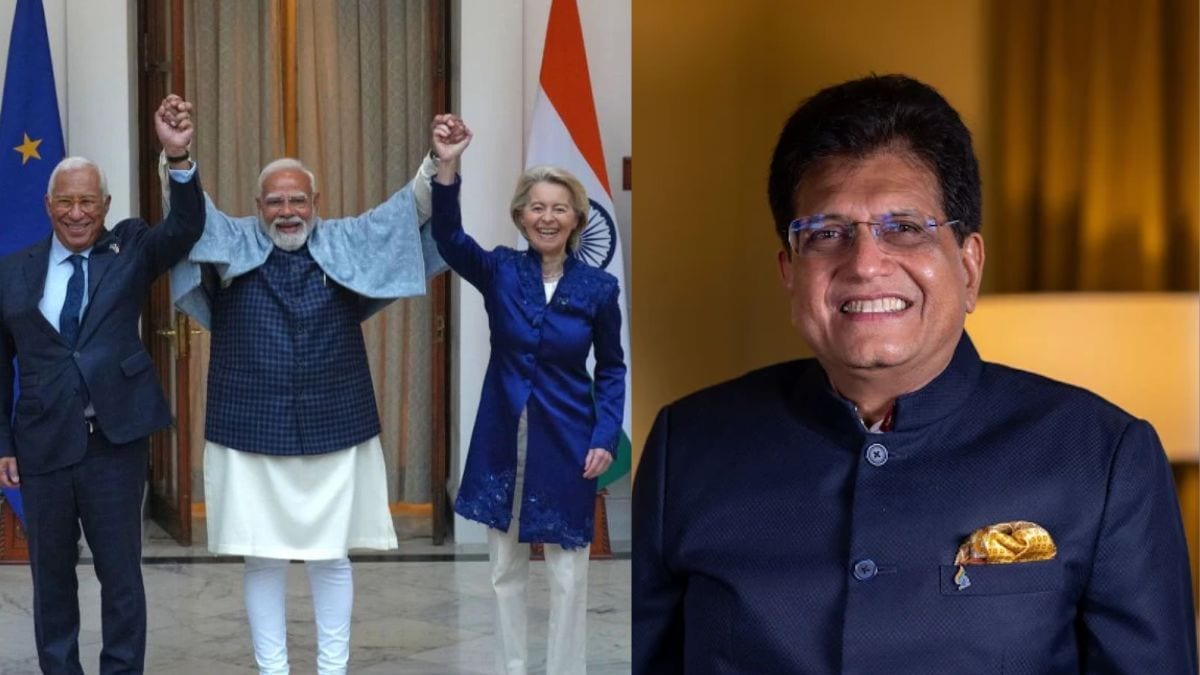
India and the European Union (EU) on Tuesday signed a Free Trade Agreement (FTA) that provides preferential access to each other’s markets by eliminating tariffs on most of their trade items. To get the benefits flowing sooner they are aiming to get it operational by this calendar year itself by fast tracking the processes involved. .
“It (the FTA) will be taken up for legal scrubbing on a fast track basis. This was discussed today. The FTA will be translated into 24 languages simultaneously. We do hope that we see the entry into force of this agreement within calendar 2026,” commerce and industry minister Piyush Goyal told reporters.
The agreement was signed by Goyal and the EU’s Commissioner for Trade and Economic Security Maros Sefcovic. After the legal text is signed it will have to be ratified by both sides.
India has secured market access for more than 99% of Indian exports by trade value to the EU. Beyond goods, it unlocks high-value commitments in services complemented by a comprehensive mobility framework enabling seamless movement of skilled Indian professionals.
Overall, India is offering 92.1% of its tariff lines which covers 97.5% of the EU exports.
Immediately on entry into force of the agreement EU will bring down duties on 70.4% tariff lines covering 90.7% of India’s exports. This includes labour-intensive sectors such as textiles, leather and footwear, tea, coffee, spices, sports goods, toys, gems and jewellery and certain marine products.
Around 20.3% tariff lines covering 2.9% of India’s exports will have zero duty access over 3 and 5 years for certain marine products, processed food items, arms and ammunition, amongst others. Remaining 6.1% tariff lines covering 6% of India’s exports will have preferential access by way of tariff reduction and no zero duties.
Products covered would include certain poultry products, preserved vegetables, bakery amongst others. For cars, steel and certain shrimps and prawns products the quotas would apply for export on lower duties.
India will reduce duties to zero on 49.6% of tariff lines immediately on the FTA coming into force. This would include chemicals, some machinery and textiles and apparel.
Around 39.5% of tariff lines are subject to phased elimination over 5, 7, and 10 years and 3% of products are under phased tariff reductions. Few products are subject to quotas for apples, pears, peaches, kiwi fruit.
Global Economic Impact
.The FTA creates a market of 1.9 billion people that accounts for 25% of the world’s economic output and 33% of trade, Prime Minister Narendra Modi said.
The large swathes of agriculture and dairy have been kept out of the agreement. In automobiles and wines from the EU a separate mechanism of quotas, gradual reduction in duties and minimum import price have been put in place.
India will immediately reduce duties on cars from the EU to 30-35% from 66-110% currently. These rates will be available for a fixed number of units and cars above 15,000 euros. These duties will be brought down to 10% gradually and the quota will reach 2,50,000 units. The electric vehicles will be out of this opening up in the first five years of the agreement.
For every quota of 100 cars, the EU will provide a quota of 250 cars to India allowing their imports into the customs union at lower duties.
On wines also duties cuts will be linked to the value of the product. For wines below a certain level there will be no duty cuts. Wines priced in the middle range and higher get higher duty cuts.
Under the pact, the duty for EU wines would come down from 150 per cent to 20 per cent (for expensive ones). Wines below 2.5 euros, there will be no duty concessions.
Indian wines too will get duty concessions in the EU member countries. On premium wines India will reduce the duty to 20% and for medium wines to 30% from 150%, On spirits the duty will come down to 40% from 150% and on beer to 50% from 110%.
On olive oils, margarine and other vegetable oils India will reduce to zero from 45%.
On processed food (breads, pastries, biscuits, pasta, chocolate, pet food) the duty will reduce to zero from 50%. These cuts will be delivered in phases.
India has also received quota based duty reduction for table grapes in the EU. The EU imports about $1.4 billion worth of tabbed grapes annually. “We have got duty free access for around $ 100 million, that is 85,000 tons of grapes. India can export at MFN (existing duty) rates also,” the official said. The deal also covers duty concessions for EU whiskies.
The agreement leaves out duty cuts on steel and quotas for exports are being worked out by the EU with all countries which have an interest in exporting that commodity to the 27-member bloc.
The EU is currently transitioning to a new, more restrictive steel trade regime designed to replace existing safeguards. The primary regulation governing this shift is a new Steel Overcapacity Regulation, which was formally proposed in October 2025 and is scheduled to take effect on July 1, 2026.
Carbon Taxation Framework
On Carbon Border Adjustment Mechanism (CBAM) the EU has offered to concession to India stating that this applies to their domestic producers also. This will result in taxation for excess carbon emission on goods covered by CBAM. Currently only seven products like iron and steel, aluminium, fertilizers, electricity and cement are covered by the mechanism.
However, if in future if the EU relaxes CBAM provisions for any country then India will automatically qualify for such concessions, commerce secretary Rajesh Agrawal said..
In services the FTA opens 144 of the 155 subsectors including IT/ITeS, professional services, education, and other business services. India’s offer on 102 subsectors covers EU priorities such as professional, business, telecommunications, maritime, financial, and environmental services. India has also received some commitments on student mobility and post-study work permits.
Apart from FTA, India and EU are also negotiating agreements on investment and geographical indications. These are being discussed separately. India and EU restarted negotiations on their FTA in July 2202 after the earlier attempt was abandoned in 2013.
It took 14 formal rounds of talks and numerous high-level discussions to get the deal finalised. The agreement now has 21 chapters, down from 23 at the start. “Some chapters have been merged at the end,” officials said.
The EU is India’s biggest trading partner with bilateral goods trade at $ 136 billion and services trade at $ 80-85 billion. India’s goods exports to the bloc stood at $ 75 billion in 2024-25 while imports were at $ 61 billion. India’s services exports to the EU were around $ 43 billion while imports were $ 34 billion in 2024.