



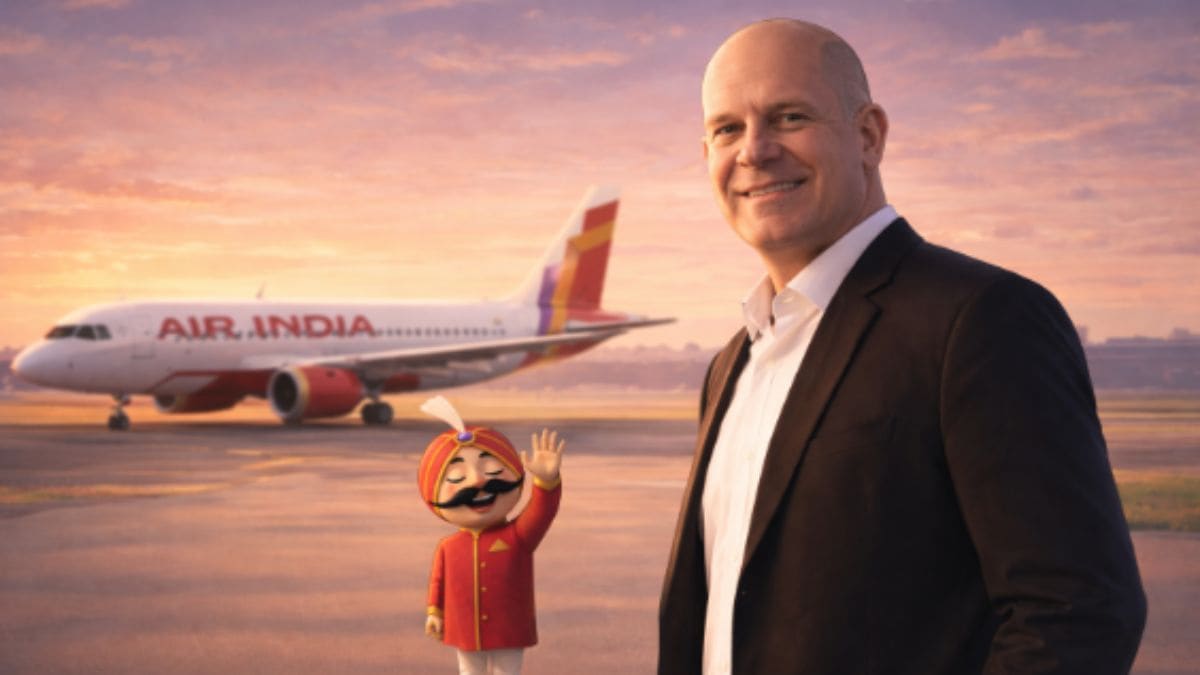
When Campbell Wilson landed in Delhi in July 2022 to take charge of Air India, he was, by his own account, not the first person the Tata Group had called. The job had initially been offered to a former chairman of Turkish Airlines, who withdrew after public and government objections about his nationality and political ties. Ratan Tata then turned to Singapore Airlines, an old partner of the Tatas, who pointed him towards Wilson with their full backing.
Wilson was 51, a New Zealander from Christchurch who had spent the entirety of his professional life with the Singapore Airlines group.
From Scoot to Air India
He had a Master of Commerce with first-class honours from the University of Canterbury, and colleagues over three decades had described him as punctilious and genial.
He had opened Scoot, Singapore Airlines‘ low-cost carrier, from scratch in 2011 and led it to becoming profitable before returning to SIA as Senior Vice President of Sales and Marketing. In April 2020, as the pandemic led to a near collapse of global aviation, Campbell went back to Scoot for a second stint to do what he earned recognition for – to steer the low-cost carrier through the wreckage, as per media reports.
Navigating Air India: Campbell takes the controls
Come 2022, Wilson Campbell officially took charge of Air India on July 25, 2022.
Wilson’s first formal act was to lay out a five-year transformation roadmap he called Vihaan.AI, an initiative aimed at making Air India a world-class global airline with what he described as an “Indian heart.” This is as per the Air India press releases dated September 15, 2022, just two months after Wilson joined Air India.
The Air India transformation: 600 aircraft, 4 mergers, and a Rs 9,800 crore loss
Over the four years from 2022 to 2025, Wilson oversaw the merger of four separate airlines: Air India, Vistara, Air India Express, and AIX Connect, formerly AirAsia India. The result was a two-carrier structure, one full-service and one low-cost. In one of his media interviews, he described it as “hugely complex.” Each carrier had its own labour agreements, IT systems, route networks, and cultures.
Alongside the merger, Air India placed an order for nearly 600 new aircraft, a figure that set a world record at the time. More than 100 planes were inducted into the fleet during Wilson’s tenure, the company stated in a press release dated April 7, 2026. He broke ground on South Asia’s largest aviation training academy, added two flight simulator facilities, launched a flying school, and initiated a greenfield maintenance, repair, and overhaul base. The full interior refit of the airline’s legacy narrow-body fleet was all but completed before he left, the company mentioned in a statement.
Wilson’s tenure rarely had clear skies. At home, the airline faced a series of regulatory penalties. In January 2023, the Directorate General of Civil Aviation fined Air India Rs 30 lakhs for mishandling unruly passenger incidents on flights from New York and Paris, an episode that became widely known as “pee-gate.” In March 2024, the regulator fined the airline Rs 8 million for failing to provide adequate rest for pilots on ultra-long-haul routes.
After the Pehelgam incident and its retaliation, Pakistan’s closure of its airspace for Indian carriers forced Air India’s planes onto longer, fuel-intensive detours, generating an estimated $600 million in additional costs by mid-2025, according to a report by Reuters. Wilson was compelled to seek government assistance to help absorb the hit, as per the Reuters report.
And then, on June 12, 2025, Wilson was accosted by one of the most challenging moments of his professional life.
Air India’s London-bound Boeing 787-8 Dreamliner – Flight AI-171 crashed just minutes after taking off from Ahmedabad, killing 241 passengers and crew onboard. The tragedy put Air India under intense regulatory scrutiny and drew personal show-cause notices for Wilson from the DGCA.
What he built and what it cost
The financial results during Wilson’s tenure were mixed. Net Promoter Scores, which measure customer satisfaction, moved from negative territory to above +50, Willson said in an interview with Times Network.
On-Time Performance reached record highs following the completion of the mergers. But the airline recorded losses of over Rs 9,800 crore in the financial year 2024-25, according to the Indian Express. The combination of integration costs, fleet expansion, airspace detours, and post-crash remediation kept Air India deep in the red, the IE report added.
The war in West Asia between Iran and Israel disrupted routes and drove up fuel costs. Global supply chain constraints meant that new aircraft and spare parts arrived more slowly than planned.
The Wilson touch to the Air India story
Wilson had also managed to put his personal stamp on the airline beyond the operational metrics. He embraced Indian culture in ways his colleagues noted and appreciated. According to his interviews, he travelled frequently to South Goa and Kerala with his wife, and professed a fondness for Kolkata. He ate masala dosa every Saturday morning and developed a weakness for butter chicken, a predilection he acknowledged with some self-deprecation. One of the first Indian concepts he learnt was “jugaad,” the art of the improvised fix, he recalled in the same Times Network interview.
The exit
According to the company’s statement, Wilson had signalled his intention to step down to Tata Sons chairman N. Chandrasekaran as early as 2024. His formal resignation came in April 2026. In the internal letter he sent to Air India staff, he pointed to the completion of the foundational work, the mergers done, the culture shifted, the new systems in place, as the reason his departure made sense now, before the next major wave of aircraft deliveries was set to begin in 2027.
“Together, we have accomplished much. I am incredibly proud of what you have achieved, especially in the face of unprecedented headwinds.” Wilson said in his farewell letter.
He signed off with the phrase “Jai Hind” and said he would remain in place until a successor was found to ensure a smooth transition.
At 54, Wilson’s journey already feels like a full arc. From founding an airline, steering another through a pandemic, and spending four intense years at the heart of one of aviation’s most ambitious turnarounds. Whether that succeeds will be a story for another day.
For now, Au Revoir!
Blue Skies and Tailwinds.
Disclaimer: This profile of Campbell Wilson’s tenure at Air India is provided for general informational and historical purposes only. While it discusses corporate performance, financial losses, and fleet expansion, the details do not constitute financial advice or an endorsement of any investment strategy. Readers are advised to verify sensitive data, such as crash reports or regulatory actions, through official government or corporate channels as the story develops.
This disclaimer has been generated using AI to support user well-being and responsible content consumption.