



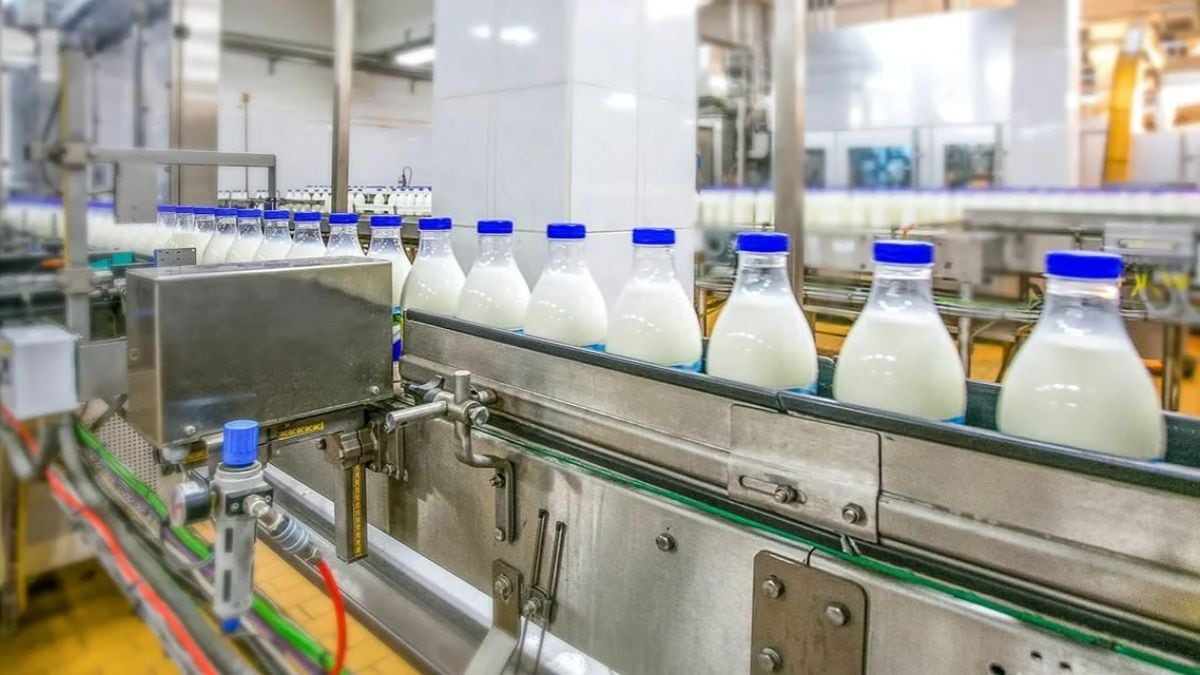
The West Asia conflict is squeezing India’s dairy sector from multiple directions at once, driving up packaging input costs, shrinking demand from HoReCa (hotels, restaurants and caterers) especially in tier-2+ cities, and triggering a migrant labour shortage at dairy factories, according to multiple industry executives FE spoke to.
The reason the sector is acutely vulnerable is structural. Roughly 70% of every rupee spent on a dairy product goes directly to the farmer as milk procurement cost. Companies make their margins in the remaining 25-30%, which must cover packaging, logistics, processing, labour, and overheads. The conflict is now inflating costs across every component within that band.
“For ease of math, if the landing cost at the factory is Rs 50, the farmer gets Rs 44-44.50, and Rs 5.50 manages landing logistics and chilling. My margin is embedded in the remaining 25-30%, and every component within that — packaging, onward logistics, labour — is going up,” said Ranjith Mukundan, CEO and co-founder of Stellapps Technologies, whose subsidiary mooMark both sells dairy products directly to HoReCa clients and contract-manufactures for brands including HUL, ITC, and ID Fresh.
“Milk is one of those few agri products where more than 70% of the landing cost flows back to the farmer. If you look at horticulture, pulses, grains, around 20% flows back.” Mukundan estimated that over the past month the company has taken a 15% negative margin impact and expects at least a 20% hit on revenue.
What did Dr K Rathnam say?
At Milky Mist, CEO Dr K Rathnam described it as a “definite dent on margins” and said the company is “holding on” through operational measures, optimising plant running hours and pushing logistics utilisation to full capacity. “We are making use of logistics 100% instead of capacity utilisation of 80-90%. Similarly, we run the plant to full capacity and then stop for a couple of days so that we are able to reduce the overhead expenses,” he said.
A significant share of that pressure is coming from packaging. Dairy packaging materials — manufactured from petroleum-derivative inputs such as plastic pellets, polymers, and naphtha — typically account for about 5% of a dairy product’s total cost. But in Rs 10-20 packs of flavoured milk, lassi, and curd, packaging can be 20-30% of product cost, Ananda Dairy chairman Dr Radhey Shyam Dixit said, making even modest input cost increases material on margins.
Cost of polymer-based packaging
Cost of polymer-based packaging like pouches, dahi cups, PET bottles has risen about 47% through March, according to Dixit. Lubricants and chemicals used in packaging production are up about 23%, he added. Metal barrels and tin cans used for ghee and anhydrous milk fat exports are also up 35-40%, said Nova Dairy director Ravin Saluja.
Plastics, films, laminates, and aluminium have climbed 15-25%, said Rathnam. Glass, which relies on LPG directly in its manufacturing, is also up about 45%, according to Mukundan.
Beyond cost, lead times to procure packaging material from suppliers have also more than doubled, and some packaging vendors have issued standing instructions refusing new orders until pricing stabilises. “I’m not getting access to plastics,” is what Mukundan said suppliers keep telling him, as they are running down old inventory with “no clarity” on when new stock will arrive.
The supply tightness is rippling into how companies plan procurement. As a contract manufacturer, mooMark’s packaging inventory cycles are driven by what clients commit to. That cycle is now stretching sharply. “What used to be 45 days to two months, because clients wanted to do just in time, now it’s increasing a minimum of 90 days and going up to 120-150 days,” Mukundan said, adding that larger clients are “aggressively doubling up” on commitments to secure supply.
Some suppliers are also engaging in profiteering. Akshayakalpa founder Shashi Kumar said some of his packaging vendors have cited hikes they could not substantiate when challenged. “People are trying to take advantage of this situation,” he said.
These input costs are climbing while demand is falling simultaneously. Demand from hotels, restaurants, and caterers has contracted sharply. Smaller establishments in tier 2-3 cities — dhabas, local eateries, small cafes — depend almost entirely on commercial LPG cylinders and lack piped gas infrastructure.
Mukundan said mooMark’s HoReCa sales through these channels have fallen more than 50% between end-February and end-March. “We’ve never from our past seen a dip during this phase,” he said, adding that the January-June period is typically amongst the strongest for dairy demand. In tier 2-3 and rural markets, caterers service weddings and large events by travelling with commercial LPG cylinders. Without reliable supply of LPG, that business has dropped off completely.
“The larger restaurants are still operating. The Oberois, the Leelas, the Lalit Ashoks, as they have direct pipe connections. But demand from the smaller ones in tier 2-3 is down by more than 50%,” Mukundan said. Dixit said Ananda has seen a 20-25% sales impact across milk, paneer, and curd.
Saluja said about 10% of Nova’s overall volumes, which accounts for milk powders, ghee, and anhydrous milk fat sold to bakeries, caterers and wedding operators, have come to a “complete halt.”
The same demand contraction that is hurting dairy companies is also being felt at the farmgate. Input costs for dairy farmers — feed, fodder, silage — are rising. But because HoReCa demand has dropped, procurement prices are flat and in some pockets have fallen. “It’s a double whammy for the farmers, because their input prices are going up and procurement prices are not,” Mukundan said.
Adding to the pressure, migrant workers who went home for Holi and Eid have not returned in adequate numbers. With LPG unavailable for cooking, many are choosing to stay. “A lot of our labour force come from UP and Bihar. They hear that the local hotels are not giving food.
They feel it’s better off to stay at home, at least you can use your firewood,” Mukundan said. Companies are trying to bring them back. “There is a lingering trauma of Covid-19. We are telling them, we will arrange for your gas cylinders, residence here locally, so that you don’t have to commute,” he said. “If you ask me to pick one aspect that has impacted badly, that would be labour. All these additional measures also cost us money.”
Dairy processing itself runs on steam from briquette-fired boilers, not LPG, limiting direct exposure to gas shortages. The more direct energy vulnerability is diesel, which powers refrigerated transport and backup electricity. “Our diesel generator dependency is close to 5-10%, because 60% of our power requirements are met by solar.
But when the grid power is not consistent, the generators run on diesel, and diesel price going up will have an impact,” Kumar said. “If there is uninterrupted supply of diesel and petrol for logistics and power backup, the industry would not suffer,” Rathnam added.
Dairy companies are for now absorbing costs without passing them to consumers. But if the pressure persists, consumer-facing price increases are likely within three to four weeks, industry executives added. “We will begin to see some measures being taken. On a 200g paneer pack that can be sold anywhere between Rs 70 to 80, my sense is a 4-5% price increase. The seasonal products like dahi, lassi, buttermilk might see a 7-9% increase,” Mukundan said.