



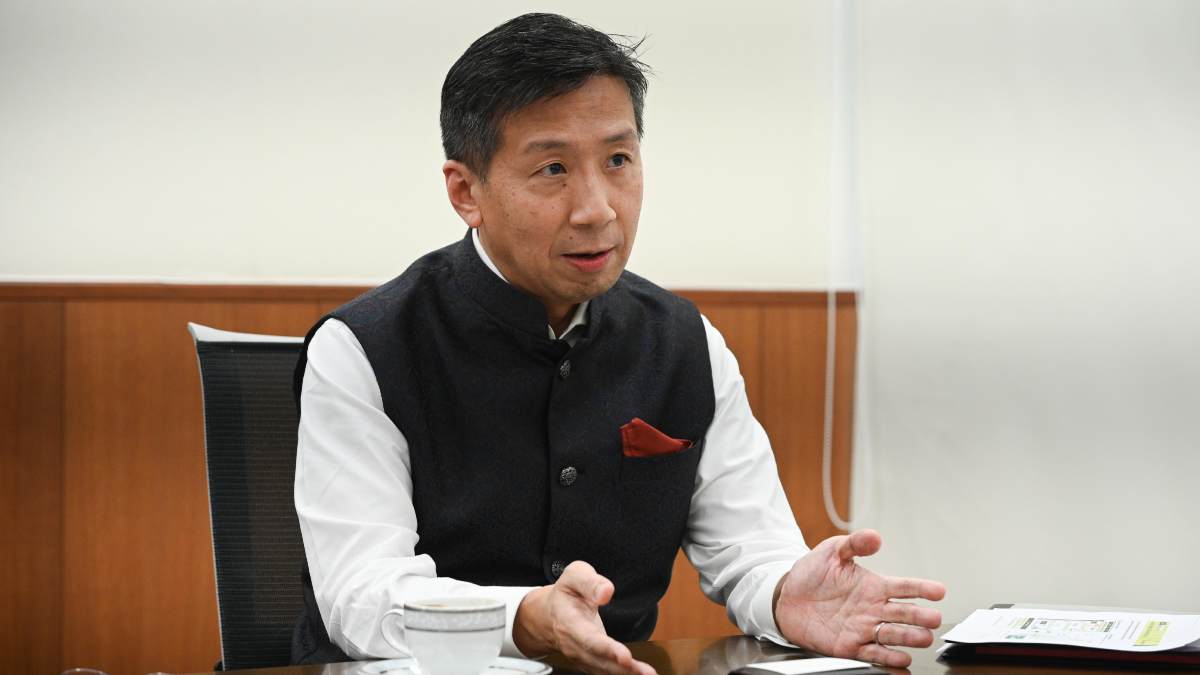
SMBC sees India as its most critical Asian market having committed $7 billion to the country and elevated it to a single country global division. Hiroyuki Mesaki, CEO, SMBC India, tells Mahesh Nayak that there are clear synergies between SMBC and Yes Bank in spaces like corporate banking and employee banking. Excerpts:
SMBC is expanding in India at a time when several foreign banks are consolidating or slowing down. How are you different from your competitors?
Many European banks have been in India for over a century, but SMBC’s roots too are deep here. Our ancestors were in Mumbai in 1916. Our current banking operations began in 2013 and we have built an onshore balance sheet of over $ 5 billion, with more than $ 3 billion in loans.
Our differentiation comes from our global strength. As a Global Systemically Important Bank (GSIB), we offer a vast global branch network, strong cross-border capabilities, support for capital injections, forex, trade, ECBs, and structured solutions, and the ability to serve Japanese, Indian, Korean, American, European, and other Asian corporates. SMBC, leveraging its global franchise, strongly supports broader partnerships.
What makes India such an important market for SMBC?
India is one of the most important countries for the SMBC Group. I was part of the founding team in 2012-15. When I returned in 2023, the change was significant and eye-opening. The biggest change has been execution speed and policy consistency. Predictability, in policy and economic measures, is crucial for bankers, and India now offers that. Also, India is a young, digitally-savvy population. These factors make India a long-term strategic priority.
What is SMBC Group’s broader strategy for Asia, and where does India fit in?
SMBC follows a multi-franchise strategy in Asia, focusing on four high-growth markets—India, Indonesia, Vietnam and the Philippines. Among these, India is the most focal market. Our presence spans from SMBC India, focusing on wholesale banking, SMFG India Credit – NBFC, including its 24.9% stake in YES Bank, which is present in retail, SME and wholesale banking.
Our aim is to contribute across wholesale, MSME, and retail, using all three channels.
Why did SMBC carve out India as an independent regional division under the Global Banking Unit?
Until last year, India was part of the APAC division. Starting FY25-26, Tokyo carved out India as a separate regional division, alongside America (US, Canada & South America), EMEA (Europe, Middle East & Africa) and APAC (Asia Pacific).
India is the only single-country division; this is unique, as it reflects India’s scale and growth potential. When it is a separate business, decision-making is faster.
SMBC has received in-principle approval to become a wholly owned subsidiary (WOS). What is the vision behind this move?
Becoming a WOS demonstrates a strong, long-term commitment to India. It allows stronger local governance, greater flexibility, scalability and alignment with global compliance standards.
Will SMBC India and Yes Bank eventually merge? Or will they operate separately?
They will operate as separate legal and regulated entities. We are the largest shareholder in Yes Bank, but not a promoter. Collaboration will continue, but within regulatory boundaries.
What kind of synergies do you foresee between SMBC India and Yes Bank?
Two clear synergy areas are corporate and employee banking. SMBC serves large corporates. If a client wants employee banking or retail benefits for thousands of workers, SMBC can’t offer that—but Yes Bank can. If a client says it has 1,000 workers, SMBC India can’t provide those retail services, whereas Yes Bank can.
Also, global clients often ask us to introduce them to reliable Indian partners. SMBC’s portfolio is top-tier conglomerates; Yes Bank can introduce strong mid-tier partners, subject to compliance.
Once you become a WOS, will SMBC enter retail banking directly?
Not at this stage. For now, we are focusing on wholesale… retail requires a huge, customer-centric architecture. Retail will continue through Yes Bank and SMFG India Credit.
How much has SMBC invested in India so far?
The total group investment in India is close to $7 billion, including the SMFG India Credit, the Yes Bank stake and capital infusion into SMBC India. SMBC India’s capital injection from Tokyo is over $1 billion.
How big is the wholesale loan book?
Our combined wholesale exposure is over $10 billion. Onshore advances are about $3.1 billion, the GIFT City branch is over $5 billion, and our Singapore book for Indian clients is over $2 billion.
How fast will this book grow over the next five years?
Demand is enormous, but growth won’t be linear. We must balance client needs with investor expectations and RoE improvement. We are accelerating asset recycling rather than simply expanding the balance sheet.
Do you engage in trading activities in India?
Yes, but our trading is client-driven, not proprietary. Some foreign banks hold large G-Secs for trading; we focus on supporting client needs.
Do you see India as part of a “China+1” strategy?
I prefer not to frame it that way. India has its own unique direction. It is not ‘next China’—it is India.
Which sectors are most promising for SMBC in India?
For us, these are clean energy and renewable—not just generation but the entire value chain, data centres — AI growth is driving massive demand, automotive—a long-standing bedrock sector, and semiconductors.