



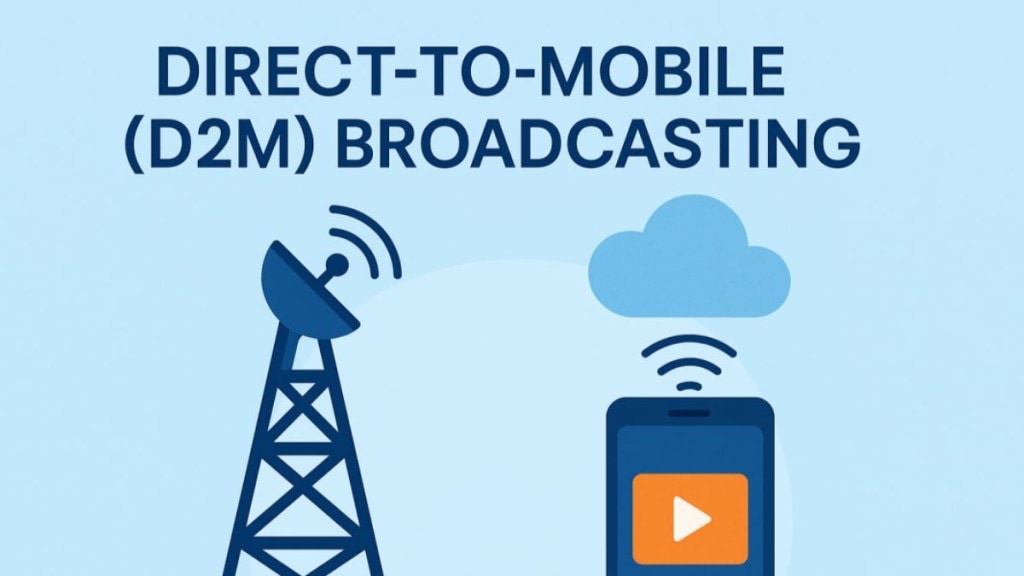
As the government inches closer in its push towards Direct-to-Mobile (D2M) broadcasting, the telecom industry has raised concerns over the manner in which the technical tests for the technology are being conducted, warning that there are gaps in testing and stakeholder participation which could have long-term implications for spectrum usage and network planning.
The Cellular Operators Association of India (COAI), representing telecom operators like Bharti Airtel, Jio and Vodafone Idea said that a non-inclusive and incomplete technical evaluation of D2M broadcasting has happened. The industry body argued that recent trials were conducted without the participation of telcos and key device ecosystem players, despite the technology having direct implications for existing and future mobile networks.
What did Lt. Gen. Dr. S.P. Kochhar say?
“Direct-to-Mobile broadcasting has far-reaching implications for spectrum, networks, devices and consumer safety. Any national-level technical evaluation of such a technology must be transparent, inclusive and technology-neutral, with active participation of all affected stakeholders,” Lt. Gen. Dr. S.P. Kochhar, Director General, COAI, said.
The concerns come even as companies such as Tejas Networks, part of the Tata Group, are pushing ahead with broadcast-to-mobile solutions aimed at easing network congestion and expanding access to digital content. Tejas Networks is advancing its Broadcast Radio Head (BRH) technology, which is designed to deliver live video and broadcast content directly to mobile devices without relying on mobile broadband or Wi-Fi networks.
How does D2M tech work?
At its core, D2M technology works on the principle of broadcasting rather than individual data streaming. Instead of each user consuming mobile data separately, the same signal is transmitted simultaneously to multiple devices, enabling live TV, video and audio content to be received directly on phones without an internet connection.
By leveraging broadcast spectrum held by Prasar Bharati, the BRH system can reach “dark homes”—households without broadband subscriptions as well as feature phone users, extending video and broadcast services to segments traditionally beyond the reach of mobile broadband. “By leveraging this spectrum, BRH could serve dark homes, households without broadband subscriptions and feature phone users, bringing video and broadcast content to segments traditionally unreachable by mobile broadband,” Parag Naik, executive vice-president at Tejas Networks said.
However, COAI said that the absence of stakeholders whose networks and spectrum resources are directly impacted, as well as device OEMs undermines the credibility of conclusions drawn from such an exercise. COAI highlighted that any such action could have direct implications for spectrum bands earmarked for current and future mobile services and for long-term network planning.
Meanwhile, the other side of the industry says that the system is designed to operate in non-IMT bands, spectrum not allocated to mobile operators and typically used for broadcasting allowing D2M services to function without interfering with commercial cellular networks. Naik added that D2M is not intended to replace telecom services but to work alongside them. “The Direct-to-Mobile technology that uses BRH cannot replace telco services but would complement them, delivering popular content to multiple users simultaneously while reducing pressure on cellular networks,” he said.
The industry has also flagged that the scope of the recent D2M tests was limited to a narrow set of parameters, such as interference and device heating, while excluding several critical technical and ecosystem-related aspects.
These include device certification requirements, electromagnetic field (EMF) norms, regulatory and licensing implications, real-world usage scenarios, and the readiness of the device and chipset ecosystem.
Further, COAI said that the test methodology does not fully reflect India-specific spectrum allocations and deployment conditions, limiting the relevance of the findings to actual operational networks.
A key concern, it said, was the absence of technology neutrality, with the evaluation focusing on a single standard while excluding other globally relevant options such as cellular-based broadcast technologies. The industry has maintained that any national-level assessment of D2M should permit fair comparison across technologies on parameters including coexistence with IMT and 5G networks, scalability, device impact and long-term spectrum efficiency.
The Ministry of Information and Broadcasting (MIB) has been pushing for the rollout of Direct-to-Mobile (D2M) broadcasting using Prasar Bharati’s spectrum and infrastructure. While trials have been conducted in Delhi and Bengaluru and larger tests are planned across multiple cities; COAI has said that, despite MIB’s September stakeholder meeting directing for a comprehensive and technology-neutral evaluation, the subsequent testing was carried out without adequate stakeholder participation.
COAI has asked for re-conducting the evaluation alongside developing standards, KPIs and benchmarks through an open consultation process.