



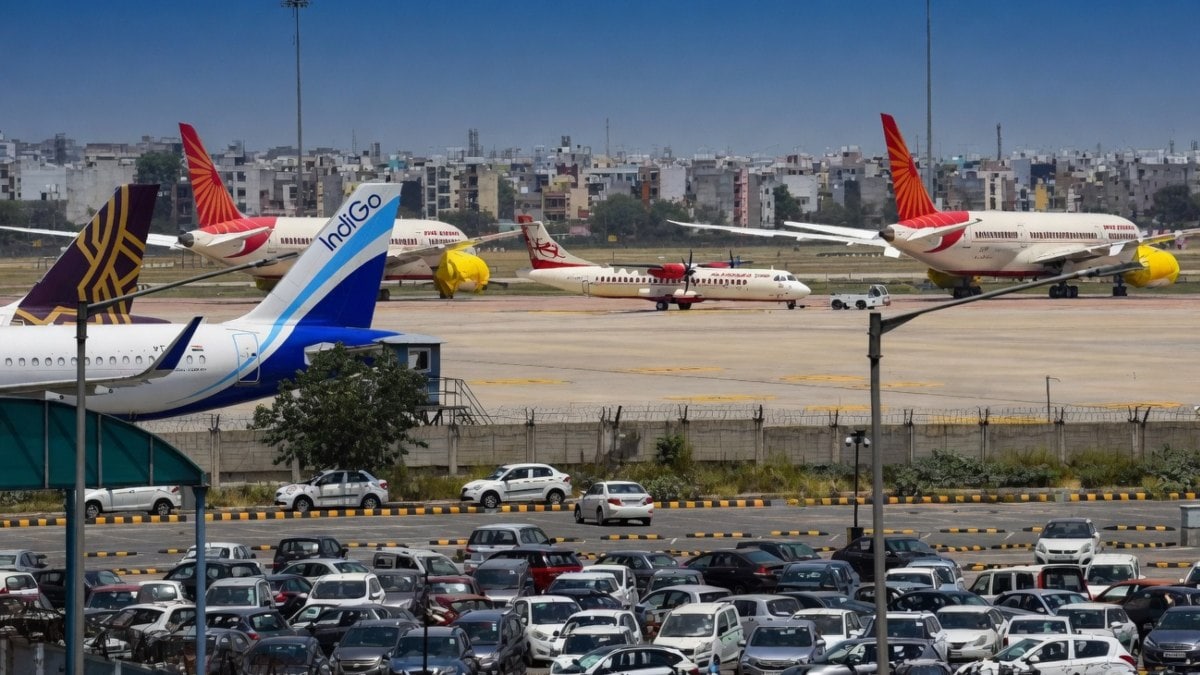
Delhi’s Indira Gandhi International Airport (IGIA) handled 1.9 million transfer passengers in May 2026, accounting for 27% of its total passenger traffic of 7.14 million, meaning more than one in every four travellers passing through the airport changed flights in Delhi to continue their journey. The transfer passenger volume rose from 1.54 million in April, when connecting passengers accounted for 23% of the airport’s overall traffic, according to airport operator GMR Airports Ltd.
The increase strengthens Delhi Airport’s position as country’s largest aviation hub. On average, around 56,000 passengers transited through the airport every day in May, with domestic connections continuing to drive the bulk of transfer traffic.
“This upward trend is even more pronounced year-on-year, with the share of transfer passengers increasing from around 20% in May 2025 to 27% in May 2026,” GMR said.
Regional Links Expand
Domestic-to-domestic (D-D) transfers remained the largest segment, accounting for 61% of total transfer traffic. The airport said this reflects Delhi’s growing role in linking metropolitan centres with emerging economic hubs, tourism destinations and other regions across the country.
Among the busiest transfer routes were Pune–Delhi–Srinagar, Srinagar–Delhi–Pune and Kolkata–Delhi–Srinagar.
The airport also recorded strong growth in international transfer traffic, supported by transit flows on routes such as Ahmedabad–Delhi–Toronto, Phuket–Delhi–London Heathrow, Dubai–Delhi–Patna and Kathmandu–Delhi–Tokyo.
The growth highlights Delhi Airport’s increasing importance as a gateway connecting South Asia with key destinations across North America, Europe, the Middle East and the Asia-Pacific region.
Global Gateway Power
“The steady growth in transfer passenger traffic is a strong endorsement of Delhi Airport’s position as India’s leading aviation hub. Today, more than one in every four passengers travelling through Delhi Airport is a transit passenger, reflecting the confidence that airlines and travellers place in our connectivity, operational efficiency and seamless travel experience,” said Pradeep Panicker, Chief Executive Officer, Delhi International Airport Limited (DIAL).
Panicker added that despite challenges facing the aviation sector, including the West Asia crisis and high aviation turbine fuel prices, DIAL continues to work with domestic and international carriers to strengthen connectivity, align networks, support transfer passengers and maintain its position as one of the region’s largest transfer hubs.