



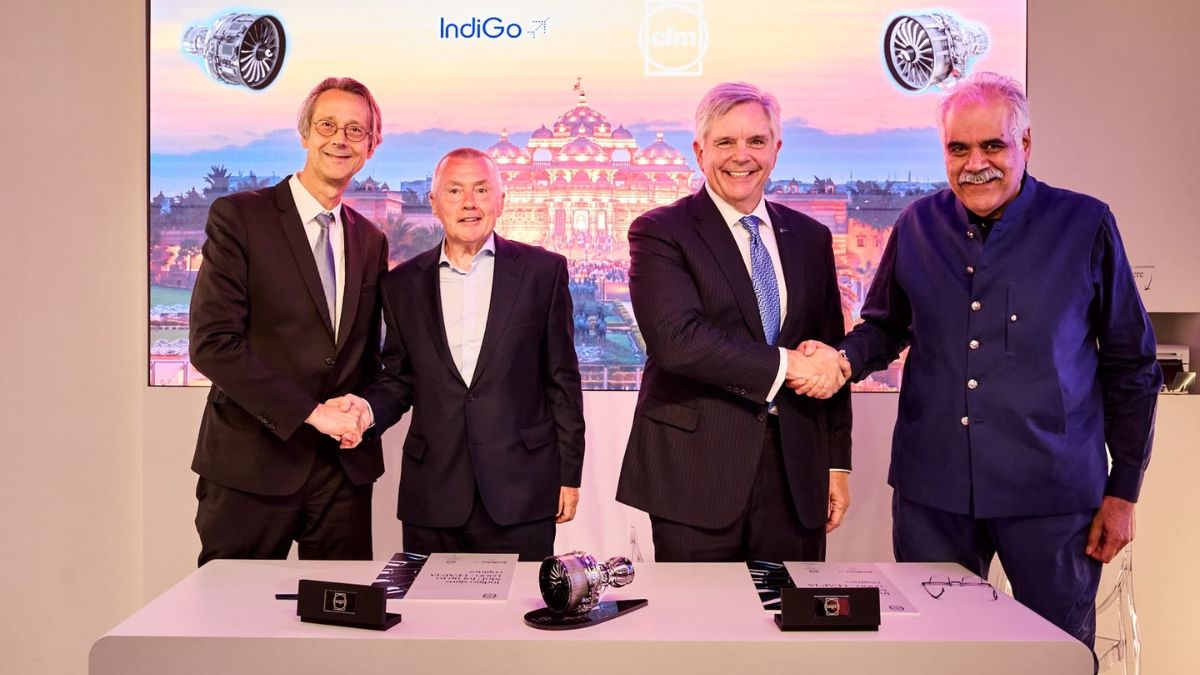
IndiGo has signed a Memorandum of Understanding (MoU) with CFM International to purchase more than 1,000 LEAP-1A engines to power 510 Airbus A320neo Family aircraft, placing the largest single order ever for LEAP engines and setting a new record for the engine maker.
Announced on Monday at the ongoing Farnborough Air Show, the agreement also marks a significant step in IndiGo’s long-term expansion strategy, with the partnership extending beyond engine supply to include support for the airline’s upcoming engine maintenance, repair and overhaul (MRO) facility in India. The deal also covers a long-term material services agreement, including the supply of spare parts to support IndiGo’s rapidly expanding fleet.
While original equipment manufacturers and airlines no longer disclose deal values as pricing varies by customer and contract terms, the list price of a LEAP-1A engine is around $14.5 million. On a list-price basis, the order would be valued at over $14.5 billion.
The airline currently operates a fleet of more than 430 aircraft and has an order book of nearly 1,000 planes scheduled for delivery over the next decade. IndiGo has outlined plans to double its fleet by 2030 as it expands both domestic and international operations.
“As IndiGo embarks on its next phase of growth towards becoming a truly global airline, we are delighted to extend our long-standing partnership with CFM International,” said Willie Walsh, Chief Executive Officer Designate, IndiGo. He said CFM has supported the airline’s growth since 2016, with more than 375 Airbus A320/321 Family aircraft currently powered by LEAP engines. Walsh added that the engine’s proven reliability would support IndiGo’s scale, operational resilience and sustainability ambitions.
H. Lawrence Culp Jr., Chairman and Chief Executive Officer of GE Aerospace, said IndiGo had trusted CFM for nearly a decade and the renewed agreement reflected that partnership. He added that LEAP engines continue to deliver up to twice the time on wing in hot and harsh operating environments while maintaining high levels of fuel efficiency and reliability.