



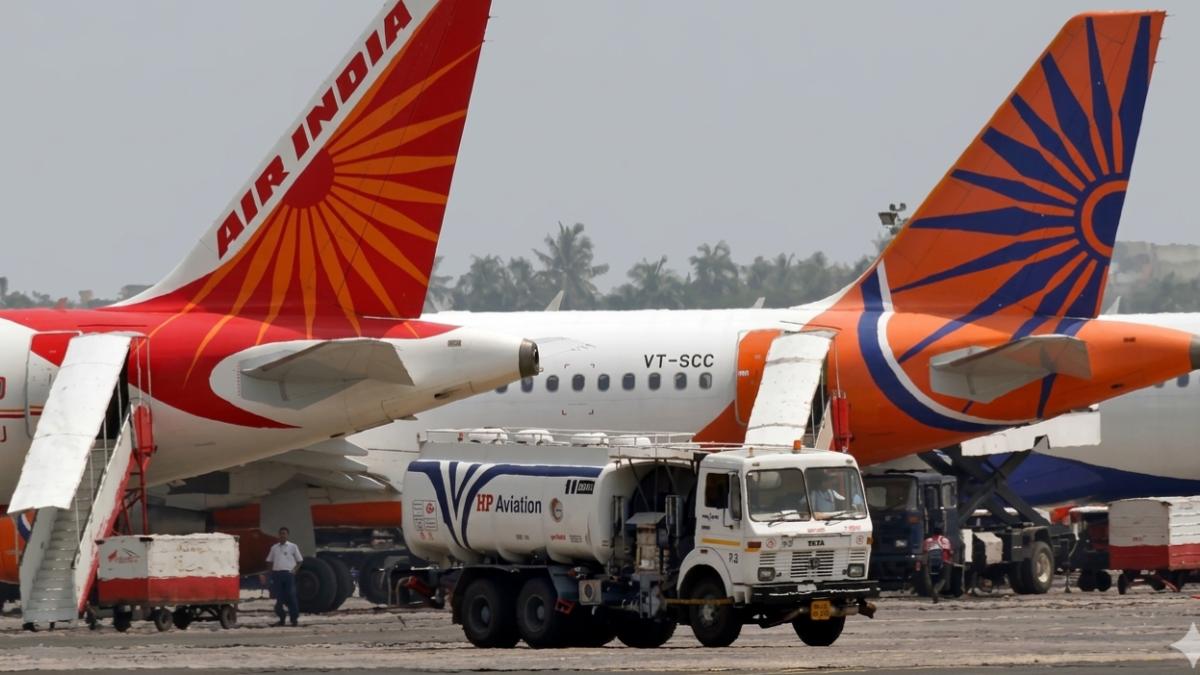
In a much-needed relief for the beleaguered aviation sector, oil marketing companies have slashed aviation turbine fuel (ATF) prices for international flights by 27%. The Indian Express and PTI, quoting sources, reported that the latest cut has brought the prices down to roughly Rs 1,05,000 per kilolitre, nearly on par with domestic jet fuel rates for the first time in months.
The relief follows a turbulent few months for Indian carriers. In April, the government allowed oil marketing companies to raise domestic ATF prices by 25%, pushing Delhi rates up by Rs 15,000 to Rs 1,04,927 per kilolitre. International ATF prices, however, were hiked far more sharply by around Rs 73,000 per kilolitre, hitting airlines’ operating overseas routes severely.
In May, domestic ATF prices were held unchanged but international rates climbed further to $1,511.86 per kilolitre, an additional jump of $76.55. For June, those rates have now been brought down sharply to $1,100 per kilolitre, offering airlines their first meaningful reprieve in months.
Domestic ATF prices, meanwhile, have been kept unchanged for the second consecutive month after airlines urged the oil marketing companies not to raise rates further until the West Asia conflict stabilises.
War, airspace and a 40% cost surge
The root of the crisis lies thousands of kilometres away. The ongoing war in West Asia has driven up global crude oil prices and triggered widespread airspace restrictions, forcing airlines to take longer, costlier alternative routes. ATF, which typically accounts for about 40% of an airline’s operating expenses, had ballooned to 55-60% of costs for Indian carriers at the peak of the crisis, IE reported quoting an Indian airline association.
Most major airlines responded by hiking fuel surcharges, particularly on international routes even as they acknowledged the surcharges would only partially offset the cost escalation.
Airlines on the brink
The financial pressure had pushed carriers to the edge. Air India, IndiGo and SpiceJet jointly wrote to the government on April 26 warning that the aviation sector was on the verge of “stopping operations”. It sought “immediate and meaningful financial support” from the Centre. Airlines also reduced flights in March and April as soaring ticket prices dampened passenger demand.
Among all carriers, Air India has been hit the hardest. The Tata-owned airline on May 13 announced major cuts to its international network. Then on May 27, it confirmed it was also scaling back domestic operations for at least two months. “In continuation of our previously announced adjustments to select international services between June and August 2026, we have temporarily rationalised operations on certain domestic routes during the same period, with a reduction in frequencies on select routes. These adjustments are driven by the sustained impact of high fuel prices on overall operations,” an Air India spokesperson said then.
Passenger traffic dips in April
India’s domestic aviation sector hit a patch of turbulence in April, with passenger traffic slipping both month-on-month and annually, according to the latest DGCA data. Airlines continued to grapple with weakening demand and rising operational costs.
Domestic carriers flew a little over 1.38 crore passengers during the month, marking a 4.2% decline from the 1.44 crore passengers recorded in March, according to the data.
The slowdown was visible on a yearly basis as well. Passenger traffic in April was 3.47% lower compared with the more than 1.43 crore flyers carried in the same month last year.