



A toothpaste tube is one of those products most people use twice a day without giving it a second thought. Yet behind billions of those tubes sits an Indian company that has quietly built the world’s largest laminated tube manufacturing business in a category most consumers never notice.
EPL Ltd, formerly Essel Propack, supplies more than 9 bn tubes annually from 21 manufacturing facilities across 11 countries, serving customers such as Colgate, Procter & Gamble, Unilever, L’Oréal, Dabur and Cipla. For years, that made it a predictable business with long customer relationships and steady demand.
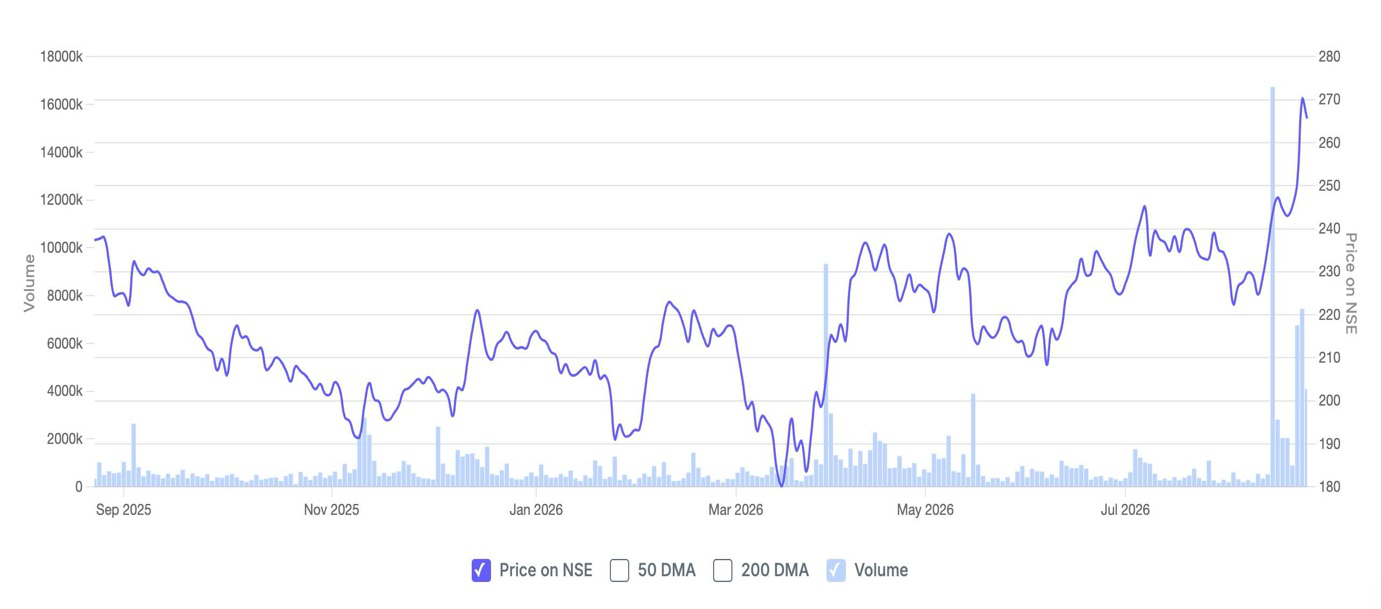
EPL Ltd 1-Year Share Price Chart
Something has changed inside the company. Instead of relying primarily on toothpaste tubes, EPL is betting that premium beauty packaging could become its next growth engine and that shift is already changing both its revenue mix and investor expectations.
The June quarter suggests the strategy is gaining momentum. Revenue rose 25.3%, management has become more optimistic about future growth and Europe’s profitability has deteriorated sharply even as inventories and debt have moved higher, making the story more complicated than the headline numbers suggest.
Join now
Beyond Toothpaste: How EPL’s Beauty Division Reached 40% of Revenue
Companies often become prisoners of the business that made them successful. Investors continue valuing them as if nothing changes, even when management is trying to rewrite the business model and that appears to be happening at EPL.
Historically, oral care dominated the company’s revenue and remains its largest category. Management has spent several years deliberately shifting towards beauty, cosmetics and pharmaceutical packaging and the numbers now show that shift clearly.
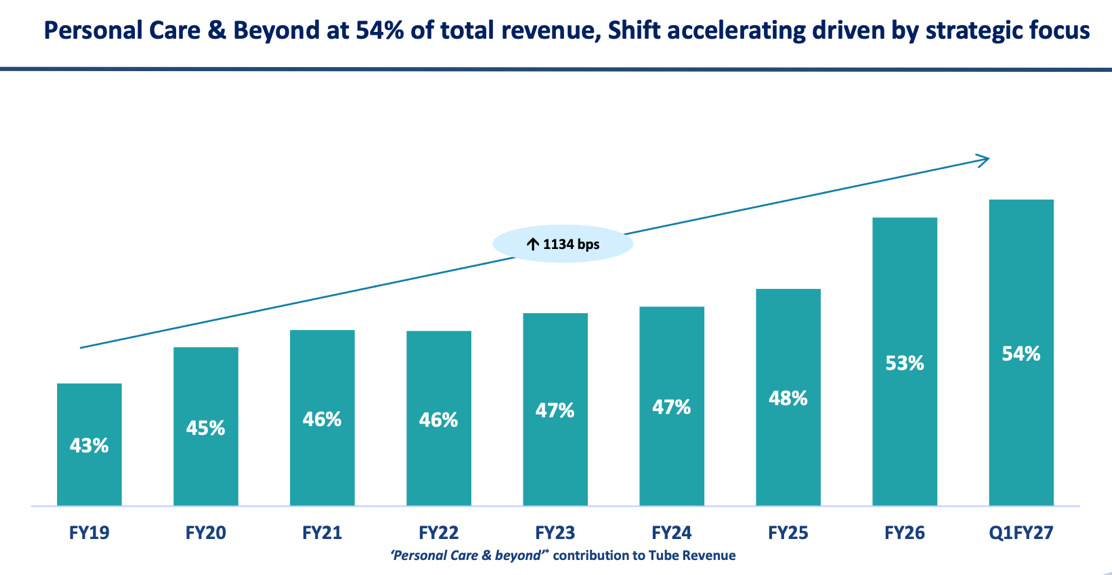
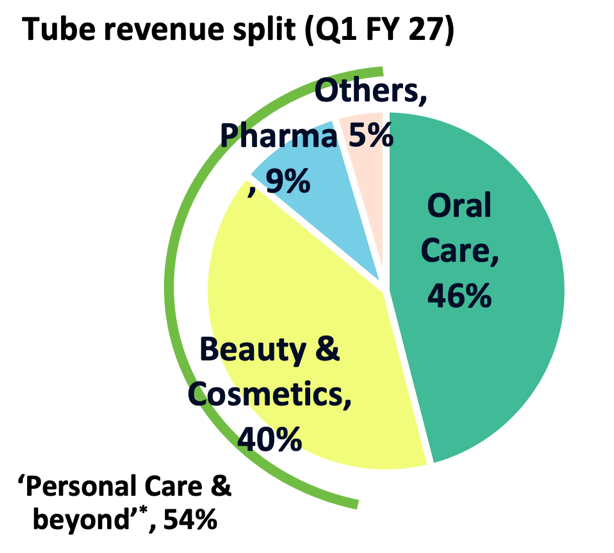
Beauty and Cosmetics grew 23.6% during the June quarter, oral care also crossed 20% growth and “Personal Care & Beyond” now contributes 54% of tube revenue compared to 43% in FY19.
This is not merely a portfolio reshuffle. Beauty brands demand customised designs, premium finishes and specialised applicators that make packaging part of the product experience itself and management said its Beauty and Cosmetics market share is currently around 8%, with an ambition to take it closer to 16% over the next few years.
The quarter looked better than the profit number suggests
The first number that catches attention is revenue. Revenue from operations increased 25.3% year-on-year during the June quarter, while operating Earnings Before Interest, Taxes, Depreciation and Amortisation (EBITDA) rose 15.2%.
The confusing part comes lower down the profit and loss statement because Profit After Tax (PAT) actually fell 1.4%. Management explained that last year’s effective tax rate had been unusually low, creating an unfavourable comparison, while maintaining that full-year profit remains on track for double-digit growth.
The more important takeaway lies in operating profitability. Reported EBITDA margin stood at 18.8%, but management argued that commodity price pass-through temporarily inflated reported revenue and that underlying EBITDA margin remained 19.6%, making raw material inflation more of an accounting distortion than a deterioration in the underlying business.
Management also highlighted that this was the fifth consecutive quarter of double-digit underlying growth. It believes the investments made over the past few years are finally beginning to reflect in the numbers.
The pricing power investors may be overlooking
The more unusual takeaway from the conference call was management’s claim that EPL has become much better at handling inflation than it was in previous cycles. The company said it recovered the full increase in raw material, freight and foreign exchange costs from customers through pricing, even though some contracts experienced temporary timing lags.
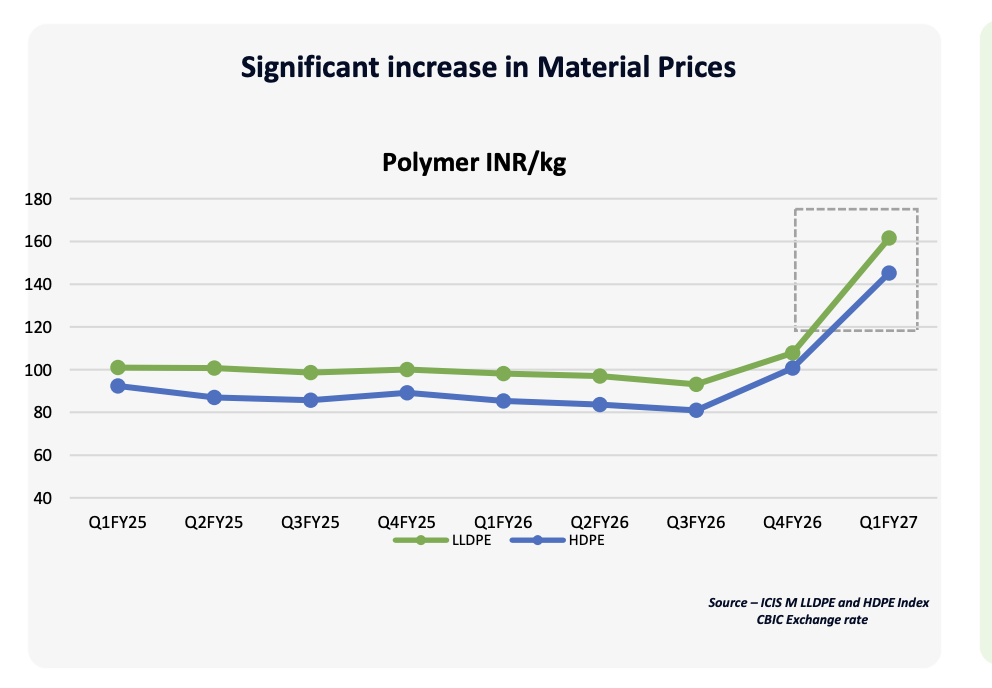
That matters because packaging companies have historically struggled to protect margins when polymer prices move sharply. Management described this as a capability it has deliberately built over multiple inflation cycles, allowing it to protect absolute EBITDA even during periods of commodity volatility.
The beauty opportunity is changing where growth comes from
Perhaps the clearest sign of EPL’s transformation is its changing revenue mix. The company now earns 54% of tube revenue from Personal Care & Beyond, representing an increase of more than 1,100 basis points since FY19.
Revenue Mix
Management has backed that shift with investment rather than marketing slogans. It has created a dedicated Beauty and Cosmetics Centre of Excellence in India, built specialised sales teams, invested in premium embellishment technologies and expanded manufacturing capabilities for differentiated products.
The products themselves reveal where management wants the business to go. EPL now showcases cooling metal applicators, soft-touch silicone tubes, seamless 360-degree printing and dual-chamber dispensing systems designed for premium skincare products and those products compete less on price and more on design.
Europe has become the uncomfortable part of the story
The strongest management commentary during the conference call came alongside its weakest operating performance. Europe illustrates that contradiction perfectly, with revenue growing 20.2% while profitability moved sharply lower.
EBITDA fell 11.9%, while Earnings Before Interest and Taxes (EBIT) dropped 44.4% during the quarter. Management blamed transitional costs from restructuring its manufacturing footprint, higher depreciation after bringing new assets into operation and operational inefficiencies that emerged during the transition.
The company insisted these issues have been identified and should improve as asset utilisation increases. Europe remains one of the company’s biggest beauty packaging opportunities, but it is also the geography creating the biggest near-term drag on profitability, making it the single biggest operational risk in the story today.
Revenue growth and margins
Looking beyond one quarter, the financial trajectory has become more encouraging than its longer-term history. According to Screener, revenue increased from Rs 4,213 crore in FY25 to Rs 4,763 crore in FY26, while operating profit rose from Rs 837 crore to Rs 965 crore and operating margins remained around 20%.
Revenue and profit trend
| Metric | FY25 | FY26 |
| Revenue | Rs 4,213 crore | Rs 4,763 crore |
| Operating profit | Rs 837 crore | Rs 965 crore |
| Operating margin | 20% | 20% |
| Net profit | Rs 364 crore | Rs 394 crore |
Those are healthy numbers, but they should be viewed in context. Over the past decade, sales have compounded at roughly 8% annually while profits have grown around 9%, showing that EPL has historically been a steady compounder rather than an explosive growth company.
The current optimism rests on whether beauty-led growth can permanently change that trajectory. Investors will ultimately judge that through sustained earnings rather than quarterly momentum.
Management has become more ambitious
The tone of management commentary often reveals as much as financial guidance itself. This time, the confidence stood out because management has raised its revenue growth outlook from early double digits to high-teen growth over the next few quarters, supported by Beauty and Cosmetics momentum, oral care recovery, Brazil’s continued strength and Thailand’s scale-up.
Management also reiterated its commitment to maintaining around 20% underlying EBITDA margins, even if commodity inflation persists. That combination of stronger growth guidance and stable margin expectations explains why investors are paying closer attention to the company’s beauty-led transition.
The company is spending ahead of growth
One noticeable feature of the recent numbers is that investments are arriving before returns fully show up. Management has expanded manufacturing capabilities, added extrusion and printing lines, invested in new tooling and built a dedicated Beauty and Cosmetics Centre of Excellence in India.
It has also created specialised sales teams focused separately on beauty products and large oral care accounts. Those investments explain why depreciation has increased and why management repeatedly described current spending as “ahead of the curve.”
The broader ambition extends beyond organic expansion. The proposed Indovinya merger remains on track after receiving Competition Commission of India approval, although National Company Law Tribunal approval is still pending, with completion expected around Q4 FY27 and management has openly said it is evaluating further acquisitions that can add new packaging formats or expand geographic reach.
Balance sheet
Growth rarely arrives without demanding capital. EPL’s balance sheet reflects that reality, with borrowings increasing from Rs 802 crore in FY25 to Rs 962 crore in FY26, although debt-to-equity remains around 0.34, keeping leverage manageable.
Management said the increase came primarily from capital expenditure and higher inventories built during Middle East supply disruptions rather than weakening customer collections. Interest coverage remains comfortable, suggesting the balance sheet still has room to absorb current investments.
The Working Capital Risk: Inventory Days Expand to 177
One ratio quietly moved in the wrong direction. Inventory days increased from 151 to 177, while the cash conversion cycle widened from 87 to 97 days, according to Screener.
Management argues this reflects two temporary factors. Higher polymer prices inflated inventory values and additional safety stock ensured uninterrupted customer supply during geopolitical disruptions.
That explanation appears reasonable. Even so, working capital deserves monitoring because inventory has moved higher over the past two years and investors will expect those numbers to improve once raw material volatility eases.
Returns remain healthy
Despite ongoing investments, EPL continues to generate respectable returns on capital. Return on Capital Employed (ROCE) remained around 18%, while Return on Equity (ROE) stayed close to 16% and management highlighted that June-quarter ROCE stood at 18.5% despite ongoing capacity expansion.
Those numbers suggest the company has so far managed to grow without sacrificing capital efficiency. That becomes particularly important when investors are evaluating whether current investments can translate into durable long-term growth.
Valuation
At around Rs 266, EPL trades at roughly 20.8 times earnings. That sits below its five-year average Price-to-Earnings multiple of around 25 times, suggesting the market is acknowledging improving growth while still assigning a discount for Europe’s profitability concerns and uncertainty around whether current momentum can sustain itself once inflation-led pricing fades.
That makes valuation neither obviously expensive nor obviously cheap. Investors are effectively paying for a business in transition rather than a fully proven growth story.
What could still go wrong?
The biggest risk is not governance. Unlike many companies associated with the old Essel Group, EPL itself has not faced major fraud allegations, regulatory action or promoter pledge issues, making the concerns largely operational rather than structural.
Europe remains under pressure, inventory has climbed and the company’s premium packaging investments still need to translate into sustained profitability across regions. Working capital also deserves attention because inventories have risen meaningfully and those gains will need to reverse once raw material volatility eases.
Another broader risk applies to investors chasing fashionable themes. Even fundamentally strong companies can see sharp price swings when expectations run ahead of earnings, particularly during bull markets when premium valuations become difficult to sustain if growth slows.
The final word
EPL’s biggest strength used to be predictability. Its biggest opportunity today is reinvention because management no longer wants investors to think of it simply as a toothpaste packaging business but as a premium consumer packaging platform built around beauty, sustainability and specialised technologies.
The irony is that this transformation has made the business both more exciting and more complicated. Growth has accelerated, guidance has improved and new categories are expanding rapidly, but Europe has become a reminder that building tomorrow’s business often creates today’s operational headaches and whether investors eventually reward EPL may depend less on beauty growth alone and more on whether that growth begins translating into stronger profitability across every geography.
Disclaimer:
Note: We have relied on data from www.Screener.in throughout this article. Only in cases where the data was not available, have we used an alternate, but widely used and accepted source of information.
The purpose of this article is only to share interesting charts, data points and thought-provoking opinions. It is NOT a recommendation. If you wish to consider an investment, you are strongly advised to consult your advisor. This article is strictly for educative purposes only.
Manvi Aggarwal has been tracking the stock markets for nearly two decades. She spent about eight years as a financial analyst at a value-style fund, managing money for international investors. That’s where she honed her expertise in deep-dive research, looking beyond the obvious to spot value where others didn’t. Now, she brings that same sharp eye to uncovering overlooked and misunderstood investment opportunities in Indian equities. As a columnist for LiveMint and Equitymaster, she breaks down complex financial trends into actionable insights for investors.
Disclosure: The writer and her dependents do not hold the stocks discussed in this article. The website managers, its employee(s) and contributors/writers/authors of articles have or may have an outstanding buy or sell position or holding in the securities, options on securities or other related investments of issuers and/or companies discussed therein. The content of the articles and the interpretation of data are solely the personal views of the contributors/ writers/authors. Investors must make their own investment decisions based on their specific objectives, resources and only after consulting such independent advisors as may be necessary.