



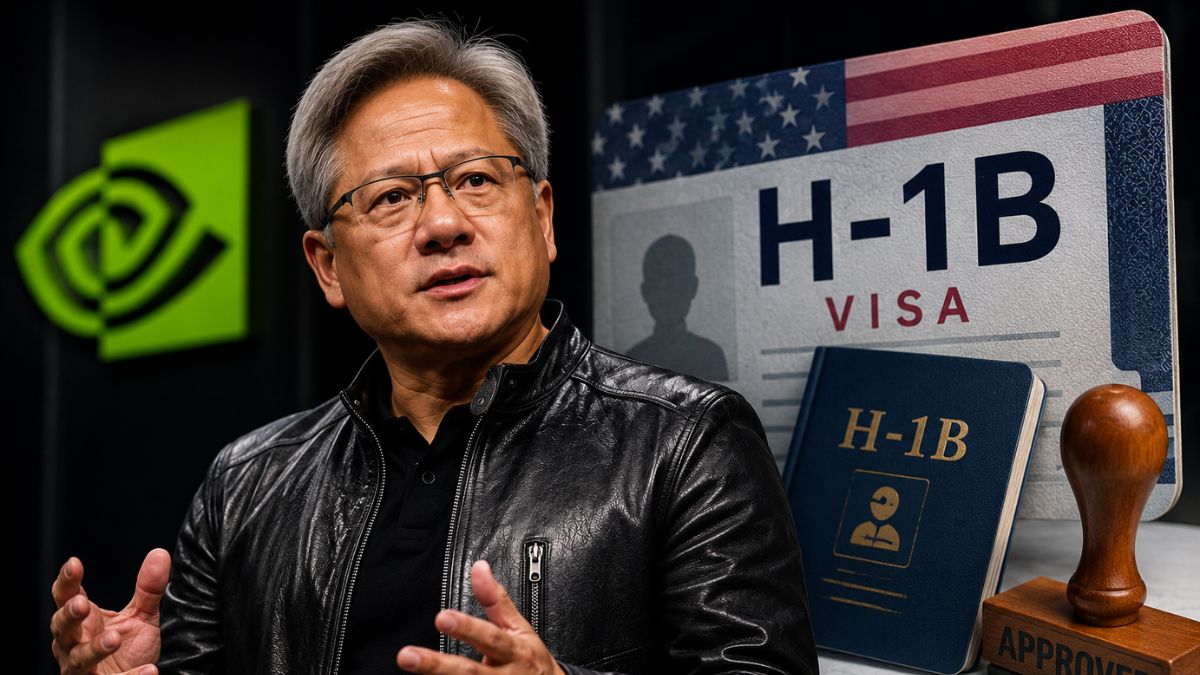
As several major technology companies slow down hiring and cut back on foreign worker recruitment, Nvidia is moving in the opposite direction. As reported by Business Insider, Federal labour filings show the AI chip giant secured certification for around 1,200 H-1B positions during the first two quarters of fiscal 2026, up from roughly 1,000 during the same period a year earlier.
The increase stands out at a time when many of Silicon Valley’s biggest employers are reducing H-1B hiring. Google’s approved H-1B positions fell from about 5,100 to 2,200 during the same period, and Amazon’s approvals dropped from around 6,100 to 4,300. The contrast shows Nvidia’s aggressive hiring strategy as demand for AI talent continues to surge.
AI boom and Nvidia’s talent hunt
Nvidia’s hiring push is closely tied to its rapid growth in artificial intelligence. The company is looking for software engineers, research scientists, product managers, hardware engineers and other specialists as businesses around the world race to adopt AI technologies powered by Nvidia chips.
Federal filings show Nvidia is offering some of the highest salaries in the industry. Individual contributors in technical roles can earn base salaries ranging from $356,500 to $391,000 a year, while architecture directors can receive up to $488,750 in base pay alone. Stock awards and bonuses can push total compensation even higher.
Indian professionals are expected to benefit significantly from this trend. Indian nationals have historically received more than 70 percent of all H-1B visas issued in the United States, meaning Nvidia’s growing demand for foreign talent is likely to create more opportunities for Indian engineers and researchers.
Strong business growth
Nvidia’s hiring spree comes as the company continues to post record-breaking financial results. In its first quarter of fiscal year 2027, Nvidia reported revenue of $81.62 billion, an 85 percent jump from $44.06 billion a year earlier. Its data centre business alone generated $75.2 billion in revenue during the quarter, explaining the scale of demand for AI infrastructure.
The company is increasingly viewed not just as a supplier of AI chips, but as one of the key builders of the infrastructure powering the global AI boom. That growth has allowed Nvidia to keep investing in talent even as rivals become more cautious.
Jensen Huang’s strong support for immigration
Nvidia’s approach to hiring shows or mirrors the views of its CEO, Jensen Huang, who has repeatedly spoken about the importance of immigration to both the company and the US technology industry.
He was born in Taiwan and later moved to the United States, Huang has often linked Nvidia’s success to the contributions of immigrants. In an internal message to employees in 2025, he said that the opportunities his family found in America had profoundly shaped their lives and added that Nvidia’s success “would not be possible without immigration.” He also described legal immigration as essential for maintaining America’s leadership in technology and innovation. “I don’t think that my family would have been able to afford the $100,000, and so the opportunity for my family and for me to be here would not have been possible with this current policy.” Huang said this on CNBC’s Squawk Box.
Huang has strongly defended the H-1B programme, calling it an important pathway for exceptional global talent to contribute to the US economy.“H-1B visas provide a vital pathway for exceptional talent to contribute to America’s growth and innovation,” he wrote this in his internal memo to staff. He has said Nvidia will continue sponsoring H-1B applicants and cover all related costs. At the same time, he has expressed concerns about recent immigration policy changes that significantly increased hiring costs for foreign workers.
A different strategy from Silicon Valley
H-1B system has undergone major changes in recent years, with higher wage requirements and additional costs pushing companies to focus on highly skilled and highly paid workers. While some outsourcing firms have reduced their presence in the programme, Nvidia appears willing to pay a premium for specialised AI talent.
At a time when many technology companies are cutting back, Nvidia is doubling down. The company’s rising H-1B hiring numbers show that, for Nvidia, access to global talent remains a central part of its strategy as it expands deeper into the AI era.