



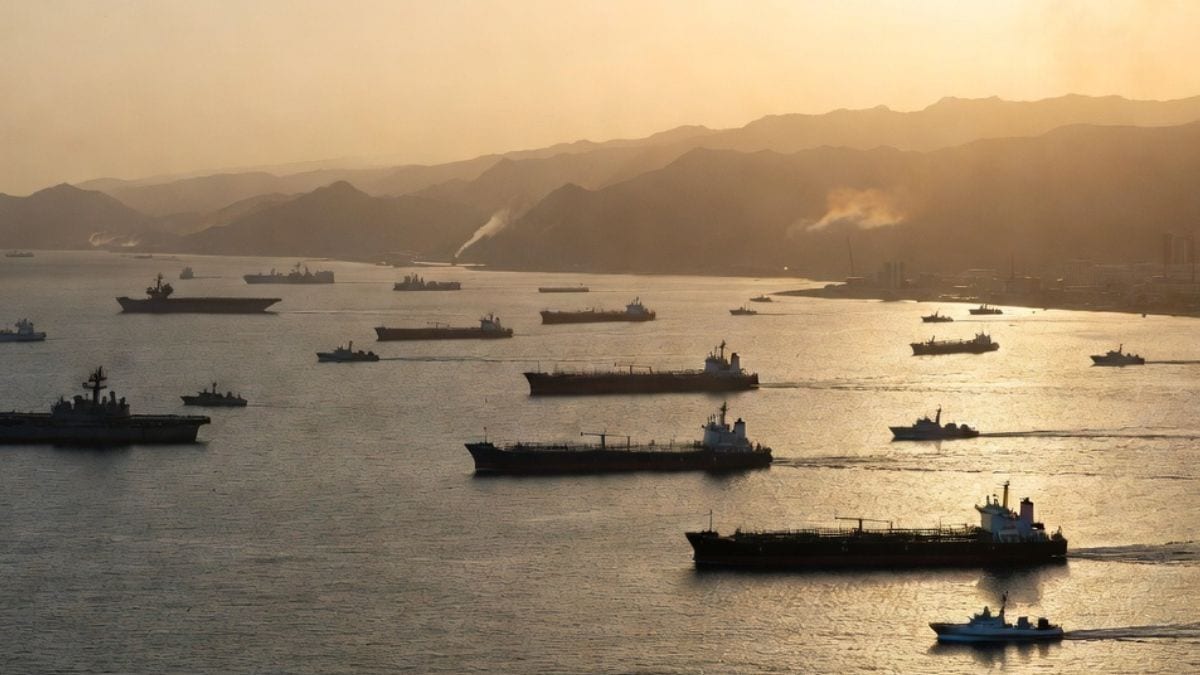
The Strait of Hormuz is not dealing with one blockade anymore. It is dealing with two at the same time, one led by Iran and the other led by the United States. For commercial shipping caught between them, the question of which costs more is the central operational dilemma of the most disruptive maritime crisis since the Second World War.
Two blockades, one narrow waterway
On March 4, Iran effectively shut parts of the Strait of Hormuz using warnings to ships, mine-laying activity, ship seizures, and swarm boat operations by the IRGC Navy. The impact was immediate. By March 12, more than 10 million barrels of oil per day had been taken out of global supply. Brent crude jumped above $120 per barrel. The IEA was quick to label it the biggest oil disruption in history.
The Pentagon told the US Congress that clearing the Strait mines could take up to six months, and only after the conflict ends.
On April 13, the United States launched a naval blockade on Iran after the failure of the Islamabad Talks. The move targeted ships entering and leaving Iranian ports. By May 23, the US Navy, backed by more than 200 aircraft and two carrier groups, had diverted around 100 commercial vessels.
US Central Command chief Admiral Brad Cooper said the operation had “squeezed Iran economically.” Donald Trump claimed it was costing Iran $500 million every day.
As a result, more than 800 heavy commercial vessels remain stranded west of the strait, war-risk insurance premiums remain elevated, and major shipping companies are continuing to delay resumption of regular operations.
The ripple effect of these blockades also saw a sharp rise in tanker rates that exploded in the early weeks. The Baltic Exchange’s VLCC benchmark reportedly jumped to over $400,000 per day at its peak. Suezmax and Aframax ships also saw extreme spikes, with earnings crossing $300,000 and $140,000 per day in some cases.
The cost of the US blockade
For ships stuck in the Gulf, waiting is expensive. Daily costs do not stop. Crew wages, loans, maintenance, and insurance keep adding up even when the ship is idle. As economist Nader Habibi told Al Jazeera, “There is no doubt that paying Iran is cheaper than a continuous blockade because a sitting tanker bleeds money.”
Avoiding Hormuz is also expensive. Taking the Cape of Good Hope route adds 10–14 days to a trip and increases fuel costs by about $1.2–1.8 million per round voyage for many vessels.
War-risk insurance has also surged. At the peak of the crisis, premiums reportedly reached 2.5% to 5% of a ship’s value per transit, roughly around $5 million for a large VLCC in some cases.
So even “avoiding risk” comes with a heavy price tag.
Iran turns the Strait into a toll system
Iran has responded to the crisis by creating a payment system for passage.
Reports from Bloomberg say Iran began charging informal transit fees of up to $2 million per ship. These payments were collected through IRGC-linked intermediaries, often in cash, cryptocurrency, or barter deals.
Between early and mid-March, dozens of vessels reportedly passed through after making such arrangements. Ships were sometimes contacted directly on radio, asked to confirm details, and then cleared after payment.
The system later became more organised. Iran launched the “Persian Gulf Strait Authority,” designed to formalise approvals and payments. Shipping companies must submit ownership details, insurance documents, crew lists, and cargo information before getting permission to pass.
No official tariff has been published, but multiple reports still place the cost at up to $2 million per transit.
Iranian officials have also suggested the system could bring in massive revenue, even up to $100 billion annually, according to public claims displayed in Tehran.
Shipping rates have ‘normalised’
By late April and May, something unexpected happened: rates started to come down.
Even though the crisis was still active, tanker earnings stabilised at much lower levels, though still strong by historical standards. VLCC earnings settled closer to around $100,000 per day, according to Lloyd’s List reporting.
According to the Lloyd’s list, Cross-Mediterranean Aframax rates are down ~57% from late February (pre-crisis levels) and only up 12% year-on-year.
The sanctions problem – Who is actually using the strait?
Even if the math looks attractive, the legal side is a hard stop for many companies. The US Treasury’s OFAC rules (FAQ 1249, May 2026) make it clear that any payment to Iran or the IRGC is not allowed for US persons or US-linked companies. Non-US companies are not fully safe either. They risk secondary sanctions.
Countries like China, India, Russia, and several Asian and Middle Eastern states have continued using the strait under various arrangements.
So is paying Iran cheaper than the blockade?
Looking at a bigger picture- A $2 million toll is lower than:
- $1.2–1.8 million extra fuel costs
- $5 million insurance spikes in some cases
- weeks of lost time and idle ship costs
But the real answer is not just about money.
For Western-owned or Western-linked companies, paying Iran is not even an option because of sanctions. For them, the “cheaper” choice is blocked legally. For non-Western operators, especially those outside the US financial system, paying Iran can make commercial sense.
And for everyone, the biggest cost remains uncertainty, because no one knows how long this system will last or what the next escalation will look like.
As maritime expert Yörük Işık put it, even if the crisis ended today, “the supply chain will take months, if not years, to recover fully.”