



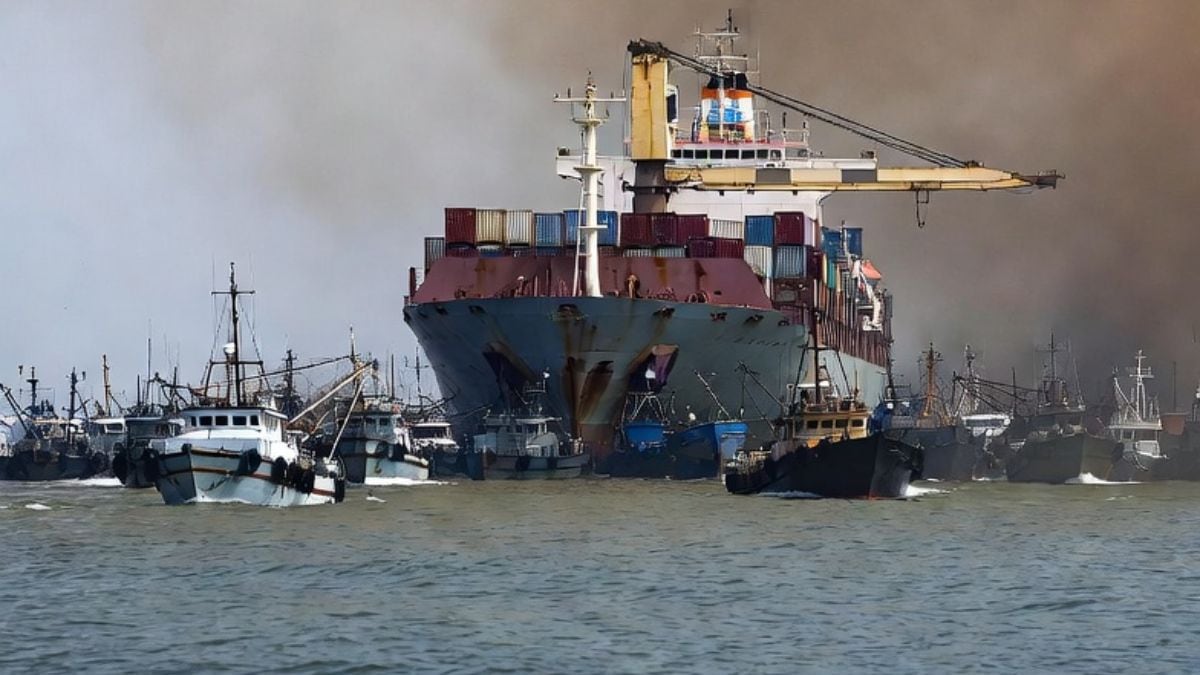
Tensions in the region are rising again, and this time the focus has shifted to another crucial sea route. An Iranian official has warned that the Bab al-Mandeb Strait (also known as “Gate of Tears”)—a narrow waterway between Yemen and Africa—could be targeted if the United States “dares to repeat its foolish mistakes.” This strait is a key passage for global trade, especially for oil moving from the Red Sea to other parts of the world.
Bab al-Mandeb is a narrow stretch of water that links the Gulf of Aden to the Red Sea and onward to the Suez Canal, making it a key route between Africa and the Arabian Peninsula. At its tightest point, it’s about 20 miles wide, with Djibouti on one side and Yemen on the other. The strait plays a crucial role in global trade, acting as a major passage for ships moving between Europe and Asia, and serving as the southern gateway to the Red Sea, connecting the Mediterranean to the Indian Ocean.
Iran warns of another major choke point after Hormuz crisis
In a post written in English on X, Ali Akbar Velayati, an advisor to Iran’s new supreme leader, Mojtaba Khamenei, made it clear that the situation could escalate beyond the Strait of Hormuz. “Today, the unified command of the Resistance front views Bab al-Mandeb as it does Hormuz,” Velayati wrote.
He added a direct warning: “If the White House dares to repeat its foolish mistakes, it will soon realise that the flow of global energy and trade can be disrupted with a single move.”
Why the Bab al-Mandeb Strait matters so much
This narrow waterway is far more important than it looks on the map. About 4.1 million barrels of petroleum passed through it every day in 2024, according to the US Energy Information Administration. While that’s lower than the roughly 20 million barrels that move through the Strait of Hormuz, it still plays an important role.
It is also a key alternative route for oil exporters. For example, around 7 million barrels of oil are transported daily via pipeline to Yanbu in Saudi Arabia on the Red Sea. From there, the oil travels through the Red Sea and then passes the Bab al-Mandeb Strait.
Beyond oil, the strait handles about 12% of global trade, as ships move between Europe and Asia through the Suez Canal. If this route is disrupted, the impact would be felt far beyond the Middle East.
Iran can influence a strait it doesn’t even border
Iran does not share a coastline with the Bab al-Mandeb Strait, but Yemen does. And that’s where the connection lies. Iran is closely aligned with the Houthis, a Yemeni militant group (now supporting Iran in attacking Israel). The Houthis have already shown their ability to disrupt shipping routes. In 2023 and 2024, they carried out dozens of strikes on vessels linked to Israel in the Red Sea during the Gaza war.
More recently, in late March, the group began launching missiles at military targets in Israel. Because of this alliance, any escalation involving the Bab al-Mandeb Strait could quickly turn into a wider regional problem.
Velayati’s statement came just hours after Trump again threatened to strike Iran’s power plants and bridge, if Hormuz is not opened.
Oil prices could surge even higher
The fallout from the Hormuz closure is already being felt. Oil prices have peaked, and gasoline prices in the US have crossed $4 per gallon. Analysts at JPMorgan say prices could climb to $150 per barrel if the situation continues. In the short term, they expect oil to stay between $120 and $130, up from about $109 recently.
If the Bab al-Mandeb Strait is also affected, prices could rise even more. Earlier warnings from Iran even suggested oil could cross $200 per barrel if the conflict drags on.
So far, the Houthis have not targeted ships in the Bab al-Mandeb Strait. In March, Iran’s state-linked Tasnim News Agency quoted a military source warning of “insecurity” in the Bab al-Mandeb and the Red Sea if the US attacked Iran’s Kharg Island.
Why Bab el-Mandeb is called the ‘Gate of Tears’
The strait is quite narrow, only about 30 kilometres wide at its tightest point. The waters here are tricky. Strong currents cut across the path, winds can change quickly, and there are reefs hidden under the surface. Long before modern ships and GPS, sailors had to rely on instinct and basic tools. Many ships didn’t make it through. Over time, the passage became known for tragedy. The “tears” in the name are said to stand for the many lives lost here.
According to Arab folklore, this strait was created by a massive earthquake that split Asia and Africa apart. Before that, the story goes, there was a land bridge connecting the two continents. When the land broke, many people were caught in the disaster and drowned. The grief from that moment, people say, is what gave the place its name — the “Gate of Tears.”