



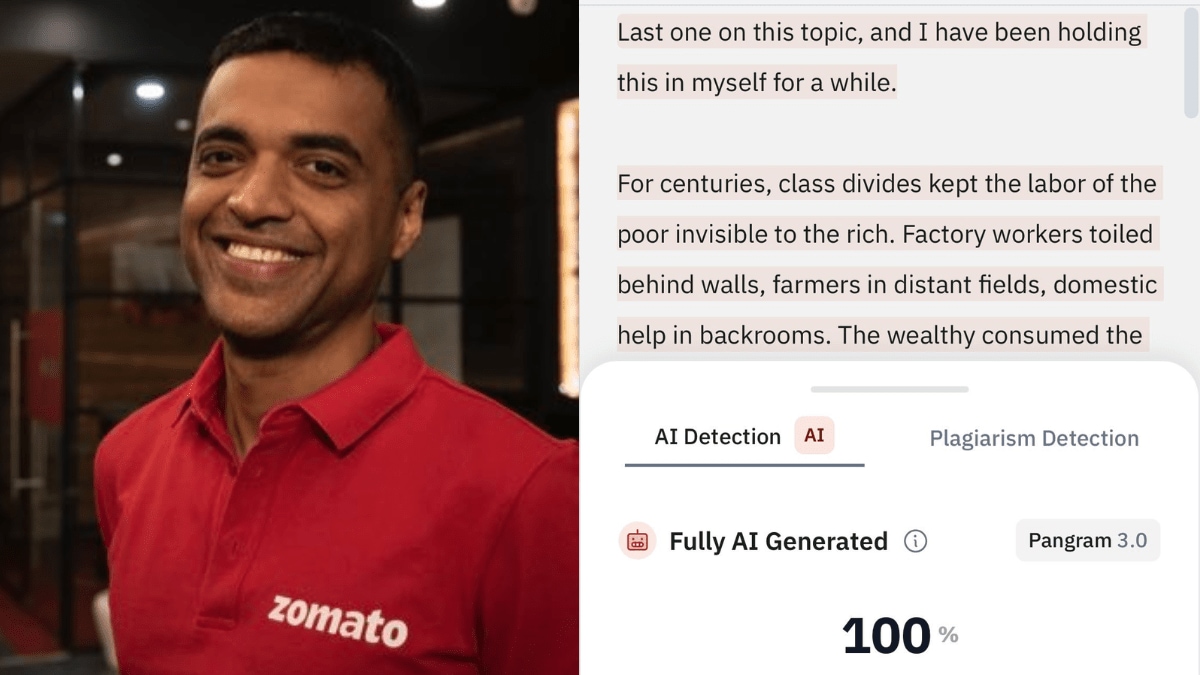
A viral post on social media has claimed that Zomato CEO Deepinder Goyal used an AI chatbot for crisis public relations, adding that, despite this, the post appears to be effective. The claim was made by Deedy Das, a software engineer and venture capitalist, who publicly called out the CEO over the alleged use of AI.
‘Zomato CEO using ChatGPT to do PR’
“Major corporate CEOs like Zomato are now using ChatGPT to do crisis comms / PR (and it’s working!),” he said in a post on X (formerly Twitter). Das added that such communication was traditionally handled by “a senior tenured marketing graduate”.
He went on to say, “Most don’t notice AI writing in the wild, but it’s changing how humans communicate before our very eyes.”
Alongside, he shared a screenshot from an AI-detection tool, which claimed the content in question was “fully AI-generated”.
In response to his post, he revealed that Das chose this very AI-detection tool because it had been “independently evaluated to have <0.5% false positive and negative rates”.
Major corporate CEOs like Zomato are now using ChatGPT to do crisis comms / PR (and it’s working!). This was a job for a senior tenured marketing graduate before.
— Deedy (@deedydas) January 2, 2026
Most don’t notice AI writing in the wild but it’s changing how humans communicate before our very eyes. https://t.co/ihGMPk24MY pic.twitter.com/9D2ARWW18N
When one social media user responded to Goyal’s original post, asking him, “AI sir?” complete with the screenshot of an AI detector saying that the text is 100 per cent AI-generated, he responded with a “No”.
FinancialExpress.com has reached out to Zomato for a comment. It will be added as and when we receive a response.
What has Goyal posted online?
Goyal, in a post on X, shared what he described as thoughts he had been “holding in” for some time. He added that for centuries, the “labour of the poor” had remained largely “invisible to the rich”. However, he said, the gig economy “shattered that invisibility”, that too, at an unprecedented scale.
“Suddenly, the poor aren’t hidden away. They’re at your doorstep: the delivery partner handing over your ₹1000+ biryani, late-night groceries, or quick-commerce essentials. You see them in the rain, heat, traffic, often on borrowed bikes, working 8–10 hours for earnings that give them sustenance. You see their exhaustion, their polite smile masking frustration with life in general,” his post, allegedly written by AI, read.
He said that this is the first time the working class and the consuming class are interacting “face-to-face” at such a scale, which he argued is why people are now “confronting guilt”.
“That ₹800 order might equal their entire day’s earnings after fuel, bike rent, and app cuts. We tip awkwardly or avoid eye contact because the inequality is no longer abstract. It’s personal,” he further said.
Goyal also said that in the pre-gig era, the rich didn’t have moral discomfort while enjoying luxury. However, that is not the case now. “Every doorbell ring is a reminder of systemic inequality,” he said, before adding, “Some defend the system (‘they choose it’), others demand change (‘this isn’t progress, it’s exploitation’).”
Last one on this topic, and I have been holding this in myself for a while.
— Deepinder Goyal (@deepigoyal) January 2, 2026
For centuries, class divides kept the labor of the poor invisible to the rich. Factory workers toiled behind walls, farmers in distant fields, domestic help in backrooms. The wealthy consumed the fruits…
The 42-year-old CEO argued that banning gig work wouldn’t solve the problem but would instead push workers into what he called the “informal economy”, where there are “even fewer protections and even less accountability”.
He added that such an outcome would allow the rich to get their comfort back, with convenience returning without the need to see the people behind the service.
“The gig economy just exposed the reality of inequality to the people who previously had the luxury of not seeing it. The doorbell is not the problem. The question is what we do after opening the door,” he said, before adding, “Visibility is the price of progress. We can either use this discomfort to build something better (which we keep doing continuously, as delivery partners are our backbone), or we can ban and over-regulate our way back into ignorance. One of those choices improves lives. The other simply helps the consuming class feel virtuous in the dark.”