



As tensions rise between the United States, Israel and Iran, much of the global attention has been focused on oil. The narrow Strait of Hormuz, which connects the Persian Gulf to the open ocean, carries nearly 20% of the world’s oil supply, making it one of the most important energy routes on the planet.
But author and investor Robert Kiyosaki says the real risk may be something even more serious than oil.
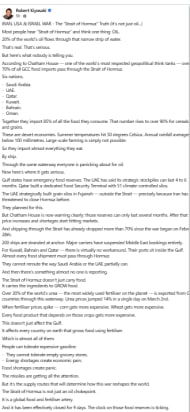
In a recent post about the war, Kiyosaki warned that the Strait of Hormuz is not just an energy corridor. It is also a critical route for global food and fertiliser supplies, a reality that could have major consequences if disruptions continue.
“The Strait of Hormuz is not just an oil chokepoint. It is a global food and fertiliser artery,” he wrote.
A food lifeline for Gulf countries
Most people associate the Strait of Hormuz with oil tankers, but the waterway also carries a large share of the food imported by Gulf nations.
Kiyosaki cited research from the Chatham House to explain the scale of this dependence.
According to the think tank, more than 70% of all food imports for Gulf Cooperation Council countries pass through the Strait of Hormuz. These countries include Saudi Arabia, United Arab Emirates, Qatar, Kuwait, Bahrain and Oman.
Together, these countries import about 85% of the food they consume. For cereals and grains, the dependence rises to more than 90%.
“These are desert economies. Summer temperatures hit 50 degrees Celsius. Annual rainfall averages below 100 millimetres. Large-scale farming is simply not possible,” Kiyosaki wrote.
Because of this, most of the food consumed in the region arrives by ship — through the same narrow waterway that the world worries about for oil.
Strategic reserves offer only short-term relief
Many Gulf countries have prepared for the possibility of disruptions. Governments have built strategic food reserves and storage facilities to manage temporary crises.
Kiyosaki pointed out that the United Arab Emirates has said its emergency stockpiles can last between four and six months. Meanwhile, Qatar has built a dedicated food security terminal with dozens of climate-controlled grain silos.
“The UAE strategically built grain silos in Fujairah — outside the Strait — precisely because Iran has threatened to close Hormuz before,” he wrote.
Still, experts warn that these reserves are only a temporary solution.
According to Chatham House, if shipping disruptions continue for several months, food shortages and rising prices could begin to affect markets across the Gulf.
Kiyosaki also claimed that shipping activity through the strait has already dropped sharply since the conflict escalated on February 28.
“And shipping through the Strait has already dropped more than 70% since the war began on February 28th,” he wrote, adding that “200 ships are stranded at anchor” and some major shipping companies have paused bookings to the Middle East.
Countries such as Kuwait, Bahrain and Qatar face an even bigger challenge because their ports sit inside the Gulf, leaving them with very limited alternative routes.
The consequences may not be limited to the Gulf region. The Strait of Hormuz is also a major route for fertiliser exports, which play a key role in global food production.
Kiyosaki noted that more than 30% of the world’s urea, one of the most widely used fertilisers is exported from Gulf countries through this corridor.
When fertiliser prices rise, the cost of growing crops such as wheat and corn also increases. That in turn affects the price of many everyday food products.
“When fertiliser prices spike — corn gets more expensive. Wheat gets more expensive. Every food product that depends on those crops gets more expensive,” he wrote.
The author warned that disruptions in supply routes could trigger broader economic anxiety. “People can tolerate expensive gasoline. They cannot tolerate empty grocery stores,” Kiyosaki wrote.“Energy shortages create economic pain. Food shortages create panic.”
As tensions continue in the region, he argues that the future impact of the conflict may depend less on missiles and more on supply chains.
“The missiles are getting all the attention. But it’s the supply routes that will determine how this war reshapes the world.”