



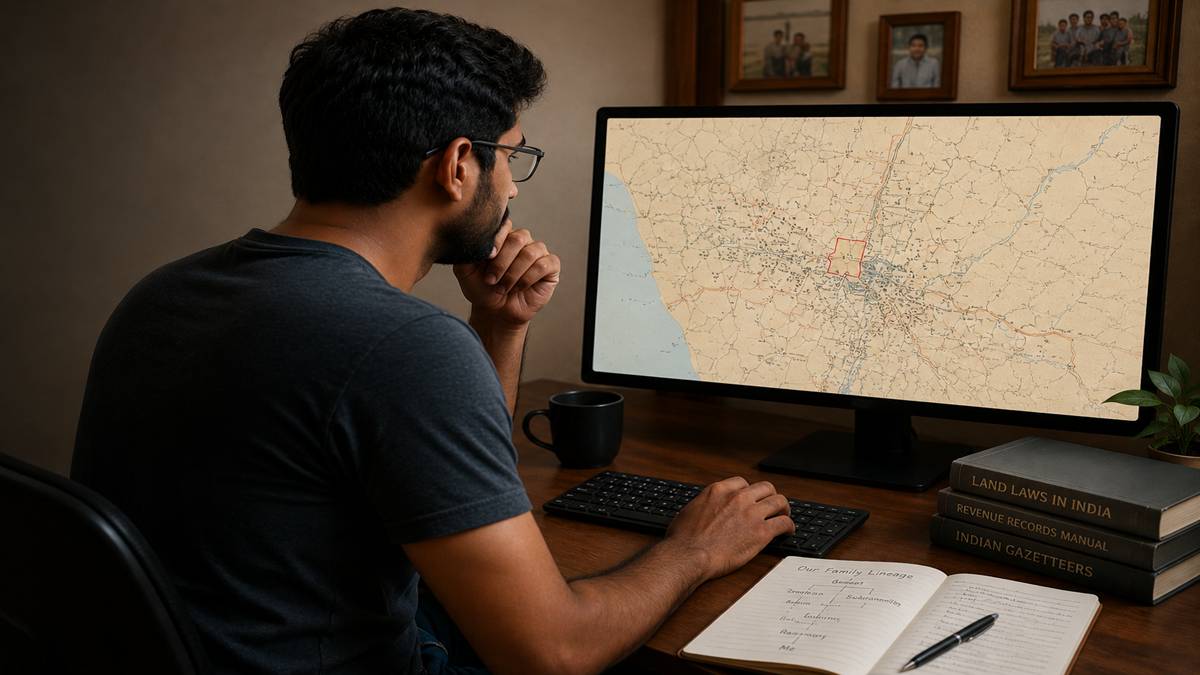
Zahid Khan, a senior technology executive, recently shared an impressive example of how AI is bridging the gap between modern tools and traditional roots.
Using Anthropic’s Claude AI, specifically its Cowork tool, Khan successfully traced and mapped his ancestral farmland in Mohammadpur village, Uttar Pradesh, turning a maze of complex government land records into clear, navigable locations on Google Maps.
In a LinkedIn post that has drawn significant attention, Khan recounted how his late father had inherited the agricultural land, which had been passed down through several generations. Despite the deep family connection, Khan had rarely visited the village, making the exact location of the plots elusive.
What once required navigating dense bureaucratic paperwork and physical visits became remarkably simple with AI assistance. Claude helped identify and interpret the land records, digitise plot layouts, and overlay them onto satellite imagery with precise boundary markings.
Khan shared screenshots of the entire process, from scanned land ownership documents to the final Google Maps view clearly highlighting ancestral plots.
How AI decoded difficult government land records
Khan stated that the biggest challenge was navigating several government land-record ports consisting of complex Hindi legal terminology and technical mapping formats.
He described the language used in the records as “the kind of Hindi that makes legal documents feel like ancient scripture.”
Using Claude Cowork’s “computer use” feature, the AI tool reportedly scanned for plots related to his father’s name, including shared ownership entries. The system then extracted Gata Sankhya numbers, this is usually used to identify land parcels in Uttar Pradesh revenue records.
As per Khan, the AI assistant also found out that the mapping system was using UTM coordinates instead of standard GPS-style latitude and longitude coordinates.
He further added that the tool suggested a process to capture polygon boundaries across all identified plots before converting the data into a format compatible with Google Maps.
What did Claude actually do?
The AI workflow eventually generated a KML file, which included mapped polygons for around 25 land parcels. Those files were then uploaded to Google Maps, creating outlines visible over satellite imagery.
“Exactly what I need to figure out where to drive down if I want to enquire the land, “ Khan said while describing the results.
The images attached to the post showed coloured plot overlays near roads, agricultural fields, schools, and official land-record documents.
Khan added humorously that the project pushed him through multiple Claude subscription plans, stating that he upgraded “from the free tier>Pro>Max subscriptions for Claude.”
‘What a fantastic case of AI use,’ say netizens
Khan’s post drew comments from many professionals across technology, finance and product management sectors. Many of them said the example underlined how AI could simplify tasks that are otherwise difficult for ordinary users.
A user commented that the coordinate conversion stage stood out because it involved a technical obstacle that people would struggle to solve independently. “What fantastic use case for using AI at the personal level,” he stated.
Another user mentioned the broader efforts around AI-based land record mapping and tokenisation projects in India. He said that young entrepreneurs were already working on “tokenisation and AI library mapping for land records and real estate.” Howver, the user also raised question that “how the ecosystem will allow them given the amount of corruption that is in land dealings.”
Meanwhile, in a separate reaction, a user mentioned that the post inspired her to try a similar process for her own family property. “I need to do this for my ancestral land too!” she commented.
Disclaimer: This story is based on a post shared by a social media user. The details, opinions, and statements quoted herein belong solely to the original poster and do not reflect the views of Financialexpress.com. We have not independently verified the claims.