



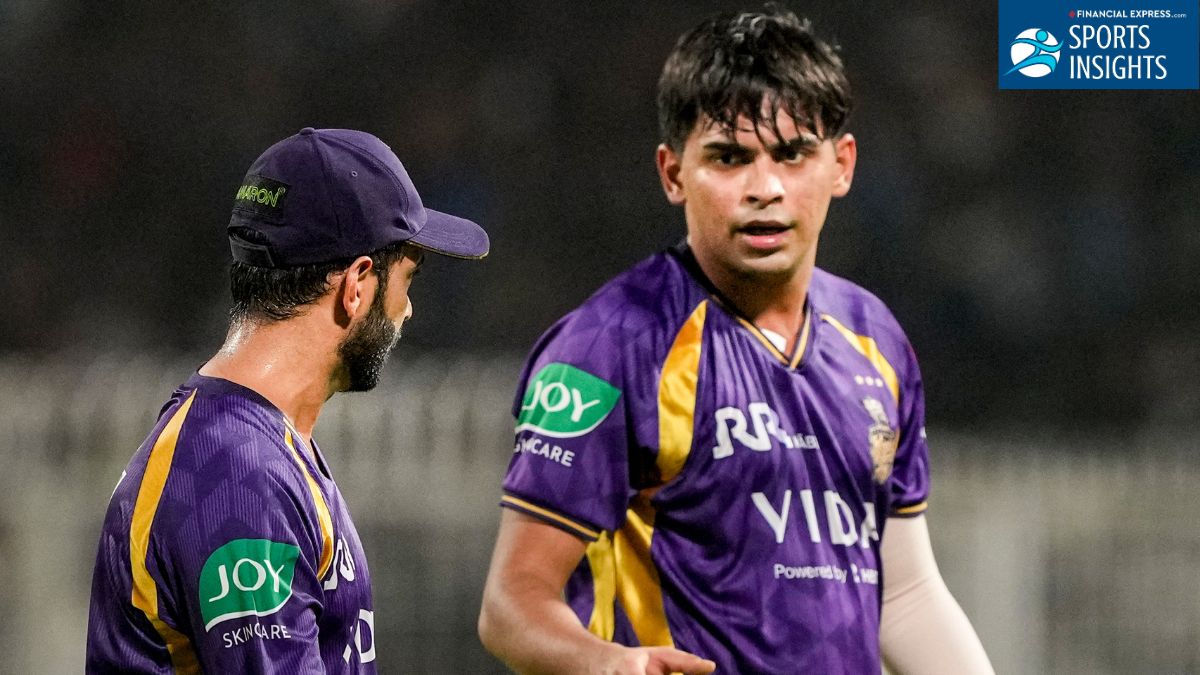
Yogendra Tyagi sold his land.
All 2.5 acres of it. The farming family from Dhanaura village in Hapur had nothing after that. No savings. No safety net. Just the quiet faith that their son’s fast-bowling career was worth more than everything they owned.
The reason they sold it was a football warm-up. Not a match. A warm-up. Kartik fractured his leg before his second Ranji Trophy game and the pelvic bone injury followed. The medical bills came and the land went and the boy lay in a hospital bed wondering if this was already over.
He was sixteen years old.
The Coach Who Saw a Fast Bowler Hiding in an Opening Batsman
Before any of this, there was Meerut. A local cricket academy. An eleven-year-old boy who walked in wanting to bat.
Vipin Vats took one look at him and said no.
Vats had already produced Bhuvneshwar Kumar and Praveen Kumar from this part of Uttar Pradesh. He knew what fast-bowling potential looked like before the kid himself did. Six-foot-three. High arm action. A body built from lifting agricultural sacks since childhood.
Vats told him fifty percent of the development work was already done just by how God had made him.
He handed him the ball instead of the bat.
Tyagi took wickets. Kept taking them. Made the UP Under-19 side. Made his Ranji Trophy debut at sixteen against Railways in October 2017, still in school, with forearms shaped by farm labour and a run-up nobody had taught anyone else.
Then the football warm-up happened and everything stopped.
One Quarter-Final That Nobody Forgot
When Tyagi came back, he came back angry. Not visibly. He is not that kind of person. But the hunger showed in the bowling.
At the 2020 Under-19 World Cup in South Africa, India needed someone to attack and he was that person for six games. Eleven wickets. Average of 13.9. Economy of 3.45.
In an age-group tournament where batters are often tentative and nervous, those numbers are what a serious fast bowler produces. Tyagi was producing them at nineteen, on foreign pitches, with a body that had already broken once.
The quarter-final against Australia in Potchefstroom is where people sat up.
Australia’s top order had batted through the tournament with comfort. Good players, technically organised, not easily rattled. Tyagi took four wickets for 24 runs. The first three came in his 1st over itself & Australia were 4 wickets down after Tyagi’s 9th delivery of the game.
He was bowling full, hitting the seam, moving it off the surface, and doing it at a pace that Under-19 batters simply had no answer for.
IPL franchises had been watching. At the auction later that year, Rajasthan Royals paid 1.3 crore for him. A number they arrived at after a bidding war. For a nineteen-year-old from a farming village in UP who had not yet played a full domestic season.
Four Runs, Two Monsters, and a Body That Said Enough.
Here is the moment that told you everything about what Kartik Tyagi was made of before his body started lying to him.
IPL 2021. Rajasthan Royals versus Punjab Kings. Final over. Four runs needed. Punjab had Pooran and Aiden Markram in the middle.
Aiden Markram, who would go on to captain South Africa. Nicholas Pooran, who would go on to captain West Indies.Between them, more T20 power than most bowling attacks ever want to face.
Two international hitters against a twenty-one-year-old who had barely played. Tyagi ran in. Dot, Single, Wicket, Dot, Wicket, Dot. Punjab got one run. Rajasthan Royals won by two runs from nowhere.
Think about what that takes. Not skill, though skill was absolutely there.
Think about what it takes mentally to bowl a last over in an IPL game, knowing that one full toss ends everything, one bad length and the game is gone, and then execute six deliveries with that weight on your shoulders and come out the other side with one run conceded.
He was twenty years old. Playing in his 2nd IPL season. And he just walked through that like it was a net session.
India were watching. The selectors were watching. Everyone was watching.
Then his body stopped cooperating.
The Years That Went Nowhere
After 2021 and before 2026, Kartik Tyagi played just 6 IPL matches and took 2 wickets at economy of 12.3.
He went from Rajasthan to Sunrisers Hyderabad for four crore in 2022, which is a number that reflects what people thought his ceiling was. Then the shin splints came. Then they came again. Then they kept coming.
Shin splints sound manageable until you understand what they mean for a fast bowler. Every time you bowl at pace, ground reaction force travels up through your foot, your shin, your knee.
If the mechanics of your delivery stride are even slightly off, that force concentrates in the wrong place and the bone protests. For Tyagi, the problem was a jump in his delivery stride that prevented him from repeating his action cleanly. The landing impact was uneven. The shins paid for it every time.
He changed his action. Then changed it again. Dale Steyn, who had worked with him at Sunrisers, watched Tyagi’s first 2026 appearance against Mumbai Indians and posted something that was honest and slightly painful to read.
Steyn wrote that Tyagi seemed to be copying other bowlers’ actions, searching for something hidden, and that at some point you need to stop copying and make the action your own.
Steyn was being kind while also being correct. Because what Tyagi was doing was not searching for aesthetic perfection. He was trying to survive. He was trying to find a way to bowl fast without his body breaking down for the fifth or sixth time in a career that had barely started.
The answer, when it came, was unglamorous. A year off. His childhood physiotherapist. Ground-level work on his run-up and landing mechanics. Making his approach more linear. Reducing the out-jump. Taking the impact off his shins and distributing it properly.
Nobody writes about physiotherapy sessions in farming towns.
Nobody makes documentaries about what happens between the IPL seasons when a young bowler tries to rebuild his body from scratch with limited resources and the knowledge that one more bad injury might end everything permanently.
Tyagi did that work quietly and came back to the 2026 auction at his base price of thirty lakh.
KKR’s Crisis and the Thirty-Lakh Solution
When KKR bought Tyagi at base price ahead of IPL 2026, it looked like a depth signing. Harshit Rana was out with knee surgery. Akash Deep was injured. Matheesha Pathirana was waiting for clearance.
KKR’s fast bowling had a hole in the middle of it and Tyagi was meant to fill some of that gap until the real options returned.
Thirteen matches later, he is KKR’s leading wicket-taker with 18 wickets. The next best pace option in the squad has taken considerably fewer. By a fair margin.
18 wickets in 12 innings. Peak speed of 149.7 kmph. His 6-foot-3 frame gives his yorker delivery a dipping trajectory that makes it very difficult to get under.
Dwayne Bravo, KKR’s bowling coach, gave him something simple to hold onto. Stop thinking about your 24 deliveries in the abstract. Plan them based on the pitch and the batter in front of you. Trust your pace. Use your variations when the situation calls for them, not because you are nervous.
The rebuilt action held. The speeds came back. And KKR, who were looking at a season without any genuine Indian pace bowling, found themselves with the most productive fast bowler in their lineup.
Against Mumbai Indians in damp conditions at Eden Gardens, he took 2 for 37 and got Tilak Varma’s wicket in a game where KKR needed to win to keep playoff hopes alive.
Against Delhi Capitals, He dismissed KL Rahul first and then came back to dismiss dangerous Ashutosh Sharma to restrict them at 142/8.
Against Sunrisers Hyderabad, he broke Travishek powerplay assault by dismissing Abhishek Sharma.
Against Rajasthan Royals, he took 3 wickets in 19th over to restrict them for 155/9
You pick the moments. This is a bowler who shows up in the moments that matter.
What Those Sold Acres Mean Now
Yogendra Tyagi sold his land in 2017 so his son could keep bowling. There is no clean resolution to that sentence. The land is gone. The sacrifice happened. Whether it was worth it is not really a question that has a comfortable answer.
What exists now is a twenty-five-year-old from Dhanaura who is fifth in the IPL 2026 Purple Cap standings. Who rebuilt his body after years of injury with a physiotherapist in a small town. Who came back at base price and is carrying a franchise’s pace attack almost by himself in the absence of everyone else.
The question Indian selectors are quietly beginning to ask is the same one everyone who watched that Potchefstroom quarter-final in 2020 should have been asking for five years.
What would Kartik Tyagi look like if his body had just cooperated?
The 2026 season is giving us the first real answer. And it is worth watching.