



There is a teenager somewhere in this story. Keep them in mind.
April 18, 2008. First-ever IPL match. Royal Challengers Bengaluru was bowled out for 82. The teenager watching had no idea he had just signed up for the longest, most painful loyalty test in Indian cricket history.
He stayed for 2009. Johannesburg. 143 to win. RCB lost by six runs. He remembers Virat Kohli and Roelof van der Merwe getting stumped.
He stayed for 2011. Chennai. He remembers Murali Vijay smashing everything.
He stayed for 2016. In front of a full Chinnaswamy. He remembers confetti falling for the other team. He stayed through the memes.
He got a job in IT, got married and had a child.
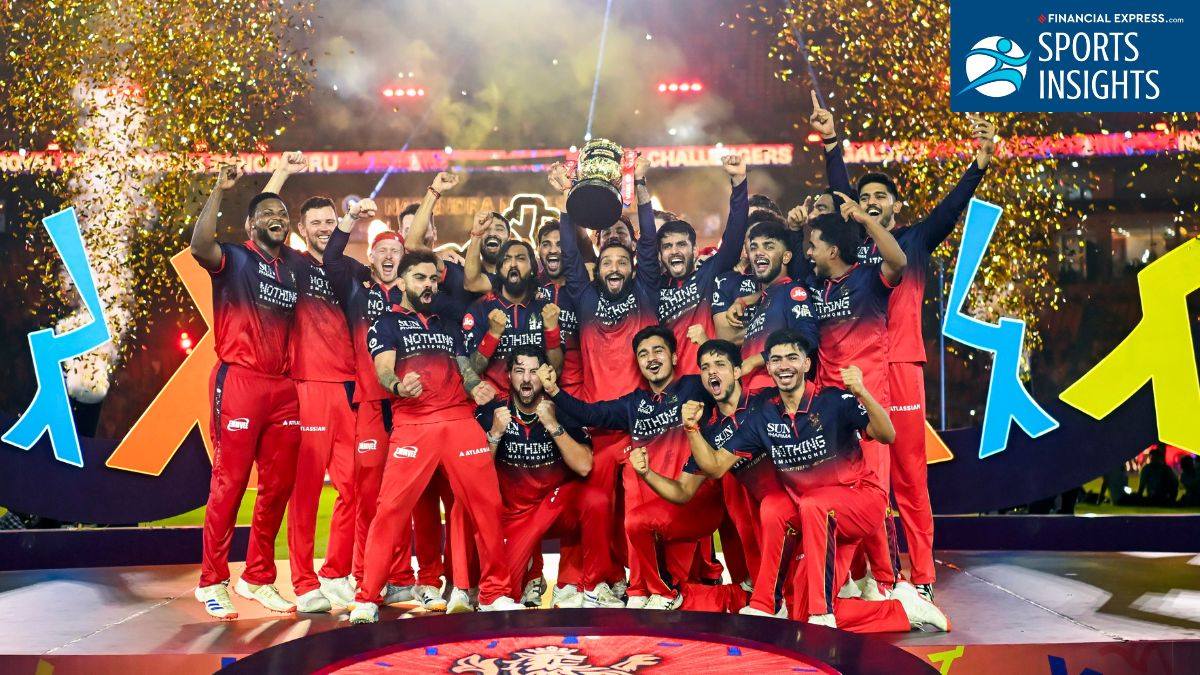
And on May 31, 2026, that same child, now four years old, wore a miniature RCB jersey while the father cried in front of a 55-inch TV. Four trophies in two years. Two IPL titles, back-to-back. Two WPL titles. From 82 all-out to this. You tell me if that is just sport.
That image, the generational handover of stubborn love, is what the 2026 championship actually means for RCB fans.
Ghosts of the Chase
Virat Kohli. The name itself is a story. For the world, he is the chase master. Hundreds in ODIs. Chasing down 300s like he is having breakfast. But in IPL finals, when RCB chased, he kept falling. The strangest thing: the man who owns chasing in international cricket could not finish an IPL final chase.
2009:Johannesburg. Target: 143. He was 20 years old. He made seven off eight balls. RCB lost by six runs
2011: Chennai. 206 to win. He batted at three. Made 35 off 32. But not enough. RCB lost by 58 runs.
2016: The year of madness. 973 runs in one season — a record that still stands. Nine stitches in his right hand. Webbing split open. Blood on the gloves. He batted through pain that would have made most men stop.
In the final at Bengaluru, he made 54 off 35. He did everything a human being could do alone. And RCB still lost by eight runs. That too at home.
He had given blood. He had given sweat. He had given 973 runs. What more?
For nine years after that, the question stayed. At some point, it stops being bad luck and the feeling that the universe has a specific sense of humour directed at one franchise.
May 31, 2026. Ahmedabad. Gujarat Titans. 156 to win. Kohli walked out. He was 37 years old. His legs are not the same. His reflexes have slowed. But the mind, it was clear. He smashed the fastest fifty of his IPL career. Not a slog. A demolition.
Pick-up sixes over midwicket. Cover drives that made fielders watch. Flicks off the pads that raced to the boundary. He finished 75 not out off 42 balls, hit the winning six over long-on, and sealed the chase. Finally. After 2009, 2011, and 2016, he won a final while chasing.
The tag of chase master was no longer a cruel joke in IPL finals. It was proven. At the presentation, he did not scream. He just smiled, a quiet smile, like a man who had finally paid a debt he did not owe. Like a man who could sleep without seeing 2016 every time he closed his eyes.
The Ground That Spat Him Out
Rajat Patidar. In 2021, he played a few games for RCB. Low scores. On April 30, at the Narendra Modi Stadium in Ahmedabad against Punjab Kings, he struggled to make 31, and they dropped him after that game. Sent him back to domestic cricket.
The 2022 mega-auction came. He went unsold. No one wanted him, not even at base price. His career was almost finished at 28. He must have sat in his room in Indore and wondered if that was it. If the dream was over.
Then a backup keeper named Luvnith Sisodia got injured. RCB needed a body. They called Patidar. He came. He hammered a century in the 2022 Eliminator. Injury in 2023. Then Faf du Plessis left. And in 2025, they made him captain.
Here is the thing about sport. In 2021, Ahmedabad rejected him. In 2025, he lifted the IPL trophy at the same ground as captain.
On June 1, 2026, his 33rd birthday, Rajat Patidar stood on the Ahmedabad turf, lifted the IPL trophy for the second consecutive year, and became only the third captain in IPL history to defend a title.
The ground that had taken his pride gave him immortality instead. Nobody would believe that pitch document.
The Trophy Magnet
Krunal Pandya. Three IPL titles with Mumbai Indians – 2017, 2019, 2020. He knows what winning looks like. He knows what champagne smells like. RCB bought him for Rs 5.75 crore in 2025. He said he would bring silverware. People laughed. RCB and silverware?
He got Player of the Match in the 2025 final: 2 for 17. In 2026, he bowled the most economical spell again – 1 for 23 – dismissed Jos Buttler, and squeezed the middle overs so tight Gujarat could not breathe.
Here is a stat that will make you think. Krunal Pandya has won two IPL trophies without Mumbai Indians.
Mumbai Indians, in 13 seasons without Krunal Pandya in their squad, have also won exactly two titles. The symmetry is ridiculous.
The Pandya household now has 10 IPL winner’s medals. Some players just know how to win. It is not in the manual. It is in the blood.
The Stop-Gap Who Became the Main Act
Nobody planned for Venkatesh Iyer to open the batting in the 2026 IPL final.
Phil Salt was fit, he’s a fine T20 opener. The logical choice was obvious. Bengaluru went with the illogical one.
Iyer is a B.Com graduate from Madhya Pradesh who was a net bowler in the UAE in 2021 before becoming one of the most expensive players in IPL auction history at KKR, then found himself here, picked up by RCB for ₹7 crore in the mini-auction as a utility option.
He walked out to open alongside Kohli and hit 32 off 16 balls: four fours, two sixes. He and Kohli put on 62 in 4.3 overs. That partnership effectively finished the game as a contest before Rashid Khan could do his usual damage in the middle overs.
When the middle-order wobble came, when RCB lost a few quick wickets and the target started looking slightly awkward, it was the cushion Iyer had built that kept the asking rate manageable. He was long gone by then. He had already done his job.
He is the kind of player who looks like a stop-gap but functions like a cornerstone. Every champion team needs a madman. Iyer was theirs.
The Real 10-Year Challenge
In 2016, a young Bhuvneshwar Kumar won the IPL with Sunrisers Hyderabad, picking up the Purple Cap on his way. He was 26, swinging the ball, making batters look foolish.
Ten years later, Bhuvneshwar Kumar is 36, playing for a different franchise. The swing that defined him has been rebuilt into something subtler.
Sachin Tendulkar described it: Bhuvi now bowls with a wobble seam, keeping the ball straight so batters cannot read which way it will move. No dramatic swing, just controlled uncertainty.
Kohli called it “uncomplicated consistency.” That phrase probably means more to a 36-year-old Bhuvneshwar than any match award.
In the 2026 final, he dismissed Sai Sudharsan with a bouncer at 138.6 kph and came back to remove Jason Holder: 2 for 29. Not the headline figures, but someone had to set the tone with the new ball, and Kumar did it with the calm that comes from 15 years of doing this.
Most men get old. Bhuvi got smarter. That is the real 10-year challenge, not a photo on Instagram. A reinvention of the self.
The Man Who Does Not Lose Finals
Josh Hazlewood. Look at his record. U-19 World Cup 2010. CLT20 2012. ODI World Cup 2015. BBL 2020. IPL 2021. T20 World Cup 2021. ODI World Cup 2023. IPL 2025. IPL 2026. He keeps adding to the list.
The man has never lost a major white-ball final. In 2026, he dismissed Shubman Gill, top edge to mid-off. Gill is a golden boy. Hazlewood does not care about gold. He cares about lengths. Then he came back and removed Arshad Khan: 2 for 37.
He is built for big moments. His action does not change under pressure. His line does not change. He does not suddenly try a slower ball when the match is on the line just to look like he tried something. He trusts his process.
In a sport full of players who fall apart in big moments by thinking too much, Hazlewood’s quality is that he thinks exactly the right amount.
Young bowlers should study him, not for his action, but for his brain.
The Future in a Room of Old Men
The RCB bowling attack is not young. Bhuvneshwar Kumar is 36. Josh Hazlewood is 35. Krunal Pandya is 33.
And then there is Rasikh Salam Dar, 26 years old, bowling like he has nothing to lose, which is the most useful mindset you can have when bowling against dangerous batters in a final.
He took 3 for 27: dismissed Nishant Sindhu, Rahul Tewatia, and Rashid Khan. He was the best bowler on the night.
There was a moment earlier in the tournament when Rasikh sent off Travis Head after dismissing him, and Kohli backed him publicly. That small incident said something about the culture Andy Flower has built. Young bowlers are not told to suppress their fire. They are told to direct it.
Rasikh is what comes after this generation retires, the answer to the question of what RCB does when Bhuvi’s knees finally say enough and Hazlewood goes home for good. Based on 2026, the answer looks fine.
The Wizard
There is a reasonable argument that Andy Flower is the greatest franchise cricket coach of the modern era.
Ashes wins with England. T20 World Cup 2010. PSL titles. CPL titles. ILT20. The Hundred. And now back-to-back IPL titles with a franchise that had spent 17 years as the punchline of Indian cricket.
What Flower does, and this sounds obvious but almost nobody does it well, is create an environment where experienced players can keep refining and young players can fail without consequence. Bhuvneshwar Kumar could work on a wobble-seam variation because the coach trusted process over results. Rasikh Salam could bowl aggressively because the coach backed aggression over safe choices.
RCB before Flower were a collection of individual talents assembled without real structure. Flower gave them structure without removing the personality. That is a very difficult balance to strike, and he strikes it everywhere he goes.
If there is a GOAT among cricket coaches, he is sitting right there. Quietly. Smiling. Probably holding a notebook that no one else is allowed to read.
Dinesh Karthik also deserves enormous credit. As batting coach, his understanding of how to rebuild a batter’s confidence, and how to get the best from Patidar and others under pressure, runs quietly beneath all of this. He never makes it about himself. He just makes batters better. That is its own kind of greatness.
What Nobody Can Take
Social media will tell you RCB fans are toxic. That they cause GDP loss. That they are the worst fanbase in sport.
People will keep making jokes. The algorithm rewards the easy narrative, and “RCB fan” has been an easy joke for so long that some people treat it like a fact of nature.
But here is what actually happened on the streets of Bengaluru after the final. Auto-rickshaw drivers celebrating. Flower sellers at KR Market with flags. Ordinary people staying up to watch and then going absolutely loud when Kohli hit that six.
This was not manufactured. There were no corporate engagement metrics behind those street celebrations. Nobody told those people to be happy. They just were, because 18 years of loyalty had finally been paid back in full, and the happiness that comes from waiting is not the same as the happiness from winning easily.
Easy wins are forgotten quickly. The things you had to wait for, the things that cost you something – those stay.
Royal Challengers Bengaluru made their fans wait 17 years for the first title. Then gave them back-to-back in consecutive seasons, like the universe finally felt guilty about all those finals.
They stayed when it was embarrassing to stay. They wore the jersey when wearing it meant being mocked. They refused the easier option of picking a winning team.
The 2026 IPL trophy is partly theirs. And no algorithm, no meme page, no troll army can take it away.
Back to that teenager
That boy from 2008 is not a boy any more. He is a man, now a parent, sitting beside his child after the 2026 trophy lift. He knows something that no social media joke can touch.
For the first time in his life, the team he loved when they were nothing is now everything.
That is not only a T20 tournament for him. That is his life.
And sometimes, life gives you back what you never stopped believing in. Even if it takes 18 years.