



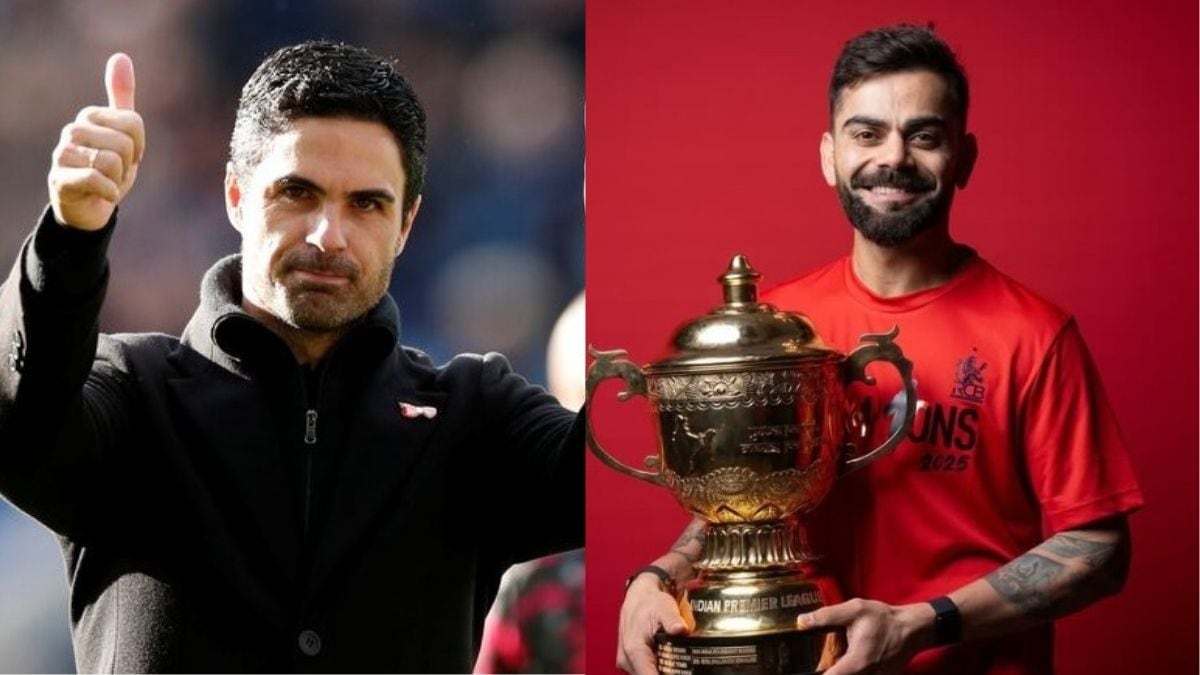
For clubs with vast global fanbases, sustained excellence without silverware can become its own burden. Arsenal know that feeling all too well. So do Royal Challengers Bengaluru (RCB).
And as the Gunners sit atop the Premier League table midway through the 2025-26 season, the question circulating among supporters is a familiar one: could this finally be their year, an “RCB moment” waiting to happen?
RCB’s long-awaited IPL triumph in 2025 ended an 18-year drought defined by near-misses, heartbreak and memes. Arsenal’s wait is even longer. Their last Premier League title came in 2003-04, when Arsene Wenger’s ‘Invincibles’ went unbeaten: 26 wins, 12 draws and a staggering 11-point margin.
More than two decades on, that season has become both a badge of honour and a psychological weight.
Top of the table again but scars remain
As of January 15, 2026, Arsenal are where their fans want them to be. After 21 matches, Mikel Arteta’s side have 49 points from 15 wins, four draws and just two defeats, conceding only 14 goals, the best defensive record in the league.
They are six points clear of second-placed Manchester City, who have 43 points from the same number of games.
On paper, the position is commanding. In context, it is familiar territory. Arsenal have now ended multiple calendar years at or near the summit in recent seasons, only to see the title slip away in the run-in often collapsing under Pep Guardiola’s relentless City machine.
This is where the RCB parallel sharpens.
For years, RCB were the league’s most followed franchise, boasting superstars, viral fan culture and immense commercial pull yet no trophy. Arsenal, too, have remained one of English football’s most supported and watched clubs despite a prolonged league drought. Popularity never translated into closure.
What RCB got right and Arsenal might be mirroring
RCB’s breakthrough in 2025 was not driven by stardust alone. In fact, it was the opposite. Under coach Andy Flower and captain Rajat Patidar, the franchise pivoted away from over-reliance on individual brilliance towards balance, role clarity and collective composure.
Nine different players won Player of the Match awards. Experienced bowlers shored up historic weaknesses. Close games, once a recurring nightmare, were finally closed out. For the first time, RCB looked calm when it mattered.
Arteta’s Arsenal show signs of a similar evolution.
This is no longer a side living off moments from one or two stars. The defensive platform built around William Saliba and Gabriel has been among the league’s most secure. Even during periods of injury disruption, Arsenal continued to grind out results, a hallmark of champions rather than entertainers.
More tellingly, Arsenal have started winning games without dominating narratives. Narrow victories, late goals, controlled second halves, these are the kinds of matches that title winners accumulate quietly.
The psychological hurdle
RCB’s title was as much about shedding baggage as it was about tactics. Years of “Ee Sala Cup Namde” finally turned from meme to reality. The release was emotional, cathartic and validating especially for Virat Kohli, whose loyalty embodied the franchise’s journey.
Arsenal’s equivalent burden is historical rather than individual. The club has finished runners-up three times in recent seasons. Fans have learned caution, not celebration. Even now, with a six-point cushion, few are ready to declare belief openly.
Statistics offer no guarantees either. Historically, teams leading the Premier League at the end of the calendar year have gone on to win the title just over half the time. Arsenal themselves have often been the exception rather than the rule.
City still loom just as pressure once did for RCB
Manchester City remain Arsenal’s biggest obstacle, just as knockout pressure haunted RCB in past IPLs. Guardiola’s side have chased down leads before, and they possess the muscle memory of winning when margins tighten in April and May.
That is where Arsenal’s season will be decided not in January dominance, but in spring resilience.
Arsenal appear closer than ever
RCB finally won because they stopped trying to outrun their past and instead played through it calmly, collectively and without panic. Arsenal, under Arteta, appear closer than ever to doing the same.
They have depth, defensive solidity and crucially experience of falling short. Whether that experience becomes a scar or transforms into a lesson will define the 2025-26 season.
If RCB taught sport anything in 2025, it is this: droughts do end. Arsenal have put themselves in position. Now comes the hardest part- finishing the job.