



India imported just under 26 million tonnes per annum (mtpa) of liquefied natural gas (LNG) in 2025, with an additional 3.5–4 mtpa of long-term contracted volumes scheduled to start deliveries from 2026, a development that is expected to narrow the country’s reliance on spot LNG purchases and increase sensitivity to global price benchmarks.
With higher term supplies coming on stream, the scope for spot LNG buying in 2026 is expected to remain limited unless international prices align with competing fuels such as propane, naphtha and fuel oil. Market participants say India is increasingly responding to dislocations between global price markers rather than locking into fixed supply structures.
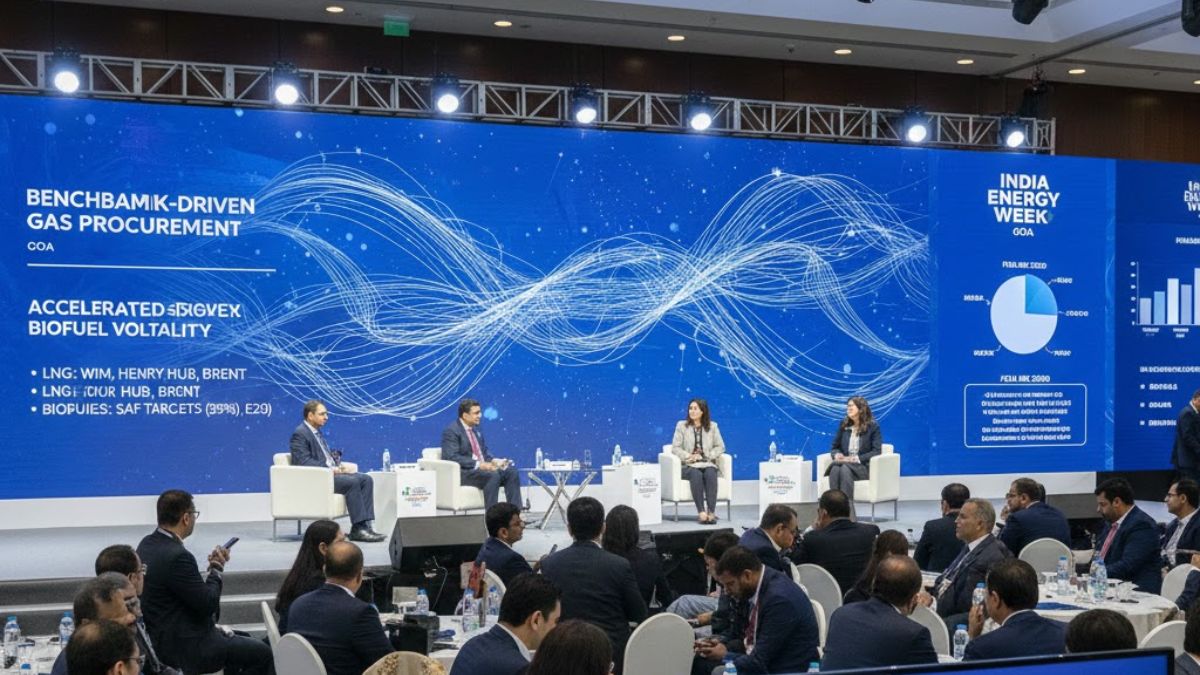
These trends were discussed on Day 2 of India Energy Week (IEW) 2026 in Goa, where speakers highlighted how benchmark-driven gas procurement and accelerated biofuel adoption are shaping India’s evolving energy strategy amid global volatility.
According to Kenneth Foo, Global Director for LNG price reporting, S&P Global Energy, India’s LNG procurement behaviour is increasingly benchmark-linked.
“As global LNG supply growth accelerates, India is increasingly a benchmark-driven swing buyer, stepping into the spot or short-term markets during dislocations between WIM vs Henry Hub vs Brent linked-pricing,” Foo said.
He noted that the arrival of additional long-term volumes from 2026 would constrain spot demand.
“Higher term supply leaves limited scope for spot LNG in 2026, especially if prices remain uncompetitive versus propane, naphtha and fuel oil,” he said.
High Price Sensitivity
Foo said early-2026 pricing briefly made LNG competitive with propane, triggering incremental demand, but the window has since narrowed, underlining India’s high price sensitivity.
“A low-price JKM and WIM environment, the weakest since 2021, is accelerating adoption of floating-price LNG structures,” he said.
According to Foo, the West India Marker (WIM)—listed on the India Gas Exchange—has already underpinned two physical transactions and is emerging as a reference price for re-gasified LNG and LNG contracts. “Uncontracted LNG has a good likelihood of having a WIM reference,” he said.
He added that incremental LNG demand from refineries, city gas distribution and industrial users would depend on LNG remaining competitive beyond non-LNG-priced fuels.
“Gas-based power demand this summer is a key swing factor. A stronger summer could lift spot demand. WIM has been used in NVVN gas-based power tenders in both 2024 and 2025,” Foo said.
He also flagged uncertainty around Russian LNG flows post-2027, noting that India’s ability to absorb such volumes would depend on pricing discounts, benchmark linkages and geopolitical risk tolerance.
Accelerating Biofuel Adoption
Alongside gas, speakers highlighted the growing role of biofuels in India’s transport decarbonisation strategy.
According to Sophie Byron, Global Director for Biofuels Price Reporting, S&P Global Energy, India has outlined Sustainable Aviation Fuel (SAF) blending targets of 1% by 2027, 2% in 2026 and up to 5% by 2030.
“Current availability focuses on co-processed SAF through current refineries, using HEFA pathways and primarily used cooking oil feedstocks,” Byron said.
She added that India is moving close to nationwide E20 gasoline blending, implying annual ethanol demand of over 10 billion litres.
“Across Southeast Asia, Vietnam is preparing for a nationwide E10 rollout, while the Philippines and Indonesia are advancing plans to increase blending beyond current levels,” Byron said, adding that post-2035, Asia’s ethanol blending rates stabilise as gasoline demand peaks.