




Parag Parikh Mutual Fund was founded in May 2013 and, over the years, earned the trust of investors.
It is one of India’s most transparent fund houses, known for its skin in the game and simple yet robust investment processes and systems, guided by the principles of value investing.
The ‘Law of the Farm’ and the Tortoise Ethos
The fund house is guided by the ‘Law of The Farm’, which states that everything takes its own time, and hastening the process will be counterproductive. This, in a way, reflects in its logo – the tortoise, which is a symbol of wisdom and longevity.
Its flagship scheme – the Parag Parikh Flexi Cap Fund (originally called the Parag Parikh Long Term Value Fund) – is among the top-performing equity funds on long-term returns. It is also the largest flexi-cap fund in India with an AUM of over Rs 1.33 trillion.
Unlike many other players in the Indian mutual fund industry, the fund house does not often launch many schemes. It holds a limited product portfolio and believes in launching a scheme when it sees an opportune time that can benefit investors.
Filling the Gap: Why a Large-Cap Fund Now?
Speaking at the unitholders’ meeting in November 2025, the Chairman & CEO of the fund house, Neil Parikh, when outlining the plan to launch a large-cap fund, had stated this new fund will be launched only when “there is a general investor need”, and if they “bring in some differentiation.”
It appears the fund house found a gap to fill. And in some measure, it has been helped by the overall sluggish market sentiment.
The trailing PE of the Nifty 100 (which represents large caps) is now at 21.9, below the 5-year median of 22.6 (as of 19 January 2026).
It is at this opportune time that Parag Parikh Mutual Fund has launched its new fund – the Parag Parikh Large Cap Fund.
How Will Parag Parikh Large Cap Fund be different from others?
Parag Parikh Large Cap Fund, an open-ended equity scheme, is designed to behave like an index fund, but with an active twist.
In other words, it will be actively managed to an extent while investing in largecap companies.
Thus, it will be cost-efficient, like an index fund, with a broad largecap exposure with implementation designed to manage trading and impact costs. The aim is to closely track the index over time, using efficient instruments and maintaining a small active share.
Key Features
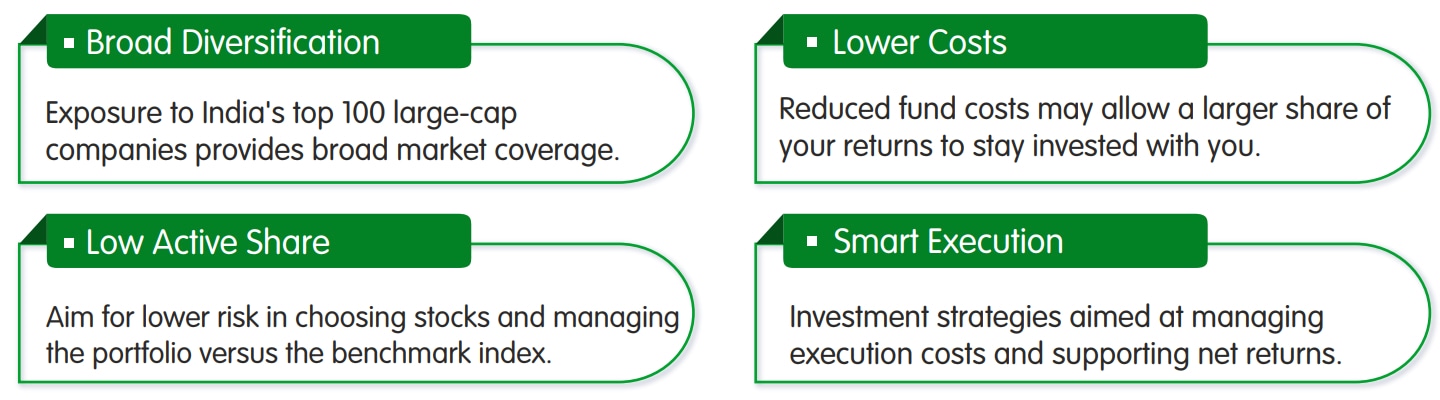
Largecaps, as you may be aware, are the top 100 companies on a full market capitalisation basis. The bluechips.
How it Differs from Traditional Large Cap Funds?
Here’s what distinguishes Parag Parikh Large Cap Fund from other schemes in its category:
| Particulars | Typical Large Cap Mutual Funds | Parag Parikh Large Cap Fund |
| Using Valuations and Fundamentals for Stock Selection | Yes | No |
| Active Share | Generally Higher | Lower |
| Expense Ratio | Typically Higher | Lower |
| Portfolio Turnover | Typically Higher | Typically Lower |
| Performance versus the Index | May diverge significantly from the benchmark index | Aims to keep portfolio positioning close to the scheme’s benchmark |
The Asset Allocation
The fund has the mandate to allocate 80-100% of its total assets to equities & equity-related securities of largecap companies.
Up to 20% of the assets the fund may invest in other largecap companies and equity & equity-related securities of foreign companies.
It may also use equity derivatives for hedging (up to 100%) and non-hedging purposes (up to 50%).
For diversification, the fund would also invest up to 10% of the total assets in units of REITs and InvITs.
Further, for liquidity purposes, the fund holds the mandate to invest up to 20% in debt & money market instruments (including securitised debt as well as participate in fixed-income derivatives for non-hedging purposes). However, the fund will not invest in AT1 and AT2 bonds (which are tier 1 and tier 2 perpetual, high-risk debt instruments issued by banks to boost their core capital, crucial for meeting Basel III regulations).
The fund may also invest up to 5% of the net assets of the Mutual Fund in its own schemes.
What is the Investment Objective?
The objective of the fund is to generate long term capital appreciation and income distribution to investors by predominantly investing in equity and equity-related instruments of largecap companies.
However, there is no assurance that the investment objective of the scheme will be achieved, and it does not assure or guarantee any returns.
The Benchmark: The fund will benchmark its performance against the Nifty 100 Total Return Index (TRI).
The Smart Execution Strategy
Parag Parikh Large Cap Fund to achieve its stated objective will be actively managed.
While aiming to maximise long term total return by investing predominantly in equity and equity-related securities of largecap companies, it does not keep any sector bias.
The fund seeks to take exposure to the Nifty 100 TRI constituents in terms of market capitalisation. It does not intend to buy/sell stocks based on their valuation or fundamentals.
When a company in an Index is merging with another firm, the fund may buy the stock, which is at a discount to the announced merger ratio up to permissible limits.
Similarly, when the Nifty 100 constituents change, the fund may rebalance gradually rather than on the exact index date to seek better execution.
Around corporate actions (demergers/special situations), the fund may phase entries/exits to manage liquidity and impact costs. The aim is to keep the overall active share low, i.e. less than 10%.
When a stock’s near-month futures trade below the cash (spot) price, it may use such futures aiming to obtain exposure more efficiently (subject to limits and regulations).
Similarly, if index futures trade below index levels, it may use such futures to obtain exposure efficiently.
The fund aims to adopt a disciplined yet flexible long-term approach to investing with a focus on generating long-term capital appreciation.
When approaching debt & money market instruments, the fund aims to identify securities which offer an optimal level of yields/returns, considering the risk-reward ratio.
A credit evaluation is carried out to study the operating environment of the issuer, and the short-term as well as long-term financial health of the issuer.
In addition, the investment team of the AMC will study the macroeconomic conditions, including the political and economic environment, as well as factors affecting liquidity and interest rates.
Who are the Fund Managers?
The fund will be co-managed by:
- Rajeev Thakkar (CIO – Equity and Equity Fund Manager)
- Raunak Onkar (dedicated fund manager for overseas securities)
- Raj Mehta (Fund Manager – Equity)
- Rakun Tarachandani (Fund Manager – Equity)
- Tejas Soman (CIO – Debt and Fund Manager – debt)
- Aishwarya Dhar (Fund Manager – Debt).
All of them have vast experience in fund management and have impressive credentials.
The Risk and Investor Suitability
The fund is classified as very high risk on the risk-o-meter.
It is suitable for investors looking to generate wealth over the long term (investment horizon of 5 years or more) with predominant exposure to largecap companies.
Moreover, the fund is an option for those who wish to keep the cost of investing low, compared to a typical largecap fund.
The expense ratio under the direct plan is 0.15%, while under the regular plan, 0.55%. This compares to a 0.20% – 0.30% expense ratio of a typical index fund investing in frontline equities and 0.65 – 0.90% for other actively managed large cap funds.
The Subscription Details
During the NFO period (19 January 2026 to 30 January 2026), the units of the fund are available for subscription at Rs 10.
Thereafter, the fund re-opens for subscription on 6 February 2026.
The fund is offered with a direct and regular plan, and under it, two options: Growth and Income Distribution cum Withdrawal (IDCW).
The minimum investment amount is Rs 1,000 for lump sum and monthly SIP investment, whereas for quarterly SIP it is Rs 3,000.
Should You Consider Parag Parikh Large Cap Fund?
The fund is launched at a time when the Indian equity market is encountering volatility due to ongoing geopolitical tensions and global macroeconomic uncertainty.
In such times uncertain times, large cap funds make sense. They hold the ability to tide through the volatility better than midcaps and smallcaps, or sector or themes.
With Parag Parikh Large Cap Fund, the returns could be index-like, particularly when it is not actively managing, rebalancing or churning its portfolio.
The fund may not significantly outperform the Nifty 100 – TRI with active selection based on fundamentals and/or concentrated bets on specific stocks or sectors.
That said, the risk exposure of the fund would also be lower compared to other actively managed large cap funds.
Consider your own personal risk appetite, investment objective, financial goals, and time horizon before investing.
And if you aren’t sure, reach out to a reach out to a SEBI-registered investment adviser.
Happy investing!
Note: We have relied on data from the scheme information document, flyers and website of the fund house for this article. Only in cases where the data was not available have we used an alternate, but widely used and accepted source of information.
Disclaimer:
The above content is for informational purposes only. Mutual Fund investments are subject to market risks. Please consult your financial advisor before investing.
Rounaq Neroy has over 20 years of experience in the financial markets and investments. He is a close observer of the Indian economy and writes deeply on the capital markets, mutual funds, stocks, precious metals, asset allocation, wealth management, and investment strategy. His editorials provide interesting, actionable investment ideas to guide readers in the journey of wealth creation and make wise decisions. Rounaq was the Head of Content at PersonalFN (Quantum Information Services Pvt. Ltd.), which also owns Equitymaster.com – India’s oldest and trusted equity research house.