



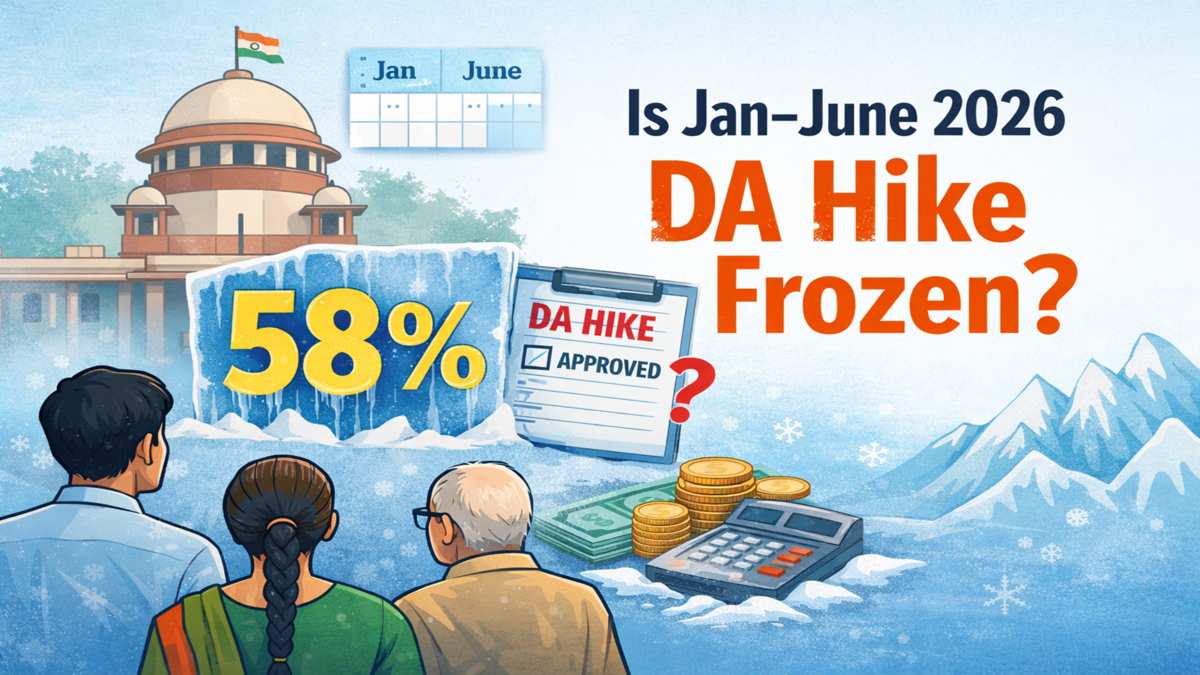
The wait for a Dearness Allowance (DA) hike for the January–June 2026 cycle is getting longer, leaving over 1 crore central government employees and pensioners anxious. Despite expectations, the Union Cabinet in its meeting on Wednesday did not take a call, keeping DA unchanged at 58% for now.
Traditionally, DA hikes for the January cycle are announced by March-end. However, this year has broken the trend, with April already underway and no official announcement yet. This delay has triggered speculation—ranging from a possible freeze in DA hikes to a merger with basic pay—as the transition from the 7th Pay Commission to the 8th Pay Commission unfolds.
Why is the DA hike getting delayed?
Experts say the delay is more procedural than policy-driven.
According to Shankar Kumar, Founder of EZ Compliance, the government is undertaking more rigorous financial scrutiny this time as DA is nearing a crucial milestone.
“The timeline is slightly outside the historical window, but it isn’t a policy shift. The delay is primarily procedural. Since DA is approaching the 60% mark, there is more detailed financial vetting. The government is also aligning this with the transition to the 8th Pay Commission framework from January 1, 2026,” he explained.
This suggests that the delay is linked to broader fiscal planning and structural adjustments rather than any intent to withhold the hike.
Is this delay unusual?
While rare, such delays are not unprecedented—especially during pay commission transitions.
Hemant Choubey, Founder & CEO of Hireduo, said: “This isn’t a shift in policy. It appears to be a ‘data-staggered’ approach. By announcing the hike in April, the government aligns payouts with the new financial year (FY 2026–27), ensuring better liquidity management.”
In simple terms, the government may be timing the hike to fit budgetary and accounting considerations rather than delaying benefits.
Is there any truth to ‘DA freeze’ rumours?
Social media has been buzzing with claims that up to three DA hikes could be frozen and merged later under the 8th Pay Commission.
However, there is no official confirmation of any such move.
DA is a statutory component of salary, revised based on inflation data (CPI-IW). Experts clearly indicate that the hike is not cancelled and employees will receive arrears from January 1, 2026. They are also of the view that the delay is temporary and procedural.
What hike can employees expect?
Based on 2025 CPI-IW data, reports suggest a 2% DA hike, taking the allowance from 58% to 60%.
The 60% mark is significant because:
It often triggers discussions on DA merger with basic pay
It has implications for salary restructuring under future pay commissions
What does the delay mean for employees?
In the short term, employees may feel some financial pressure.
Shankar Kumar noted: “You are effectively dealing with 2026 inflation on 2025 salary levels. But once announced, the hike is retrospective. For example, an employee with ₹56,100 basic pay could receive arrears of around ₹6,700–₹7,000 for January–March.”
However, there are also indirect effects.
Hemant Choubey added: “A lump-sum arrear may temporarily push employees into a higher tax bracket for that month. Also, delays in DA-linked components like HRA and PF contributions mean missing out on compounding benefits during the period.”
Summing up…
There is no indication that the DA hike has been frozen. The delay appears to be driven by transition to the 8th Pay Commission, higher DA levels nearing 60%, and financial vetting and fiscal alignment.
For now, DA remains at 58%, but a decision is expected soon—likely with arrears—bringing relief to employees and pensioners who have been waiting since January.
Disclaimer:
The information provided in this article is based on publicly available data, expert opinions, and media reports. The government has not made any official announcement regarding the Dearness Allowance (DA) hike for the January–June 2026 cycle at the time of writing. Readers are advised to wait for formal notification from the government for any confirmed changes.