




Delhivery is finally making money.
That in itself is not the most interesting part.
For years after its listing on the stock market, the company seemed to be a familiar Indian startup story: size came first, gains could wait.
But the true story had started much earlier.
Between FY19 and FY22, deliveries rose from 148 million to over 582 million, as the company quickly expanded its network across India.
Warehouses multiplied, line-haul capacity increased, and the network grew to cover 18,074 pin codes by the end of FY22.
The company was building something far bigger than a courier business. It was building a national logistics platform designed to handle complex and uneven supply chains in India.
By the time it was on the secondary market, the core belief was already in place: once the network reached a sufficient size, operational leverage would take over.
For a long time, that potential remained just that, potential.
Because the obstacle was never service demand.
It was the kind of demand Delhivery was focusing on.
Much of its progress came from low-margin, high-intensity e-commerce cargo, where pricing power was inadequate, competition was aggressive, and the last-mile costs stayed fundamentally high.
Even as volumes mounted, profitability did not. By the end of the financial year 2023, that hypothesis was beginning to break.
Despite handling hundreds of millions of shipments, the operating margins remained low between 2-6%, and net profitability continued to be elusive till FY2024.
Costs, from goods to sorting to last-mile delivery, had grown faster than the company’s capacity to monetise its network.
The issue was no longer whether Delhivery could expand.
It was what that growth was worth.
And that is where the story gets interesting.
When unit economics broke down
If the size was not restoring the business, something deeper had to be.
The turning point did not come from a decline in demand. It came from pricing stress and falling yields.
The management accepted that competitors’ aggressive pricing had begun to eat away at margins in the main express parcel business.
Moreover, shipment numbers were no longer rising meaningfully, while freight and last-mile delivery costs stayed high.
This trend created an operational gap. More shipments did not turn into more profit.
At that point, the reasoning of the business had to change.
Delhivery was pushed to move its attention from volume expansion to returns per shipment, and from acquiring more clients to maintaining price discipline.
The changeover was not about doing more. It was about earning better from what was already being done.
Walking away from bad growth
The first evident sign of this change was counterintuitive. It showed up not in improving margins, but in reducing volumes.
Courier parcel shipments expanded just about 1.1% YoY in Q4 FY25, reaching 177 million shipments despite a strong e-commerce environment.
This reduction was not accidental. It was intentional.
The company left or repriced low-return agreements, lowered exposure to non-paying clients, and improved per-shipment contribution.
In a business built on magnitude, choosing to reduce growth is not an easy decision. But it was needed.
And it worked.
As volume growth moderated, cost control improved. The operating margins expanded from 4% in Q1 FY25 to 6% in Q1 FY26.
The turnaround, in effect, began before growth resumed, a sign that the structural economics were beginning to reset.
PTL takes over
But cost control alone does not generate an about-turn. It only steadies the business.
The true shift came from changing where growth came from.
Delhivery began restructuring the engine of its business by expanding its Part Truckload (PTL), a segment with completely different economics from express cargo delivery.
PTL is a core logistics service for businesses to ship medium-sized goods that do not need a full truckload. This service allows clients to share one vehicle, making it economical, dependable, and faster compared to the regular truck delivery services offered by other logistics companies.
Between FY24 and FY25, PTL moved from a ₹46 crore loss to a ₹101 crore profit, with margins expanding to 5.4% YoY. The volume growth stayed robust, reaching ₹1696 crore, up 19% YoY in FY25, and continued to expand in FY26.
This growth counted because PTL is not driven by the same limitations.
It deals in higher ticket sizes, low last-mile complications, and more steady pricing. As its share improved, it began altering the overall margin profile of the company.
What appeared as diversification was, in reality, margin design.
When the network finally starts working
This shift in mix would not have been enough on its own without another change, utilisation.
For years, Delhivery had built capacity ahead of demand. It invested in a nationwide network covering thousands of pin codes, along with big sorting centres, line-haul setups, and last-mile resources.
But that came at a high price.
High fixed costs were being spread across underutilised volumes, restricting operational leverage and keeping margins under pressure.
Now, that equation is inverted.
Express parcel volumes rebounded to 208 million in Q1 FY26, growing 13.6% YoY, while PTL freight volume expanded 14.7% YoY.
More importantly, operating margins across express and PTL improved, hovering between 10-16%.
That’s when the improved model began working.
The same network now carries a higher output, lowering cost per shipment and expanding margins. Size, which was once a drag, started acting as an advantage.
Success, now supported by numbers.
By the end of FY25, the cumulative effect of these shifts started becoming visible in the financials.
Revenue was ₹8,932 crore. The service operating profit rose to ₹988 crore, while margins increased meaningfully, going from the negative levels in FY24 to positive.
What’s more, Delhivery had a net profit of ₹141 crore excluding exceptional items, compared to a loss of ₹269 crore the previous year.
This impetus has continued into FY26, with profit after tax reaching ₹260 crore in 9MFY26 and margins maintaining their upward course. The express parcel shipment volumes rose 30.2% YoY to 748 million, and PTL service shipped 1,442K metric tons rising 16.5% YoY during the same nine-month period in FY26.
The return on equity in the past year was 2%, while the return on capital employed was 2.7%.
What stands out is not just the return to profitability, but how it was achieved. Not through faster growth. But through better economics per shipment.
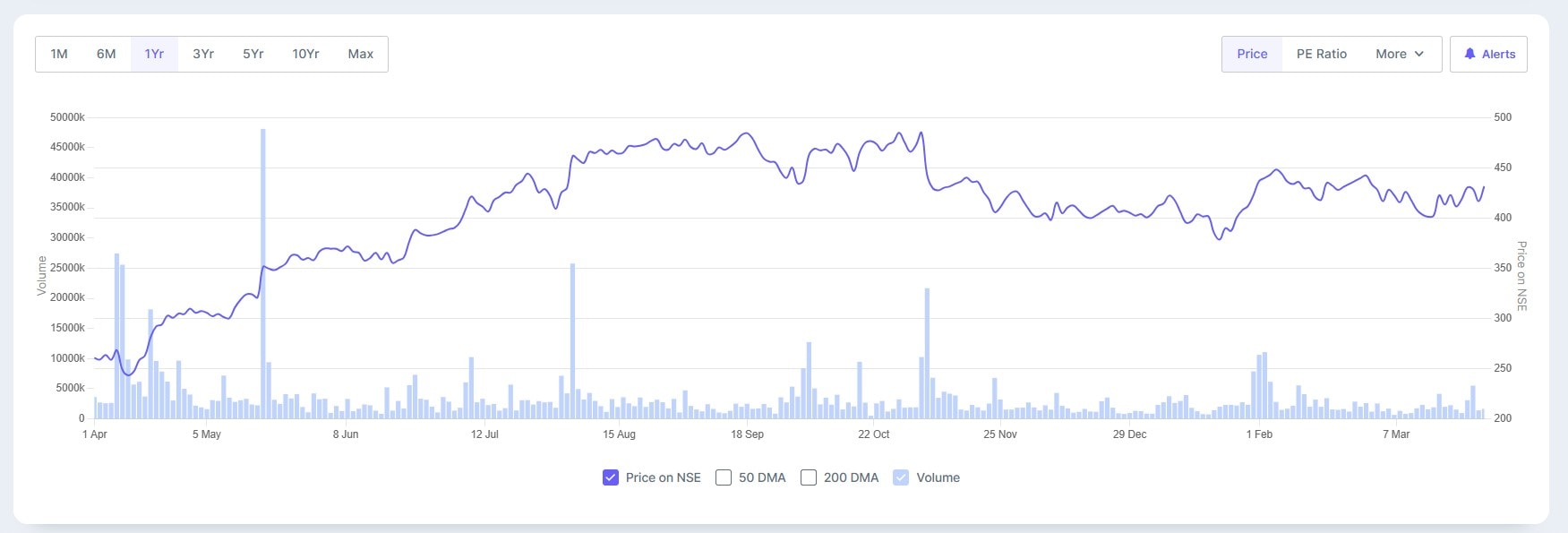
This change is noticeable in the stock price as well. It rose 60% in the last year.
Delhivery 1-Year Share Price Trend
From optimisation to consolidation
Once the business steadied, the next phase began to take shape. Delhivery moved from optimisation to solidification.
The acquisition of Ecom Express helped, and it is showing up in higher volumes, particularly in express cargo shipments.
But unlike the phases where growth ate into margins, this phase has the capacity to strengthen them.
Higher volumes are now flowing through an improved network. Greater density improves route efficiency, lowers cost per shipment, and improves operating leverage.
This current trend is not a return to old growth patterns, but a more measured, margin-accretive version of it.
On the valuation front, it trades at P/E multiples of ~181x, much higher than the sector median at 19x. Its EV/EBITDA (Enterprise Value/ Earnings before interest, taxes, depreciation and amortisation) of ~35x is at a premium compared to the sector median of ~11x.
Yet, the risks aren’t far behind
That said, this story is not without its weaknesses.
Margins, while increasing, are still not at levels seen in more mature logistics businesses. Core profitability is still vulnerable to pricing pressure, particularly in the extremely competitive e-commerce segment.
Integrating Ecom Express has also created operational issues and short-term cost pressures.
There is also another crucial challenge.
Can Delhivery keep its price discipline and cost control as volumes rise again? It is still untested over a full cycle.
Usually, logistics businesses struggle to balance growth with profitability, often going back to aggressive pricing to gain market share.
Avoiding that trap will be critical.
What’s next for Delhivery
The next phase of the story will be influenced not just by Delhivery, but by the development of India’s logistics ecosystem.
E-commerce growth is expected to stay strong, but its characteristics are changing. Faster delivery expectations, high return rates, and increasing competition among platforms are pushing logistics providers to become effective and flexible.
At the same time, the broader shift to organised logistics, led by GST, formalisation, and supply chain integration, is creating fundamental advantages for players that are expanding their reach.
This is where Delhivery’s position becomes relevant.
It runs at the junction of e-commerce, freight, and supply chain services, with a network that is already created and now being optimised.
If the next phase of India’s logistics growth is classified less by expansion and more by efficiency, Delhivery will be entering the sector from a position stronger than before.
The question now is not whether it can build in size.
It is whether it can maintain discipline as scale returns, and in doing so, help explain what a profitable logistics platform in India actually looks like.
Want to keep an eye on this business? Add it to your watchlist.
Disclaimer:
Note: We have relied on data from www.Screener.in throughout this article. Only in cases where the data was not available have we used an alternate, but widely used and accepted source of information.
The purpose of this article is only to share interesting charts, data points, and thought-provoking opinions. It is NOT a recommendation. If you wish to consider an investment, you are strongly advised to consult your advisor. This article is strictly for educative purposes only.
Archana Chettiar is a writer with over a decade of experience in storytelling and, in particular, investor education. In a previous assignment, at Equentis Wealth Advisory, she led innovation and communication initiatives. Here, she focused her writing on stocks and other investment avenues that could empower her readers to make potentially better investment decisions.
Disclosure: The writer and her dependents do not hold the stocks discussed in this article.
The website managers, their employees (s), and contributors/writers/authors of articles have or may have an outstanding buy or sell position or holding in the securities, options on securities, or other related investments of issuers and/or companies discussed therein. The content of the articles and the interpretation of data are solely the personal views of the contributors/ writers/authors. Investors must make their own investment decisions based on their specific objectives, resources, and only after consulting such independent advisors as may be necessary.