



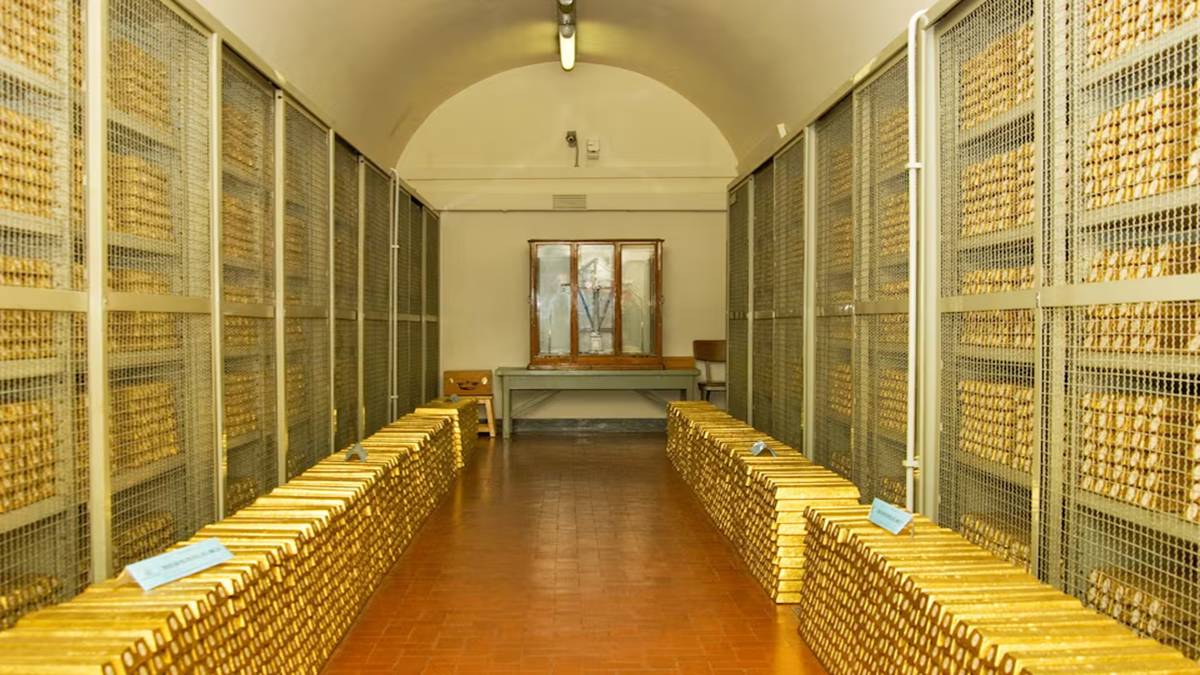
Gold has crossed a key milestone in the financial markets that would have seemed unthinkable just a few years ago. For the first time, gold has surpassed US government bonds as the leading reserve asset globally, driven by massive central bank purchases and a price rally that has nearly doubled gold’s value in just two years.
Central banks now hold more gold than US government bonds or euros in their foreign exchange reserves. The share of gold in total official foreign reserves reached 27% at the end of 2025 — surpassing both the euro at 15% and US Treasuries at 22%. In other words, gold is now the single largest component of global official reserves.
But is it only a valuation story?
There is an important caveat worth understanding. Gold prices surged by around 65% in 2025 and 25% in 2024. Such a dramatic price rally mechanically increased gold’s share of total reserves, even if central banks had not bought a single additional tonne.
When corrected for valuation effects — using the gold price at the end of 2023 — the picture looks different. The share of the euro (16%) and gold (16%) is at par, while the share of US Treasuries remains markedly higher at 26%. So while the headline numbers are striking, the structural shift is less dramatic than it appears on the surface.
Central Banks Are Still Buying — Consistently
That said, the buying of gold by central banks is not slowing down. Persistent geopolitical tensions continued to drive strong central bank demand for gold in 2025. While central bank gold purchases decreased to around 850 tonnes in 2025 — down from over 1,000 tonnes annually between 2022 and 2024 — they remained well above historical norms, despite historically high gold prices.
Who Is Selling — and Why?
Not all central banks are selling. Following the outbreak of war in the Middle East, the Turkish central bank sold or loaned out about 130 tonnes of gold — one of the largest reserve drawdowns in recent years — to defend its currency, mitigate soaring energy import costs, and manage economic fallout. In 2026, besides Turkey, other known sellers include Russia, reportedly to fund its ongoing war against Ukraine.
Buying in 2026
In 2026, after a surprising net sale of 30 tonnes in March — led by Turkey’s massive 60-tonne offload — April saw a sharp reversal. The World Gold Council reported that central banks resumed net gold purchases in April, having bought 17 tonnes.
The physical stock of gold held by the RBI as of March 31, 2026, was 880.52 tonnes, which has remained unchanged as of June 3.
Is Trust in the Dollar Declining?
This brings up a bigger and more uncomfortable question: are global central banks losing faith in dollar-backed assets?
What this trend may indicate is that global central banks are relying more on gold rather than holding bonds — even bonds issued by the world’s most powerful government. Bonds, it is worth noting, are denominated in the issuing government’s own currency — in this case, US dollars.
To understand the stakes, it helps to understand what a fiat currency actually is. A fiat currency — such as the Indian rupee, US dollar, euro, pound, or yen — is a trusted medium of exchange issued by a recognised government or authority. The Indian rupee and the US dollar, for example, are backed by the “full faith and credit” of their respective governments. Essentially, fiat currency is government-issued money that is not backed by a physical commodity like gold or silver.
What the ECB’s Christine Lagarde Says
Not everyone is convinced that gold’s rise signals a permanent shift. In a recent report, Christine Lagarde, President of the European Central Bank, wrote candidly about the limitations of gold as a reserve asset.
“Going forward, gold faces limitations as an official reserve asset compared with the major fiat currencies: its price is volatile, it is not remunerated, and, when held in physical form, it is costly to store. More importantly, the supply of gold is not fully elastic and does not adjust seamlessly to shifts in international demand for liquidity,” wrote Lagarde.
The bottom line
Gold’s rise to the top of global reserve assets is partly a valuation story and partly a genuine structural shift — driven by geopolitical anxiety, distrust of dollar dominance, and a decade of relentless central bank buying. Whether it marks a permanent realignment or a cyclical peak remains the defining question for global reserve managers in the years ahead.
Disclaimer: This article is for general informational purposes only and does not constitute investment, financial, or trading advice. Gold prices are subject to significant market volatility. Past trends in central bank gold buying are not indicative of future behaviour or gold price movements. Readers are strongly advised to consult a SEBI-registered investment advisor or qualified financial professional before making any gold-related investment decisions.