



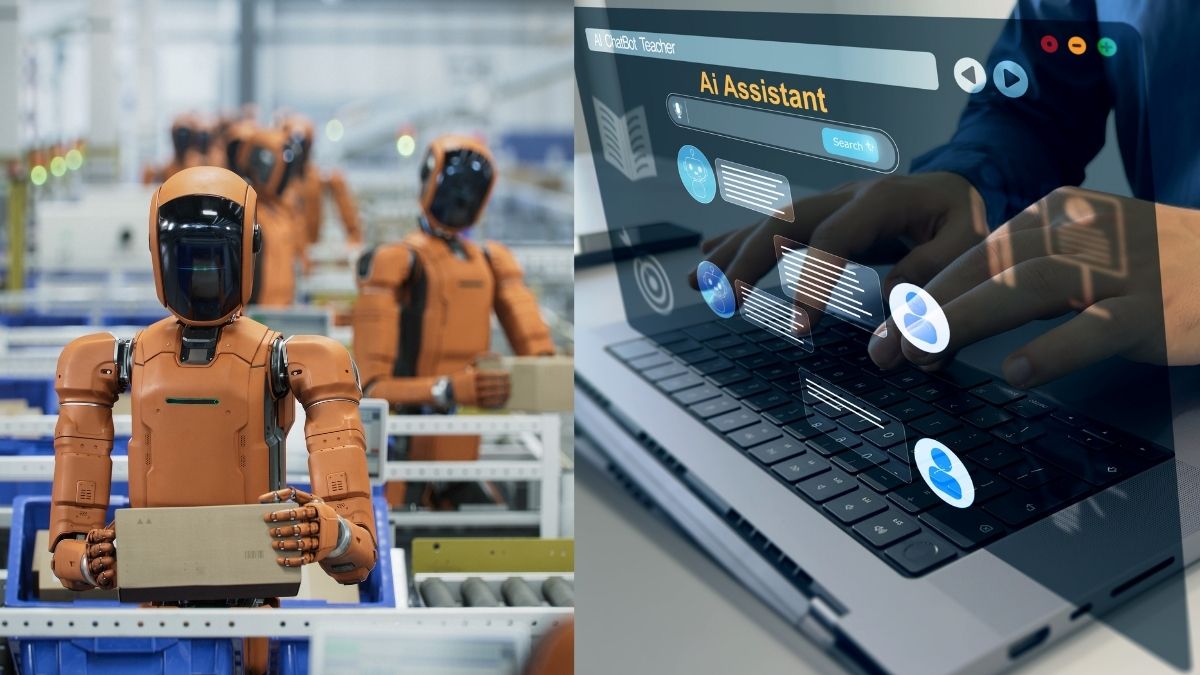
$25,000 per day to teach AI use
There’s no doubt that AI is rapidly becoming a core workplace skill. Global financial institutions are now racing to train employees in using tools like OpenAI’s ChatGPT and Anthropic’s Claude. Companies fear that employees lacking AI skills could quickly fall behind competitors in an increasingly automated financial environment. One startup capitalising on this urgency is Wall Street Prompt, founded in 2025 by former SoftBank employees Felipe Sinisterra and Dave Wang. According to a Bloomberg report, the company has already attracted major clients such as Citigroup, Bank of America and T Rowe Price. The striking part is the company reportedly charges up to $25,000 per day for these sessions, highlighting how valuable AI literacy has become on Wall Street.
Humanoids achieve 200-hour shift
US robotics startup Figure AI has claimed a major milestone in humanoid automation after its Figure 03 robots completed a 200-hour autonomous livestream without any hardware failures. During the test, the robots processed nearly 250,000 packages continuously using the company’s Helix-02 AI system. Figure’s robots first crossed 24 hours of uninterrupted work earlier this month before scaling up to the longer experiment. The livestream featured three humanoid robots autonomously sorting small packages around the clock. While many companies showcase flashy demos, maintaining consistent autonomous operation for extended periods without breakdowns has proven difficult.
Robot dogs with famous human faces
Digital artist Mike Winkelmann, better known as Beeple, is once again pushing conversations around AI and creativity with a new art exhibit in Palo Alto. Beeple’s work often combines satire, politics and internet culture with futuristic imagery, making him a central figure in debates around whether AI-generated creations should be considered ‘real art’. The latest exhibition blends surreal digital installations with experimental robotic sculptures, including robot dogs designed with famous human faces. The show explores how AI is reshaping visual storytelling, authorship and identity in contemporary art. The Palo Alto exhibit also reflects Silicon Valley’s growing interest in AI-powered creative tools, where technology companies and artists increasingly intersect.
Earbuds as visual assistants
Researchers at the University of Washington have developed an experimental system called VueBuds that turns wireless earbuds into AI-powered visual assistants. The prototype uses tiny low-resolution cameras embedded in off-the-shelf earbuds to capture what a user is seeing in real time. Images are transmitted via Bluetooth to a smartphone or nearby device, where an on-device AI model processes visual information and responds within roughly a second. For example, a user could point toward a Korean food package and ask for a translation, receiving spoken feedback instantly through the earbuds.
AI films shake up Cannes
AI-generated films made using ByteDance technology attracted major attention at this year’s Cannes Film Festival, signalling how rapidly generative AI is entering mainstream entertainment. Two short films created using ByteDance’s Seedance 2.0 AI model were selected from more than 1,000 entries across 120 countries at Marché du Film, the festival’s business marketplace. But the biggest talking point was Hell Grind, a 95-minute action-fantasy film promoted as the world’s first fully AI-generated feature-length movie. Supporters argue AI could drastically lower production costs and democratise filmmaking, while critics fear job losses and the erosion of artistic authenticity.
AI remixes
Streaming giant Spotify and music label Universal Music Group have signed a landmark licensing agreement that could reshape the future of AI-generated music. Under the deal, Spotify Premium subscribers will soon be able to legally create AI-powered covers, mashups and remixes using licensed songs from Universal’s catalogue. The feature will operate as a paid add-on built around what the companies describe as a ‘consent, credit and compensation’ model. Artistes whose music is used in AI-generated remixes will receive attribution and a share of revenue generated from the tool.
A collar that lets pets talk to you
A Chinese startup is promising to bridge the communication gap between humans and pets. Meng Xiaoyi has unveiled an AI-powered collar designed to translate animal sounds and behaviour into human language. The wearable device, fitted around a pet’s neck, analyses vocalisations such as barks and meows along with emotional and behavioural patterns. The company claims the system can interpret pet communication with an accuracy rate approaching 95%. Using AI models trained on animal sounds and behavioural data, the collar attempts to convert signals into understandable human speech through a companion app. The concept taps into a growing global market for smart pet technology, where consumers increasingly spend on AI-enabled trackers, feeders and health monitors.