



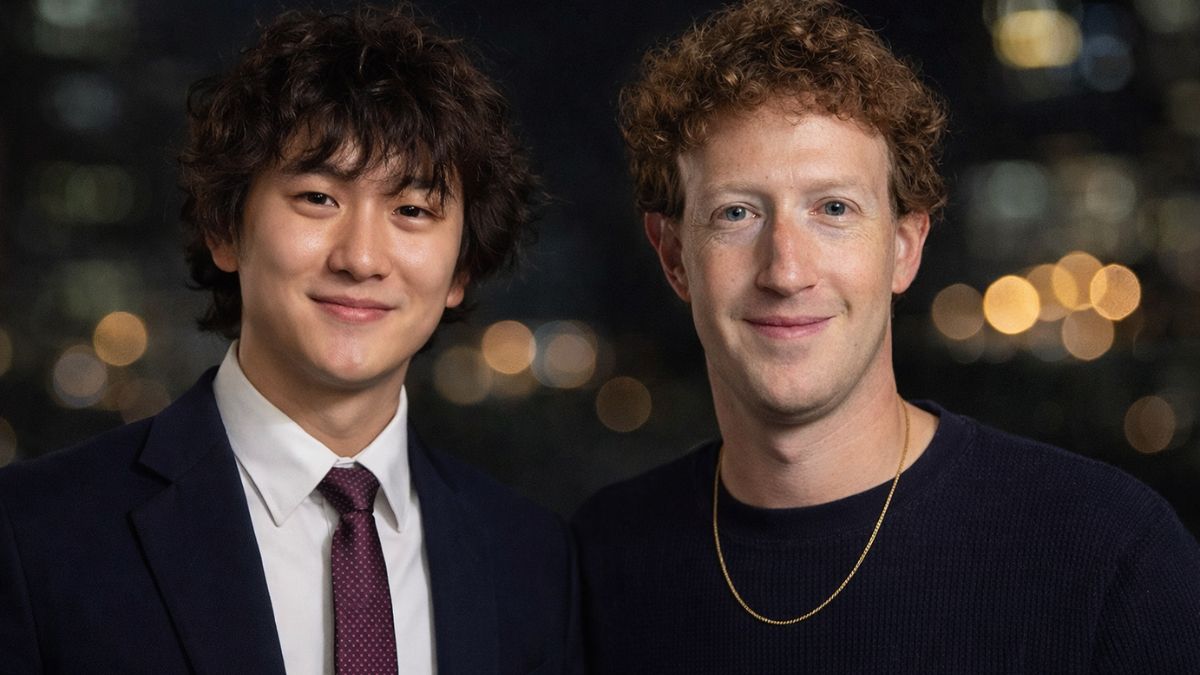
Alexandr Wang, Meta’s Chief AI Officer and former founder of Scale AI, has made a bold forecast with regard to the future of AI model development – the next five years could usher in some of the most monumental scientific breakthroughs in human history, driven by the emergence of superintelligence. Wang joined Meta seven months ago to lead the newly formed Meta Superintelligence Labs (MSL) – a team focused on putting Meta at the front of the AI race with Google and OpenAI.
Speaking on a podcast with Varun Mayya, Wang highlighted that accelerating progress toward superintelligence will enable historic advancements across fields like medicine, physics, and beyond. “The next five years will bring some of the most significant scientific discoveries in human history,” Wang stated. He added that these AI-assisted breakthroughs could rank among the most impactful ever made by our civilisation.
Meta pushes towards superintelligence
Wang’s comments come as Meta is focused on aggressively pushing to close the gap with rivals like OpenAI and Google in the race for advanced AI. With a massive user base of 3.5 billion daily active users owing to its social media and messenger platforms, Meta holds a unique distribution advantage, allowing it to rapidly deploy new models and experiences globally. Through MSL, the company is focusing on building smarter foundational models, integrating research and product development in a “virtuous flywheel” where frontier research directly fuels consumer products and scales infrastructure for larger, more capable systems.
A key part of Meta’s vision involves personal superintelligence — AI agents that act as trusted, always-on digital partners. These agents would operate 24/7, understanding users’ goals, routines, and contexts across a “constellation of peripherals” beyond smartphones, including wearables like Meta Ray-Ban smart glasses.
Wang also described current hardware like the glasses as “one software update away from superpowers,” with upcoming integrations of modern AI models set to transform them into powerful contextual assistants.
Wang on building trustworthy AI agents
Wang stressed the importance of responsibility in this pursuit, noting that building trustworthy agents requires collaboration with philosophers and psychologists to shape model behaviour for mutual success between humans and AI. “Developing a personal agent—one that users trust with their personal goals and daily routines—requires an extreme level of responsibility,” Wang explained.
He also praised working with Meta CEO Mark Zuckerberg, describing him as a leader who quickly spots technological shifts and turns them into practical products and ecosystems. Despite Meta’s heavy investments – billions in AI infrastructure, talent poaching, and compute – the focus remains on long-term durability and competitive moats that are hard to replicate.