



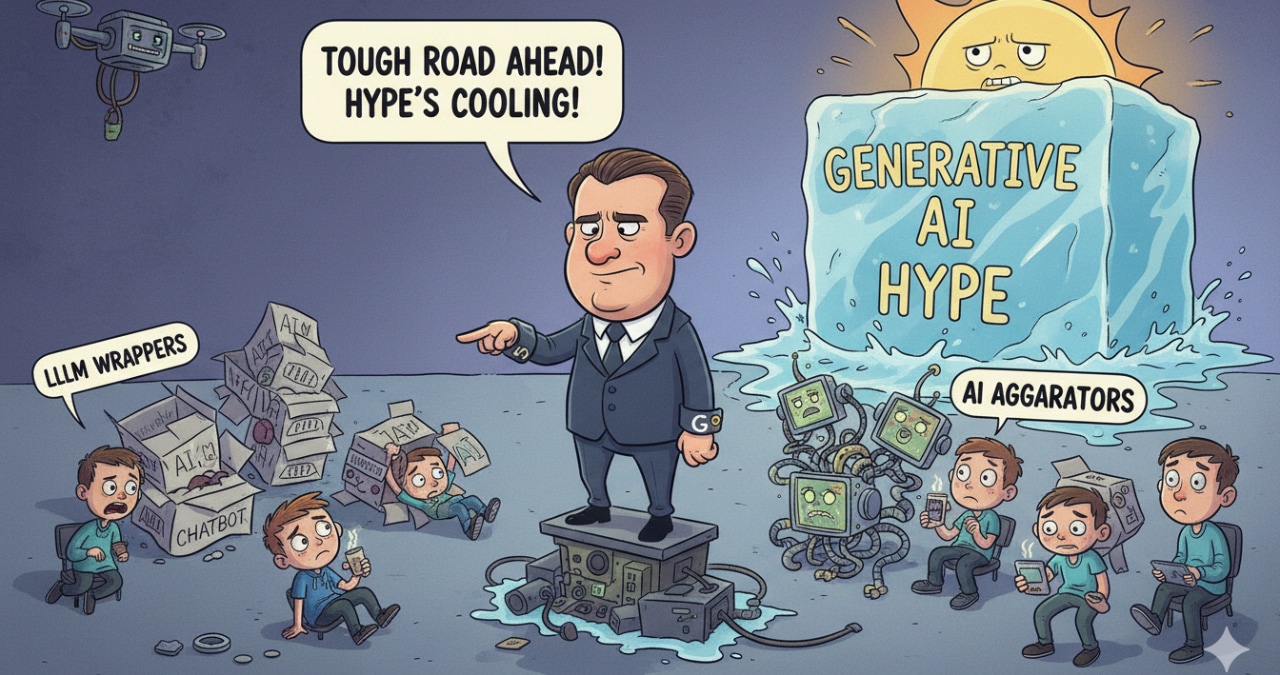
A senior Google executive has warned that certain AI startups, particularly those built as LLM wrappers or AI aggregators, are entering a challenging phase, with many now showing signs of strain akin to a “check engine light” coming on. Darren Mowry, who leads Google’s global startup organisation across Cloud, DeepMind, and Alphabet, shared his insights on the Equity podcast. He argued that the early generative AI boom, which fueled a rapid startup gold rush, is winding down.
During the hype peak, startups could attract funding by simply slapping a sleek interface on top of frontier models like GPT, Claude, or Gemini, adding niche use cases for specific audiences such as students or marketers.
However, Mowry highlights that the industry no longer has patience for purely white-labeled models or thin wrappers. “If you’re really just counting on the back end model to do all the work and you’re almost white-labelling that model, the industry doesn’t have a lot of patience for that anymore,” he stated. He was even more direct about aggregators: “Stay out of the aggregator business.”
Why these AI startups are becoming fragile
Mowry highlighted that model providers themselves are rapidly building enterprise-grade features, governance layers, optimisation tools, and smarter routing capabilities. This compresses margins and reduces the value proposition for middleman platforms that aggregate multiple models into one interface or API.
Investors and customers increasingly demand defensible moats, such as proprietary data, deep workflow integration, vertical expertise, or embedded intellectual property, rather than superficial wrappers around existing large language models (LLMs).
He drew a parallel to the early cloud computing era. Intermediaries reselling AWS capacity were eventually squeezed out as Amazon added its own enterprise tools, security, migration services, and DevOps consulting. Only those who added genuine differentiated value survived.
Sectors and startups still showing promise
While LLM wrappers and aggregators face tough times ahead, Mowry expressed optimism for other parts of the AI ecosystem. He pointed to a strong future for:
– Developer platforms and “vibe coding” tools (e.g., Replit, Lovable, Cursor—a GPT-powered coding assistant).
– Direct-to-consumer AI applications, especially creative tools (e.g., Google’s AI video generator Veo, which is gaining use among film and television students).
– Domains like biotech and climate tech, where access to large, high-quality datasets provides a natural advantage.
Examples of startups with more defensible plays include Harvey AI (focused on legal workflows) and tools that integrate deeply into specific industries or user needs.