



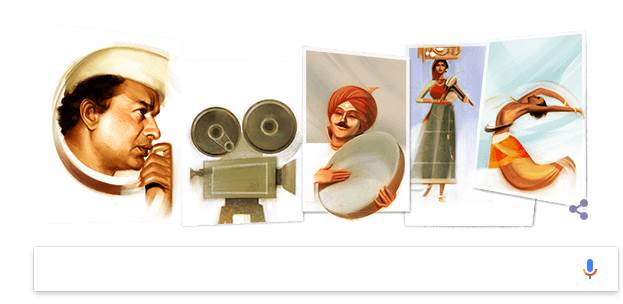
Google today paid rich tributes to legendary filmmaker V Shantaram through their solemn doodle on Saturday. Shantaram was no ordinary person since he is majorly responsible for changing the face of Indian cinema with his directorial ventures. The doodle celebrates the filmmaker’s lasting impact on the Indian cinema. Shantharam was born as Rajaram Vankurde Shantaram on 18 November in 1901 and started off with doing odd jobs at the in Maharashtra Film Co. which was then owned by Baburao Painter at Kolhapur. The doodle which Google dedicated to the legendary soul of Shantharam depicts three film produced and directed by him in the 1950s that had won him numerous national and international laurels. Just four years later, he found himself debuting on the same silver screen as an actor in the silent film, Surekha Haran. A consummate actor, an innovative editor, an insightful director and a producer that Shantharam was, he evolved a new style of filmmaking and grammar. As an actor he played the lead in at least of two of India’s landmark films, which he also directed. As a producer his films dealt with the social, economic and political problems of a society struggling under colonial rule and then as a country trying to establish its place as a nation.
V Shantaram’s journey in films:
V. Shantaram took up a job at a local tin-shed cinema for a sum of 5 rupees per month. Just four years later, he found himself debuting on the same silver screen as an actor in the silent film, Surekha Haran. He directed his first film Netaji Palkar in 1929 and founded the Prabhat Film Company along with Vishnupant Damle, K.R. Dhaiber, S. Fatelal and S.B. Kulkarni, which made Ayodhyecha Raja, the first Marathi language film in 1932 under his direction. He left Prabhat co. in 1942 to form “Rajkamal Kalamandir” in Mumbai. Shantaram had also garnered praise for his Marathi film Manoos. Fondly known as Annasaheb, he is associated with popular films like Dr. Kotnis Ki Amar Kahani (1946), Amar Bhoopali (1951), Jhanak Jhanak Payal Baaje (1955), Do Aankhen Barah Haath (1957), Navrang (1959), Duniya Na Mane (1937) and Pinjra (1972).
V Shantaram songs:
Shantaram took a very active interest in the creation of his music. Some of his songs had to rehearsed several times before they were approved by V. Shantaram. He performed so well that veteran actor Rajesh Khanna to praised him for his performance. Some of Shantaram’s song were: Aao Aao Honhaar Ho Pyaare Bachhe, Ho Umad Ghoomad Kar Aai Re, Mein Gaau Tu Chup Ho Jaa, Mein, Saiyya Jhoothon Ka Bada Sartaaz, Yeh Maalik Tere Bande Hum. Some of his songs have been sung by melody queen Lata Mangeshkar.
V Shantaram awards:
Shantaram was conferred with the prestigious Dadasaheb Phalke Award in 1985 and was also recognised with the Padma Vibhushan in 1992. He also has a Filmfare to his name for the film Jhanak Jhanak Payal Baaje. Besides his films were also nominated for the coveted Cannes Film Festival and Golden Globe Awards.
V Shantaram Family:
Shantaram who was born in a Marathi family was married thrice. His first marriage was with Vimla with whom he had three kids, son Prabhat Kumar, daughters Saroj and Charusheela. His second marriage was with Jayashree with whom he had three daughters, Kiran, Rajashree and Tejashree. He was married to actress Sandhya for the third time.