



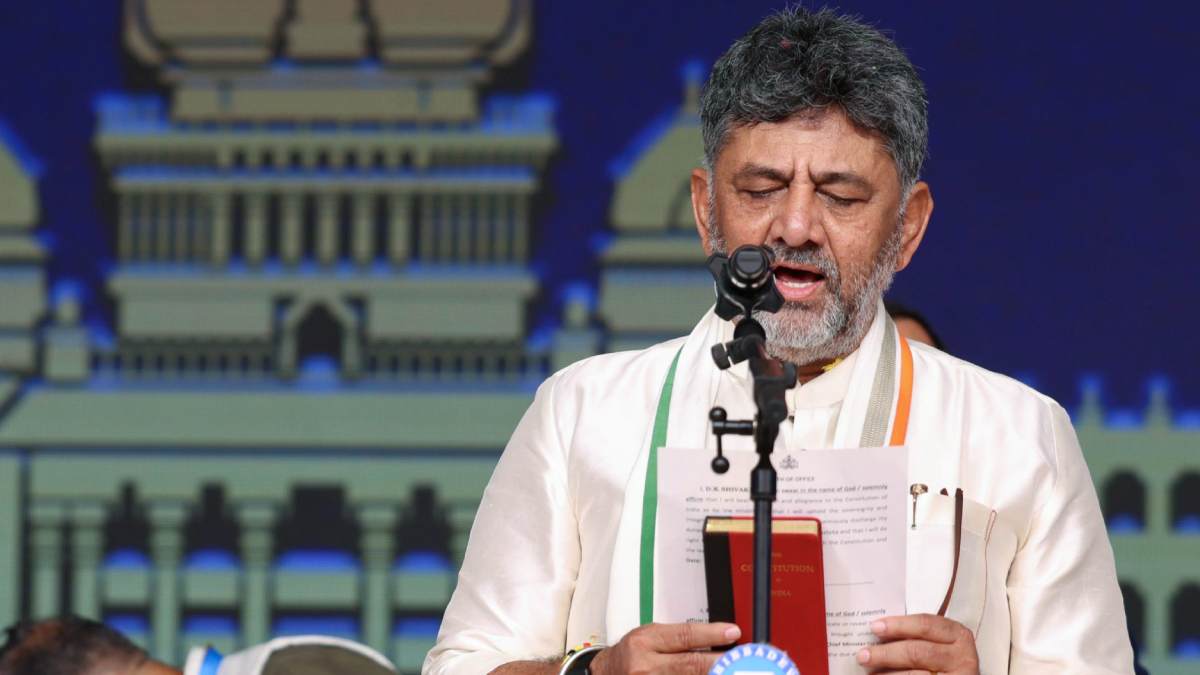
Newly sworn-in Karnataka Chief Minister DK Shivakumar on Wednesday unveiled a series of major decisions in his first Cabinet meeting, including free bus travel for all students, a new employment initiative for Kannadigas and a Rs 2,000-crore infrastructure package for Bengaluru.
The announcements, made just hours after taking charge, signal the Congress government’s attempt to combine welfare measures for youth with urban development initiatives, particularly in Bengaluru, a city that has long struggled with traffic congestion and infrastructure challenges.
Free bus travel extended to all students
Addressing reporters after chairing his first Cabinet meeting alongside Deputy Chief Minister G Parameshwara and other Cabinet colleagues, Shivakumar said students from school to postgraduate level would be eligible for free bus travel across the state.
“We have decided that all students, whoever it may be, right from school to post-graduation, will get free bus passes. They’ll have to apply for the passes because we’ll need to identify students,” Shivakumar said.
The chief minister said the scheme would be implemented irrespective of its financial implications. “We’ll implement it regardless of the cost. This is DK Shivakumar’s government,” he remarked.
The decision expands the state’s existing Shakti scheme, which currently provides free bus travel for women. Shivakumar noted that male students had repeatedly questioned why the benefit was limited to girls and women.
Rs 2,000 crore approved for Bengaluru roads
A major focus of the government’s first-day agenda was Bengaluru’s infrastructure. The Cabinet approved Rs 2,000 crore for road development projects under the Greater Bengaluru Authority and the Bengaluru Development Authority.
The move aligns with Shivakumar’s long-articulated “Brand Bengaluru” vision aimed at improving mobility, easing traffic congestion and modernising civic infrastructure in the state capital.
Government plans jobs initiative for Kannadigas
Alongside the student transport initiative, the government announced plans to create a structured employment programme aimed at increasing job opportunities for local Kannadigas in the private sector. Shivakumar said the government would work with industry stakeholders before finalising a framework.
“The government will fix a percentage of jobs that should be given to local Kannadigas. We’ll take the industry into confidence. Within a month, I’ve asked three of my Cabinet colleagues to plan this out and give a report,” he said.
Relief for property owners on occupancy certificates
In another relief measure for urban property owners, the government announced a one-time exemption from obtaining occupancy certificates (OC) for buildings up to 2,400 square feet. Previously, exemptions were limited to properties measuring up to 1,200 square feet.
The chief minister said the decision was intended to help thousands of property owners who had been affected after the Supreme Court made occupancy certificates mandatory for obtaining water and electricity connections.
The government also decided to extend the conversion of ‘B’ khata properties to ‘A’ khata status across Karnataka, a move expected to benefit property owners seeking legal recognition and easier access to civic services.
10,000 Bharat Jodo Youth Clubs to be set up
Targeting youth engagement, the Cabinet approved the creation of 10,000 “Bharat Jodo Youth Clubs” across the state. According to Shivakumar, the initiative is aimed at promoting social harmony and nurturing future leadership.
“This will groom young leadership and promote social harmony. Each association will get a government grant of Rs 10 lakh,” he said.
New government takes charge with first cabinet decisions
The government also formally unveiled its first Cabinet, reflecting an effort to balance regional representation, caste equations and internal party dynamics.
Veteran Congress leader G Parameshwara was appointed Deputy Chief Minister, reinforcing the party’s outreach to Dalit communities while providing the new administration with an experienced second-in-command.
The Cabinet includes senior leaders K H Muniyappa, K J George, M B Patil, Ramalinga Reddy, Satish Jarkiholi, Krishna Byre Gowda, Priyank Kharge, U T Khader, Eshwar Khandre, Yathindra Siddaramaiah, Byrathi Suresh and Sharan Prakash Patil.
Political observers are expected to closely watch the roles assigned to Priyank Kharge, one of the Congress party’s prominent younger leaders, and Yathindra Siddaramaiah, whose induction underscores the continuing influence of former Chief Minister Siddaramaiah within the state unit.
The composition of the Cabinet also reflects the Congress leadership’s effort to ensure representation from key regions, including Bengaluru, Old Mysuru, Kalyana Karnataka and northern Karnataka, as the new government begins its tenure with a mix of welfare promises and development-focused initiatives.