



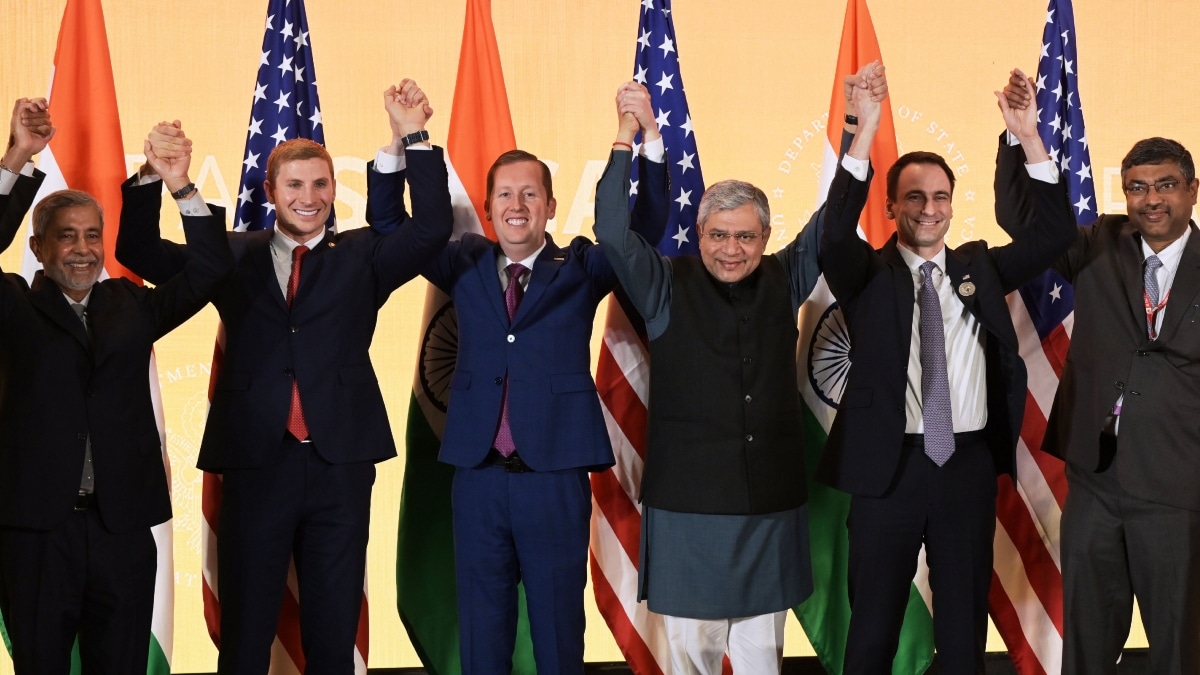
India officially signed the decalration on Friday to become part of Pax Silica, a US-led group focused on artificial intelligence and supply chain security. The agreement was signed during a ceremony held on the sidelines of the IndiaAI Impact Summit in New Delhi. Speaking at the event, US Ambassador Sergio Gor described the India-US partnership as a “coalition of capabilities” and said that peace comes through strength.
India signed the declaration during a ceremony held on the sidelines of the AI Impact Summit. The event was attended by Union Minister Ashwini Vaishnaw, US Under Secretary of State for Economic Affairs Jacob Helberg, and US Ambassador to New Delhi Sergio Gor.
“Pax Silica is a declaration that future belongs to those who build and when free people join forces,” Helberg said.
Gor described Pax Silica as a “coalition of capabilities” and formally welcomed India as a co-founder of the coalition. He said the partnership between the world’s two largest democracies is now “limitless.”
Speaking to the reporters, Vaishnaw said, “We have a large talent pool, and we have conducted our foreign policy in a way which creates their trust. As part of that, today, the Pax Silica was signed, which is very important for the semiconductor supply chain, semiconductor manufacturing, and chip design, for establishing the entire semiconductor ecosystem in our country.”
What is the Pax Silica declaration?
According to the US State Department, Pax Silica is meant to bring “friendly and trusted” countries together to make sure that important technologies are safe, dependable and not controlled by hostile play.
This strategic initiative, which is seen as a response to China’s strong hold over global manufacturing supply chains, was launched on December 12, 2025. Its goal is to “reduce coercive dependencies” and build a “secure, prosperous, and innovation-driven silicon supply chain” – covering everything from critical minerals and energy supplies to advanced manufacturing, semiconductors, AI infrastructure and logistics, the report mentioned.
When it was first announced, the US surprised many in India by leaving the country out. Instead, it named “allies” such as Japan, the Republic of Korea, Singapore, the Netherlands, the United Kingdom, Israel, the United Arab Emirates and Australia. This raised concerns that uncertainty around the India-US trade deal was leading to wider differences between the two nations.
However, since Gor’s arrival in India, tensions between the two sides have eased considerably. The broad framework for the Indo-US trade deal has now been agreed upon.
How Pax Silica will benefit India
India’s inclusion in Pax Silica is being seen as an important move to strengthen cooperation in emerging areas of technology, especially artificial intelligence and semiconductors.
The US State Department said the initiative will also focus on protecting sensitive technologies and critical infrastructure from undue access or control by countries of concern. It aims to build trusted technology ecosystems, including Information and Communication Technology (ICT) systems, fibre-optic networks, data centres, foundational AI models and applications. India has previously raised concerns about China’s role in parts of its critical infrastructure, such as telecom networks, as per the report.
“Pax Silica will greatly benefit India’s electronics and semiconductor industry. Ten plants are already established in India and are in the process of being established, and very soon, the first semiconductor plant will begin commercial production. In that context, the most advanced two-nanometer chips are being designed in India today,” Vaishnaw added.
India’s entry into Pax Silica also comes at a time when US companies have committed significant investments in India’s AI infrastructure.
Overall, this development is expected to give a boost to India’s semiconductor mission and its progress in the global AI race, where it started later than some other countries. Sources said the presence of top American CEOs and founders at the AI summit – including Sundar Pichai and Sam Altman – shows how important Delhi has become in the global AI and semiconductor landscape, it added.