



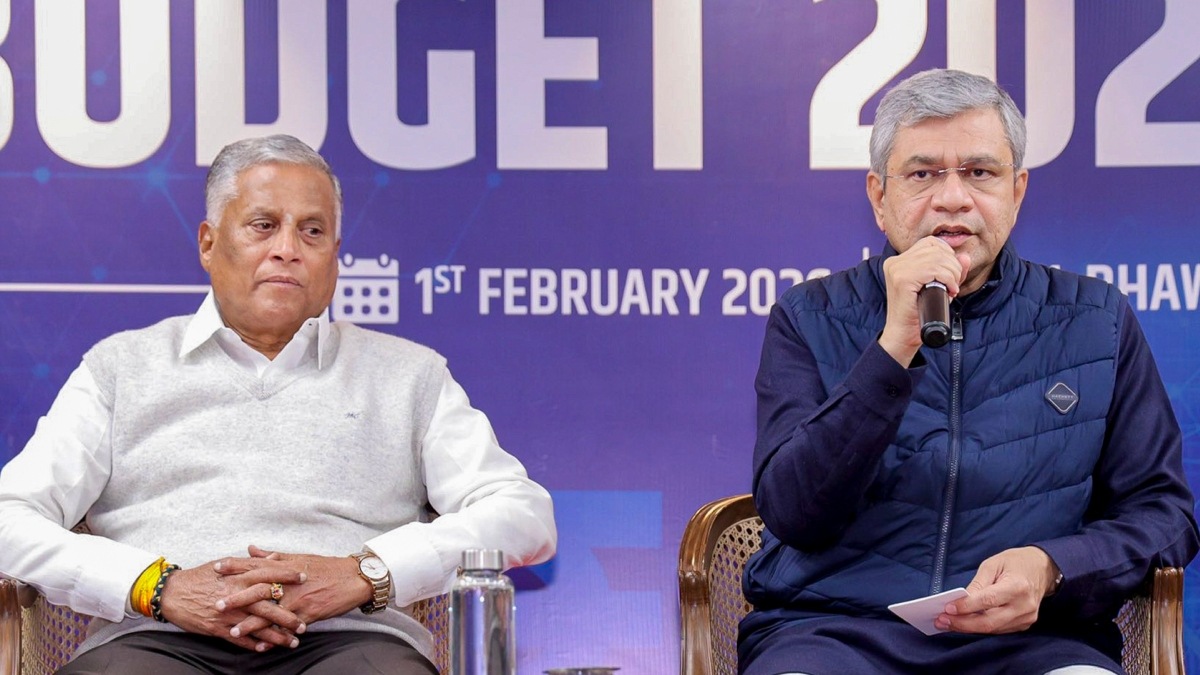
The railways ministry will shortly commission the detailed project reports (DPRs) for seven bullet trains and one dedicated freight corridor (DFC) announced in the Budget 2026-27, said railways minister Ashwini Vaishnaw on Monday. The minister said that the government has plans to build 7,000 kms of bullet train network across the country, out of which 4,500 kms have been announced thus far across two phases.
“The Mumbai-Ahmedabad High Speed Rail (MAHSR) project is about 500 kms, and these upcoming seven projects would cover around 4,000 kms. The work on the MAHSR is progressing at a rapid pace. We will start the bullet train operations from next year,” he said.
As per the budget documents, the government has revised its passenger revenue targets downwards to Rs 87,300 crore in FY27 as against the revenue target of Rs 92,800 crore in the last year’s budget. This is despite the government expecting a jump of 4.5% in passenger traffic for FY27 over the previous year’s revised numbers.
What do FY27 estimates suggest?
Though the FY27 estimates are still higher than the revised passenger revenues of Rs 80,000 crore for FY26. On the freight revenues’ side, the revenue estimates for FY27 are similar to projections for FY26 (Rs 188,000 crore).
Vaishnaw said that fares for bullet train as expected to be affordable as railways plans to cater to the middle-class and lower income groups through this service.
On Sunday, the finance minister outlined seven new high-speed rail corridors to boost connectivity between major cities such as Mumbai, Delhi, Bengaluru, Chennai, Hyderabad, Pune, Varanasi, and Siliguri. The FM also said that a new DFC connecting Dankuni in West Bengal to Surat in Gujarat will also be constructed.
What do experts say?
Experts said that high-speed rail corridors are as much economic instruments as transport projects. “If implemented with clear contracting frameworks and risk allocation, these corridors can unlock regional growth, integrate labour markets, and catalyse private investment along urban and industrial clusters,” said Shreevardhan Sinha, senior partner (corporate & commercial) at Desai & Diwanji.
Meanwhile, the FY27 budget has increased the railways’ capex to Rs 2.93 lakh crore, which is 10.5% higher than the revised estimates for FY26. The higher outlay is on account of more allocation towards provident fund and pension, addition of new rail lines, doubling of existing lines, and appropriation to pension fund. Within Rs 2.93 lakh crore, the government is expecting to generate Rs 12,000 crore through public-private partnership (PPP) mode.