



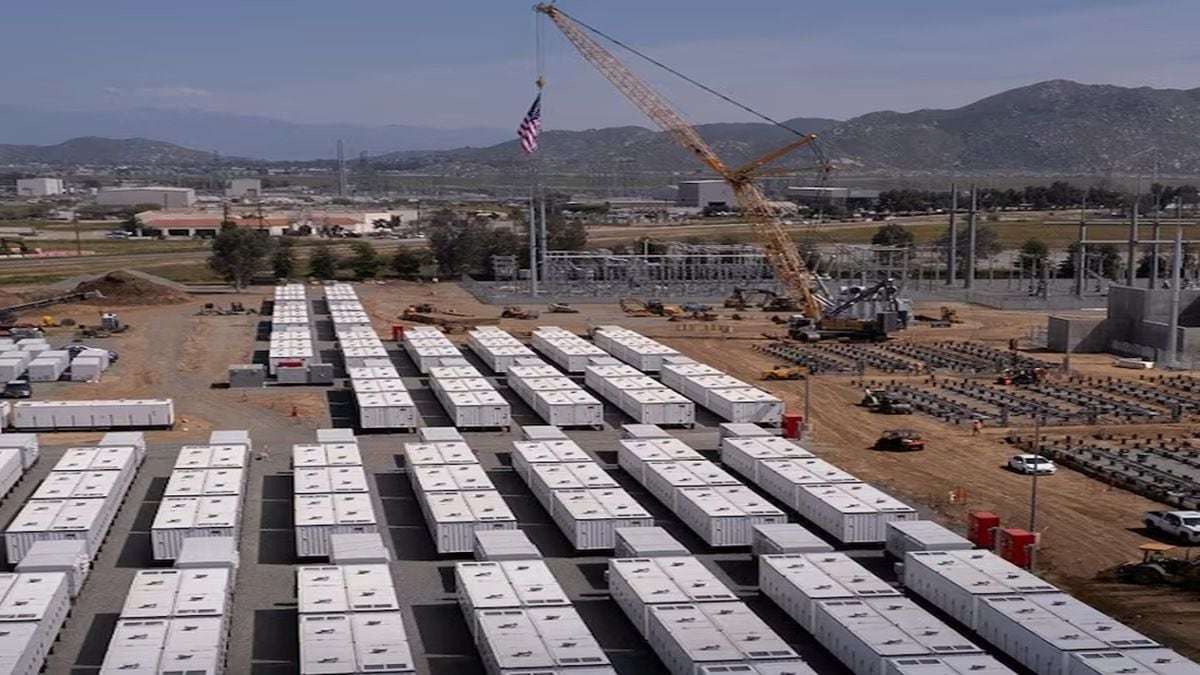
Reliance Industries Limited is targeting the start of commercial-scale production at its battery giga-factory around July, while simultaneously increasing its planned annual manufacturing capacity to 40 gigawatt hours (GWh) of lithium iron phosphate (LFP)-based batteries from the earlier 30 GWh target, according to the company’s latest annual report.
In its FY26 annual report, RIL said its Battery Energy Storage System (BESS) giga-factory has entered an “advanced commissioning” stage. “With civil construction complete and equipment installation underway, production will ramp through the second half of 2026, focused on LFP chemistry for utility-scale BESS and mobility,” the company said.
Scaling Up Ambitious Targets
The latest timeline indicates that Reliance’s battery manufacturing project is moving closer to commercial operations after facing delays linked to technology integration, equipment sourcing and supply-chain disruptions. Industry sources said the upstream supply chain for battery cell manufacturing equipment — much of which is sourced from China — has been impacted by export restrictions, shipment delays and longer lead times for critical machinery.
The FY26 report also marks a significant increase in the project’s scale. While the company’s FY25 annual report had outlined plans for a 30 GWh modular battery giga-factory, the latest filing says Reliance will operationalise 40 GWh of annual capacity initially, with a roadmap to scale this up to 100 GWh over time.
The commissioning of the facility is expected to take place in phases during FY27, as Reliance positions itself to tap into India’s rapidly expanding energy storage market. According to BloombergNEF India’s energy storage market is projected to surge to 336.7 GWh by 2035 — nearly 115 times the cumulative installations recorded in 2025.
If Reliance succeeds in commissioning the plant and ramping up production within the revised timeline, it could become the first major company to substantially fulfil the manufacturing commitments made under India’s Advanced Chemistry Cell (ACC) Production Linked Incentive (PLI) scheme.
PLI Scheme Deadlines
Reliance had secured 5 GWh capacity under the first round of ACC PLI bids concluded in 2022 and later emerged as the largest winner in the second round of auctions in 2024 with an additional 20 GWh allocation.
Under the scheme’s conditions, manufacturers are required to meet commissioning timelines after the appointed date or face financial penalties. Reliance was exposed to delay-related penalties on its initial 5 GWh allocation, while potential liabilities could have come significantly if timelines for the additional 20 GWh capacity are not met within the prescribed gestation period.
Reliance first unveiled plans for its battery giga-factory in FY22 as part of the Dhirubhai Ambani Green Energy Giga Complex in Jamnagar, where it proposed setting up four giga-factories covering solar modules, batteries, electrolysers and fuel cells.
Over the following years, the company acquired battery technology firms including Lithium Werks and Faradion as part of its strategy to build capabilities across both LFP lithium-ion and sodium-ion battery technologies.
Apart from batteries, Reliance has also begun work on its electrolyser giga-factory, which the company said will be commissioned and ramped up in phases over the coming quarters.