



In a major trade update, India on Monday agreed to set a target of raising annual trade with the United Arab Emirates (UAE) to USD 200 billion by 2032 and signed various pacts strengthening cooperation in AI, defence and nuclear cooperation.
The announcement came shortly after UAE President Sheikh Mohamed bin Zayed Al Nahyan’s visit to Delhi. The volume of two-way trade between the two sides was USD 84 billion in 2023-24.
Following Nahyan’s near 3.5 hour visit to Delhi, both sides also settled on a long-term agreement for the annual supply of 0.5 million metric tonnes of LNG (Liquefied Natural Gas) to India by the UAE. The UAE is India’s second-largest supplier of LNG to India after Qatar.
Modi welcomes UAE President at Delhi airport
In a visual that became the subject of much discussion on social media platforms and ONSIT forums alike, PM Modi welcomed Al Nahyan at the Delhi airport earlier today with a hug.
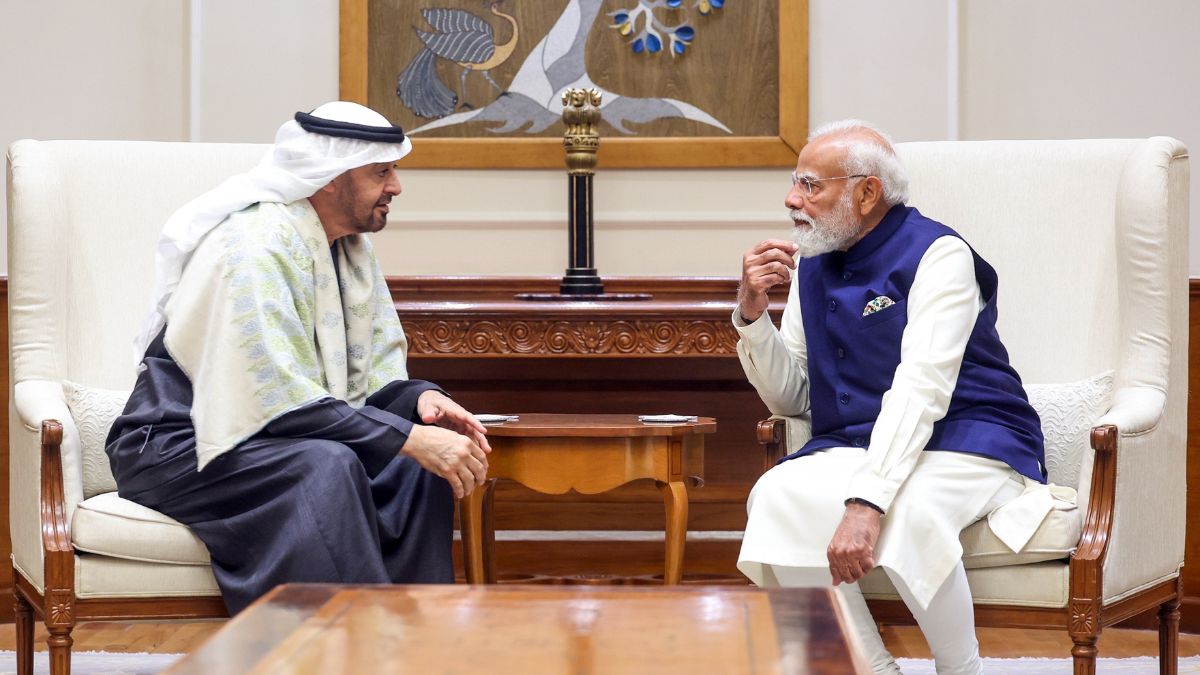
Following Nahyan’s arrival in Delhi, he travelled to the prime minister’s residence in the same vehicle as Modi. At the residence both leaders are understood to have engaged in strategic talks in delegation-level formats.
“This has been a short, but extremely substantive visit,” Foreign Secretary Vikram Misri said at a media briefing after Al Nahyan concluded his nearly three-and-a-half-hour visit.
The discussions took place against the backdrop of rising tensions in the Middle East and global trade disruptions triggered by Washington’s tariff policies.
Defence, space and AI take centre stage
A key outcome of the talks was the decision to significantly expand defence ties. Misri said a letter of intent was signed to work towards a framework agreement for a strategic defence partnership, signalling closer collaboration in security and defence manufacturing.
“Artificial Intelligence was identified as a priority area of cooperation”, Misri said. As per the statement issued by the foreign secretary both sides have decided to collaborate on AI by setting up a supercomputing cluster in India with support from UAE.
According to Misri, the Gulf nation will also look at investments for expanding data centre capacities in India.
Apart from discussing ways to collaborate on the segment of Artificial Intelligence, both sides also signed letter of intents to expand the scope of their partnership on the subjects of defence and space infrastructure.
Under the initiative of developing space infrastructure, both sides will look to set up new launch complexes, satellite fabrication facilities, joint missions, space academy and training centres, the foreign secretary said.
The two countries also decided to explore partnerships in advanced civil nuclear technologies, including large nuclear reactors, small modular reactors, advanced reactor systems and nuclear power plant operations, particularly in the context of India’s evolving regulatory framework.
Investments, food security and data diplomacy
A separate document was signed to facilitate the UAE’s participation in developing a special investment region in Dholera, Gujarat. The project is expected to include an international airport, a pilot training school, a maintenance, repair and overhaul (MRO) facility, a greenfield port, smart urban townships, railway connectivity and energy infrastructure.
An agreement on food safety cooperation was also concluded, aimed at boosting agricultural and food exports from India to the UAE. Misri said the pact would benefit Indian farmers while strengthening food security in the UAE.
Both sides also agreed to explore the possibility of setting up “digital embassies”, a relatively new concept that would involve housing data under mutually recognised sovereignty frameworks.
Shared ‘International’ concerns and stability in Gaza
As per the foreign office’s statement, the leaders also discussed developments in Yemen, Gaza and Iran, though Misri declined to provide details.
Prime Minister Modi was recently invited to join the Board of Peace on Gaza by Donald Trump. Indian authorities haven’t commented on if the invite has been accepted, but Modi has in the past extended help in bringing the war to an end.
There has been simmering tensions between Saudi Arabia and UAE over Yemen and the unsettling political scenario continues to play in Gaza.
In his statement, Misri said that Modi and Al Nahyan unequivocally condemned cross-border terrorism and stressed that perpetrators, supporters and financiers of terrorism must be brought to justice. The UAE president also expressed support for India’s chairmanship of the BRICS grouping this year.
The visit highlighted the growing strategic convergence between New Delhi and Abu Dhabi at a time of regional churn and global realignments.