



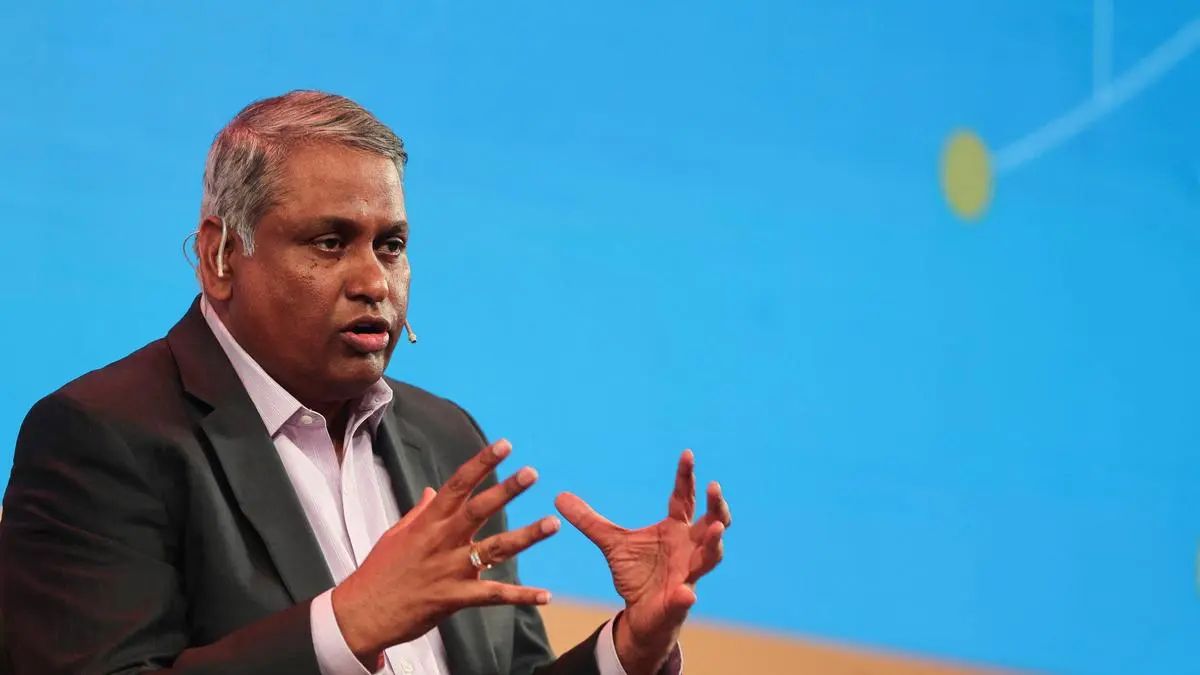
India’s technology services industry faces a “painful reinvention” as artificial intelligence reshapes how work is delivered, HCLTech chief executive C Vijayakumar (CVK) said, warning that the current transition differs from earlier industry shifts because it will prioritise efficiency over headcount growth.
Vijayakumar gave his views as part of a fireside chat with McKinsey & Company’s Noshir Kaka at the ongoing Nasscom Technology and Leadership Forum in Mumbai on Tuesday.
“This transition is different from the other transitions. It’s going to be a painful transition or reinvention because it involves people,” he said, adding that the industry would ultimately emerge stronger and more relevant to enterprises.
How is the AI wave different from Y2K, cloud transformation
Unlike earlier waves such as Y2K, cloud or digital transformation — which required more hiring — AI is enabling companies to deliver the same work a lot more efficiently with significant speed. That structural shift, he suggested, will force firms to rethink operating models, workforce deployment and value creation.
At the same time, Vijayakumar argued that market concerns about the sector may be overstated because analysts often underestimate the complexity of enterprise systems and the advantage incumbent service providers hold.
“What market probably does not visualise is how critical incumbency in existing customers is and how complicated the enterprise landscape is,” he said.
Legacy infrastructure, regulatory constraints, sensitive data environments and undocumented system logic mean AI adoption is far from plug-and-play. “If all the AI technologies need to land and deliver value to an enterprise, it’s the service companies which can get it done. Context matters.”
Continued growth in enterprise technology spending
CVK also highlighted continued growth in enterprise technology spending, though value distribution across the tech stack may evolve. Semiconductor firms and technology OEMs currently capture disproportionate value due to supply constraints, while hyperscalers remain central to enterprise compute despite heavy capital intensity. SaaS providers, meanwhile, could face pricing pressure as AI-led applications begin to chip away at certain functions.
Over the longer term, Vijayakumar expects the biggest value creation to come from frontier model companies working alongside services firms that possess deep enterprise knowledge. As companies modernise with an AI-data mindset, he said, services providers are well positioned to capture a larger share of both traditional IT budgets and emerging AI-led spending.
For the workforce, the shift will demand both technical depth and human judgement. Routine work will increasingly be automated, making higher-order thinking and innovation more important.
Demand for specialised skills in data, cloud, security and AI will rise, but strong software engineering fundamentals will remain essential because critical workflows and security-sensitive systems still require human oversight.
Adaptability and the ability to continuously learn will be the most valuable traits, he said.
Within HCLTech, Vijayakumar said the focus is now on scaling enterprise AI adoption. “Today AI technology is not the problem. It’s the ability to scale the adoption of AI in the enterprises to deliver measurable outcomes. That’s the real challenge,” he said.
The company is investing in platforms and intellectual property to bring an AI-native approach across the software lifecycle and enterprise operations, while also leaning on its growing software products business to strengthen its platform mindset. With AI data centres, vertical applications and new compute environments driving fresh spending, Vijayakumar said the industry’s reinvention, though difficult, could unlock significant long-term opportunity.