



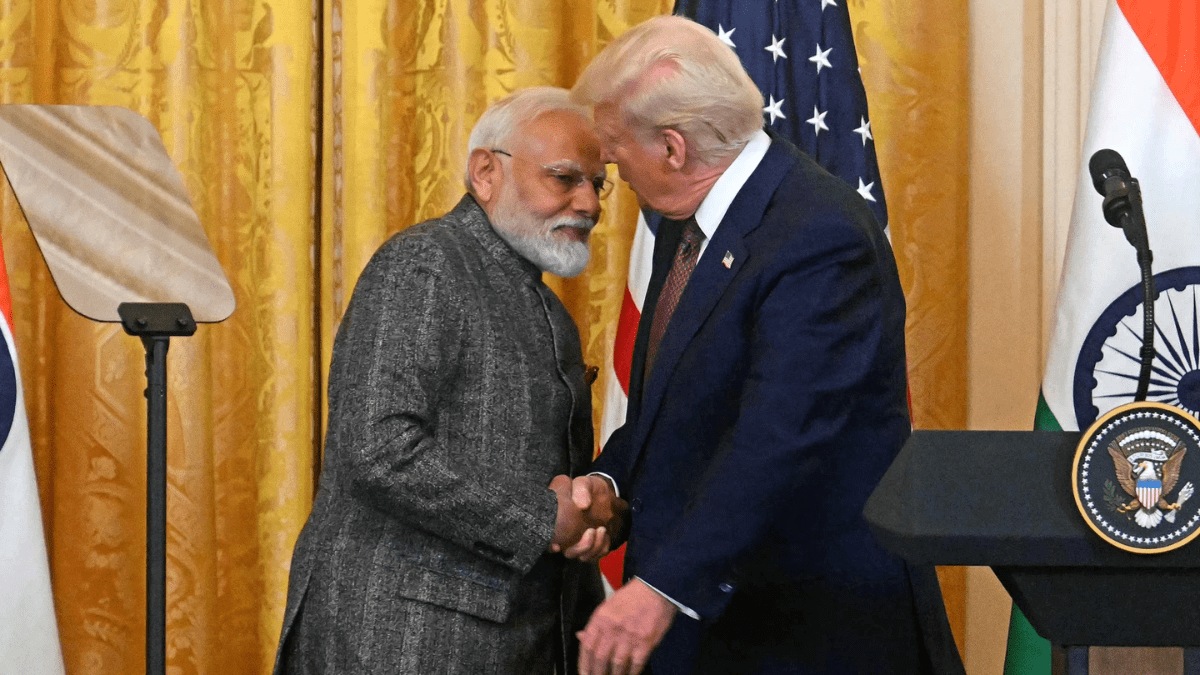
Hopes of a trade deal between India and the US revived on Monday with the new US ambassador to India Sergio Gor saying the two countries will discuss trade issues in their next call scheduled for Tuesday.
Gor’s comments came close on the heels of US Commerce Secretary Howard Lutnick’s statement last week the much-touted deal with India did not happen because Prime Minister Narendra Modi did not call US President Donald Trump, after a deal was set up in May-July last year. India then termed the claim “inaccurate.”
It was not immediately known if the call that Gor referred to would be one between Modi and Trump.
Market reaction
Benchmark Sensex and Nifty closed 0.36% and 0.42% higher, respectively, on Monday. In volatile trading, the Sensex tumbled 715.17 points, or 0.85%, and the Nifty tanked 209.9 points, or 0.81%, in the morning, before posting a sharp recovery.
Trade talks between India and the US fell apart and Trump doubled tariffs on Indian goods in August to 50%, among the world’s highest rates, including a punitive levy of 25% for New Delhi’s purchase of Russian oil.
India’s exports to the US plunged since May, only to recover moderately in November, as exporters from various sectors struggled to retain customers even while margins have reduced to wafer-thin levels and large-scale job losses occurred in labour-intensive sectors like gems & jewellery and textiles.
Gor’s recent statements
Addressing the media and staff on his first day in office, Gor said:“Real friends can disagree, but always resolve their differences in the end… Remember, it (India) is the world’s largest nation so it’s not an easy task to get this across the finish line but we are determined to get there.” “ I also hope that the President (Donald Trump) will be visiting India soon, hopefully next year or two,” the ambassador said.
“Last week, our great secretary of State, Marco Rubio, powerfully stated that this year will be a year of reciprocity. We are raising the standard for diplomacy itself. That means fair trade, mutual respect, and shared security,” Gor said.
He said that relations between India and the US are bound not just by shared interests but by relationships anchored at the highest levels and “no partner is more essential than India”.
Lutnick’s remarks followed Trump saying Modi knew he was unhappy with India’s purchases of Russian oil and that Washington could raise tariffs on New Delhi “very quickly.” A new US law with the proclaimed intent to “punish Russia” secured the President’s approval last week, raising the spectre of tariffs of up to 500% on India and China for buying Russian oil and uranium.
Lutnick’s comments were disputed by the ministry of external affairs (MEA), while Commerce and Industry Minister Piyush Goyal said that “there is no need to believe statements from abroad.” The time period that the US commerce secretary was referring to would be around July-August last year when the US signed a spate of trade deals just before the imposition of reciprocal tariffs by end-August.
The reciprocal tariffs of 25% and another 25% for buying Russian oil had led to a freeze in trade negotiations for a short while before Goyal visited the US in September to restart them. Since then there have been regular exchanges of delegations. A group of officials from the office of US Trade Representative visited India and held extensive discussions on the agreement on December 10-11.
The ambassador also said that India would be invited to Pax Silica initiative of the US as a full member. Pax Silicon aims to build a secure, and innovation driven silicon supply chain from critical minerals and energy inputs to advanced manufacturing, semiconductors, AI development, and logistics. Nations that joined last month include Japan, South Korea, the United Kingdom, Israel, Netherlands and Australia among others.
Pax Silica aims to reduce coercive dependencies, protect the materials and capabilities foundational to artificial intelligence, and ensure aligned nations can develop and deploy transformative technologies at scale.
In February India and the US decided to complete negotiations on the first tranche Bilateral Trade Agreement (BTA) by November last year. By March they had finalised the Terms of Reference of the agreement.
Exporters are waiting for an early conclusion of the deal as the US is India’s biggest export market.