



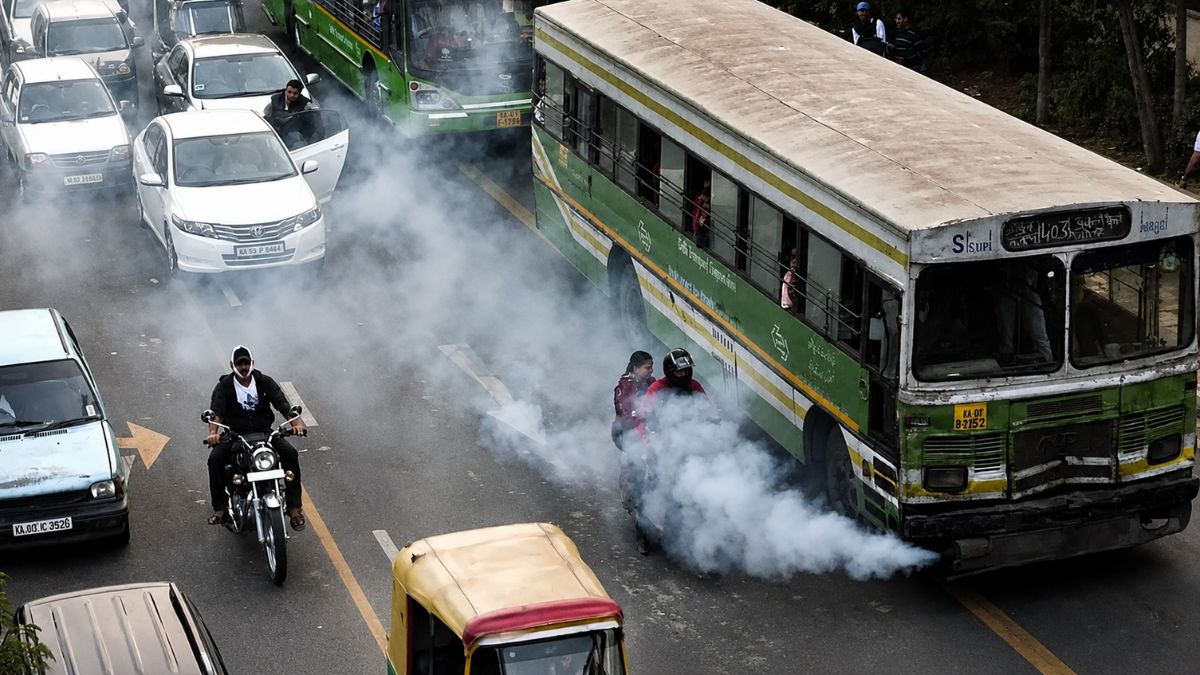
The Union Cabinet on Wednesday approved a ₹9,585-crore incentive scheme aimed at replacing older, polluting trucks and buses in the Delhi-NCR region.
The two-year scheme, to be funded through the National Capital Region Planning Board (NCRPB) under the Ministry of Housing and Urban Affairs, will provide financial incentives to owners of BS-IV and older commercial vehicles to upgrade to BS-VI-compliant or electric vehicles.
The programme carries a total outlay of ₹9,585 crore, including ₹5,041 crore from the Centre and an estimated ₹1,601 crore in tax concessions from participating states. It will be implemented jointly by the Ministry of Road Transport and Highways and the Ministry of Petroleum and Natural Gas in coordination with Delhi, Haryana, Rajasthan and Uttar Pradesh.
The government estimates that about 2.07 lakh vehicles, including 1.91 lakh trucks and 16,329 buses, will be covered under the scheme across the Delhi-NCR region.
The move comes amid growing concerns over deteriorating air quality in the national capital region. According to a source apportionment study conducted by the Automotive Research Association of India (ARAI) and The Energy and Resources Institute (TERI), the transport sector contributes 14% of PM2.5 emissions, 40% of carbon monoxide emissions and 63% of nitrogen oxide emissions in Delhi-NCR.
Although trucks and buses account for only 3% of the vehicle fleet, they contribute 36% of transport-sector PM2.5 emissions. The government said a single pre-BS vehicle emits pollution equivalent to 14 BS-VI heavy-duty vehicles, while a BS-IV vehicle emits 2.7 times more than a BS-VI counterpart.
Under the scheme, owners of BS-III and older vehicles will be required to scrap their vehicles at authorised vehicle scrapping facilities. BS-IV vehicles can either be scrapped or sold outside the NCR in non-National Clean Air Programme (NCAP) cities and towns.
To qualify for benefits, vehicle owners must purchase and register a BS-VI-compliant or electric replacement vehicle within the NCR region. In Delhi, however, light goods vehicles bought under the scheme must be electric, while buses will be eligible only if they run on BS-VI CNG technology or are fully electric.
Government-owned vehicles will not be eligible for the programme.
As part of the incentive package, the Centre will provide a 5% interest subvention on vehicle loans for five years, monthly fuel vouchers worth up to ₹4,800 depending on the vehicle category, and additional lump-sum benefits for electric vehicle purchases or through trading of Certificates of Deposit generated under the vehicle scrappage framework.
State governments participating in the scheme will waive registration fees and provide motor vehicle tax concessions of up to 100% for new vehicles and 50% for used vehicles for a period of 10 years. States will also waive pending liabilities on old vehicles enrolled under the programme.
Automobile manufacturers participating in the initiative will offer discounts of 8% on the ex-showroom price of eligible vehicles.
The government said the scheme will be administered through a digital platform that will enable real-time eligibility verification, automated disbursal of interest subvention and fuel vouchers, and monitoring of emissions reduction outcomes.
While enrolment under the scheme will remain open for two years, central incentives will continue for five years from the date of registration of the replacement vehicle.
An empowered committee headed by the Cabinet Secretary will oversee implementation of the programme. The committee will include the Chief Executive Officer of NITI Aayog, secretaries of key ministries and chief secretaries of participating NCR states. At the district level, implementation and monitoring will be carried out by district magistrates and collectors.
The government expects the accelerated replacement of older commercial vehicles with cleaner alternatives to significantly reduce vehicular emissions and improve air quality across the Delhi-NCR region.