



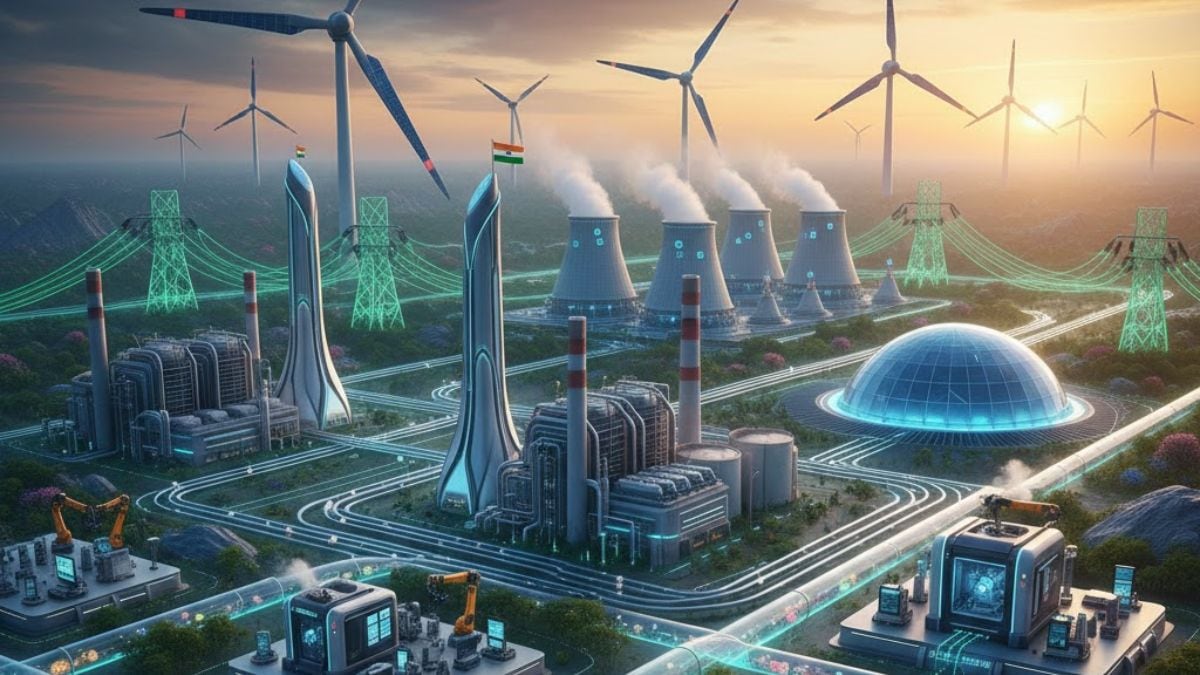
The Union Budget has laid out one of its most ambitious industrial and energy blueprints yet, with finance minister Nirmala Sitharaman unveiling a coordinated push across rare earths, clean manufacturing, nuclear power and industrial decarbonisation.
The package signals a clear intent to reduce import dependence, strengthen domestic value chains and position India as a competitive manufacturing hub in the global energy transition.
A key announcement was the proposal to establish dedicated rare earth corridors in mineral-rich states such as Odisha, Kerala, Andhra Pradesh and Tamil Nadu. Sitharaman said the move builds on the rare earth permanent magnet scheme launched in November 2025, and aims to anchor downstream manufacturing in India.
Rare earth elements are critical inputs for electric vehicles, wind turbines, electronics and defence equipment, and the corridors are expected to integrate mining, processing and manufacturing ecosystems closer to source regions.
Industrial Decarbonisation Journey
The Budget also marks a decisive step in India’s industrial decarbonisation journey. Sitharaman said Budget 2026 aligns with the Carbon Capture, Utilisation and Storage (CCUS) roadmap launched in December 2025, with the government targeting scale-up across five hard-to-abate sectors—power, cement, refineries, steel and chemicals.
An outlay of ₹20,000 crore over the next five years has been earmarked to push CCUS technologies to higher readiness levels and enable commercial-scale deployment.
Industry sees the CCUS allocation as a critical signal. Atanu Mukherjee, President & CEO of Dastur Energy, said the funding reflects a realistic approach to emissions reduction without compromising competitiveness.
He emphasised the need to translate policy intent into projects through shared CO₂ transport and storage infrastructure, early-mover risk support, and clarity on long-term liability and access norms.
On the institutional front, Sitharaman also announced that Power Finance Corporation and Rural Electrification Corporation will be restructured, a move expected to streamline financing for the power and infrastructure sectors amid rising capital requirements for energy transition projects.
Customs Duty Exemptions
Customs duty measures form another pillar of the Budget’s manufacturing push. The government has extended customs duty exemption on imports required for nuclear power projects till 2035, offering long-term policy certainty to a capital-intensive sector.
Capital goods used for processing critical minerals in India have also been exempted from customs duty, while zero customs duty has been announced on sodium antimonate, a key input in solar glass manufacturing.
Manufacturers have welcomed the clarity. Chetan Shah, Chairman & Managing Director of Solex Energy Limited, said the Budget places manufacturing at the heart of India’s energy transition.
He noted that exemptions for batteries, energy storage systems, critical minerals and nuclear infrastructure will accelerate domestic value addition and reinforce India’s ambition to “Make in India for the World”.
Complementing these measures, the Budget rationalised the Tax Collected at Source (TCS) on scrap and minerals to 2%, easing working capital pressure for recyclers and processors. It also proposed excluding the entire value of biogas while calculating central excise duty on biogas-blended CNG, providing a boost to the compressed biogas ecosystem.
Taken together, the announcements underline a clear Budget strategy: secure critical inputs, back clean manufacturing and decarbonise industry—while keeping investment, jobs and competitiveness firmly in focus.