



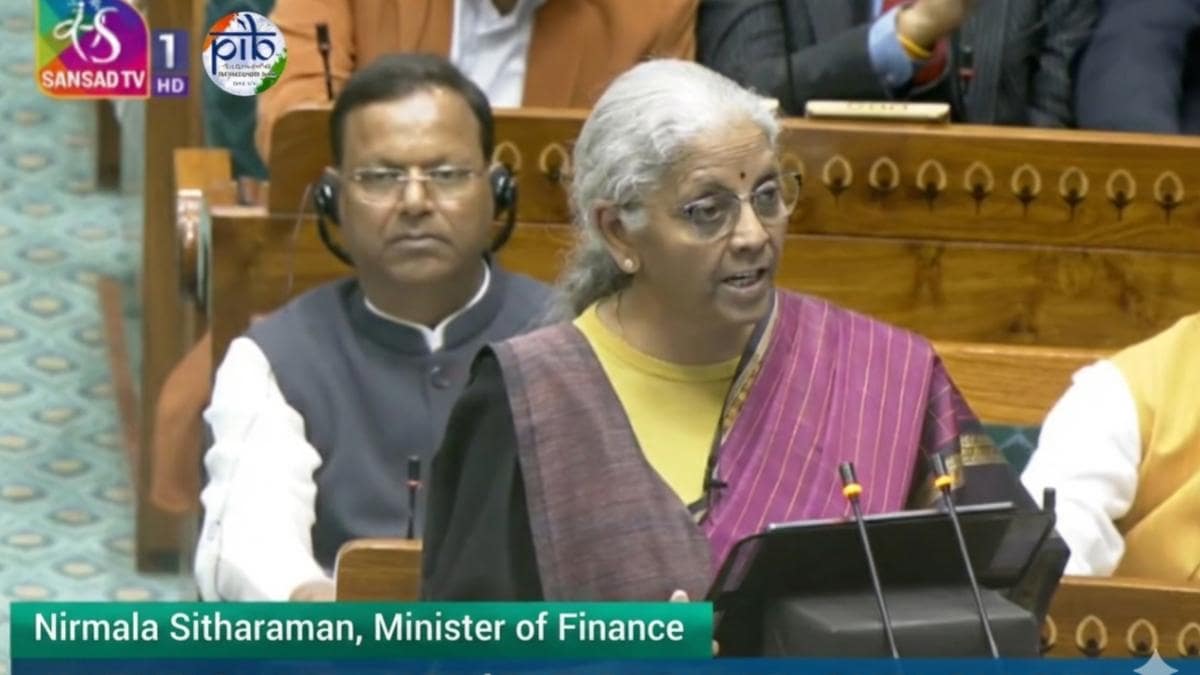
Finance Minister Nirmala Sitharaman, presenting Union Budget 2026–27 on Sunday, announced a series of customs duty reductions and tax rationalisation measures. According to Sitharaman’s budget speech, various everyday consumer goods and essential items are set to be more affordable, while raising costs for select financial transactions and imports.
With Sitharaman presenting her ninth consecutive Budget, attention has shifted to how these proposals will impact household spending and investor behaviour.
What gets cheaper?
- Lower tariffs on personal imports
One of the broad-based measures announced was a reduction in tariff rates on all dutiable goods imported for personal use, with duties cut from 20% to 10%. In reality, this is expected to ease costs for consumers purchasing goods from overseas, particularly high-value personal items.
- Electronics and consumer appliances
Among household appliances, microwave ovens are set to become cheaper following the duty rationalisation on specific components. The finance minister also said that sports equipment will see lower prices.
In the electronics segment, mobile phones, electric vehicle batteries, and solar panels are expected to cost less, aided by exemptions on capital goods and critical inputs used in domestic manufacturing.
- Relief for health and essential goods
The government has exempted basic customs duty on 17 drugs and medicines used in cancer treatment. Sitharaman added that medicines used to treat diabetes and cancer will become more affordable as a result of the duty changes.
In addition, import duties have been exempted on medicines and food for special medical purposes used to treat seven more rare diseases, extending relief to patients with niche and high-cost therapies.
- Travel, education and medical remittances
To reduce the tax burden on individuals, the Budget has lowered Tax Collected at Source (TCS) on overseas tour packages to 2%, from the earlier rates of 5% and 20%.
Similarly, TCS on remittances for education and medical purposes under the Liberalised Remittance Scheme has been reduced from 5% to 2%. However, the budget also mentions that this 2% rate applies to remittances under the Liberalised Remittance Scheme (LRS) specifically for amounts or aggregates exceeding ten lakh rupees. Foreign travel is also set to be affordable with the TCS rate of overseas tour programme being reduced to 2%.
- Defence and aviation sector
The government has proposed to exempt basic customs duty on components and parts used for manufacturing civilian training and other aircraft.
Additionally, raw materials imported for aircraft parts used in maintenance, repair or overhaul (MRO) by defence units will also be exempted, supporting growth and self-reliance in the aviation sector.
- Leather products
Apart from electronics and medicines, leather products are also set to see a reduction in prices following changes in import duties.
For exporters, the limit for duty-free imports of inputs used in seafood processing has been increased to 3% of the previous year’s export turnover. Duty-free imports have also been extended to shoe uppers and synthetic footwear, supporting labour-intensive sectors.
- Bidis are likely to be cheaper
However, TCS on tendu leaves, a key raw material for bidis, has been reduced from 5% to 2%, easing cash flow pressures for producers, though the Budget does not explicitly state whether this will translate into lower retail prices.
- Fish
Fish caught by Indian vessels in the exclusive economic zone and on the high seas will now be fully exempt from customs duty.
- Nuclear power and critical minerals
Outlining the proposals, Sitharaman said the government would extend the basic customs duty exemption on imports for nuclear power projects till 2030–35.
“The basic customs duty exemption on imports for nuclear power projects will be extended till 2030–35 and expanded to cover all nuclear power plants, irrespective of capacity,” she said.
Further, capital goods imported for processing critical nuclear minerals in India will be exempt from customs duty.
- Biogas-blended CNG
The Budget also addressed taxation on cleaner fuels. “For biogas-blended CNG, the entire value of the biogas component will be excluded while calculating central excise duty,” Sitharaman said, improving the commercial viability of sustainable fuel blends.
- Battery storage and solar glass manufacturing
“The basic customs duty exemption on capital goods used for manufacturing lithium-ion cells will be extended to cover battery energy storage systems as well,” Sitharaman said.
The finance minister also announced a customs duty exemption on sodium antimonate, a key input used in the manufacture of solar glass, to support domestic clean energy infrastructure.
What gets costlier?
- Alcohol and select goods
The TCS rate on alcoholic liquor for human consumption, as well as on scrap and minerals, has been raised from 1% to 2% as part of a broader rationalisation of collection rates.
- Specific imports and tax compliance
Basic customs duty on potassium hydroxide has been raised from nil to 7.5%, while duties on umbrellas and umbrella parts have been revised upward to a specific rate to support domestic manufacturing.
- Investing and trading
The most significant impact is on futures and options (F&O) trading, where the government has increased the securities transaction tax (STT) as a “course correction”.
The STT on futures contracts has been raised from 0.02% to 0.05%, while the STT on options, both on premiums and on exercise, has been increased to 0.15%.
The Budget proposes that no deduction will be allowed for interest expenditure incurred to earn dividend income or income from mutual fund units, increasing the effective tax burden for leveraged investors.
- Changes in taxation of gold bonds and buybacks
The capital gains tax exemption will now apply only if the bonds were subscribed to at the time of original issue and held continuously until redemption on maturity. As per the budget 2026-27, investors who acquire SGBs from the secondary market will no longer be eligible for the exemption.
In addition, the Budget seeks to curb tax arbitrage in corporate buybacks. While shareholders will continue to treat buybacks as capital gains, promoters will be subject to an additional buyback tax, 22% for corporate promoters and 30% for non-corporate promoters.
- Misreported income
The Budget also introduces a new framework to address misreported income, expanding the scope of immunity from penalty and prosecution. Until now, immunity was available largely for cases of underreporting due to errors or oversight. The proposed changes extend this to misreporting, subject to strict financial conditions.
In cases of standard misreporting, taxpayers seeking immunity will have to pay 100% of the tax amount as additional income tax, over and above the original tax and interest. Where misreporting involves unexplained cash credits or similar items, the additional payment rises to 120% of the tax. Immunity will not be available where prosecution has already been initiated under specified provisions.
- Small taxpayers and foreign asset disclosures
The Budget proposes a Foreign Asset Disclosure Scheme, offering a one-time, six-month window for small taxpayers, such as students or relocated NRIs, to disclose foreign income or assets below specified thresholds.
For undisclosed foreign assets or income of up to Rs 1 crore, taxpayers will be required to pay 30% tax on the fair market value, along with an additional 30% tax in lieu of penalty, to secure immunity from prosecution. Where income was disclosed but the foreign asset was not, and the value is up to Rs 5 crore, immunity can be obtained by paying a flat fee of Rs 1 lakh.